diff --git a/research/syrinx-modeling/README.md b/research/syrinx-modeling/README.md new file mode 100644 index 0000000..c76e06b --- /dev/null +++ b/research/syrinx-modeling/README.md @@ -0,0 +1,73 @@ +# Syrinx Modeling Research + +This folder persists public syrinx-modeling references for Aqua's graph-native bird voice work. Downloaded PDFs and HTML snapshots live in `sources/`; `sources.json` records provenance and notes when only metadata was reachable. + +## Distilled Takeaways + +### The Syrinx Is A Nonlinear Source, Not A Pitch Knob + +The useful public model family starts with the Mindlin/Laje low-dimensional syrinx oscillator. It does not treat birdsong as an oscillator whose frequency is directly commanded. It treats the labia as a nonlinear biomechanical oscillator driven by physiological controls, mainly subsyringeal or bronchial pressure and syringeal muscle tension. Pitch, amplitude, register changes, onset, and some complex acoustic events emerge from the oscillator and its coupling to the tract. + +Aqua implication: current `freq=` on the acoustic source is acceptable only as a smoke-test carrier. The reusable DSL primitive should be a labial oscillator with pressure, tension/stiffness, aperture/rest position, mass, damping, saturation, and coupling/load controls. Fitted pitch should become an observation or target loss term, not the primary command. + +### Smooth Motor Gestures Can Produce Complex Song + +Laje, Gardner, and Mindlin model birdsong syllables as paths through a low-dimensional parameter space. The strongest practical lesson is not the exact coefficient set; it is that smooth pressure/tension/gating gestures can produce rich syllables without a massive symbolic score. Later prosthetic and neural-synthesis work reinforces this: real-time synthesis can be driven by low-dimensional physiological trajectories. + +Aqua implication: fit time-varying curves before expanding the static parameter grid. The next bird-golf pass should infer/control pressure envelopes, labial tension curves, active opening/gating, and left/right phase or alternation. Static candidates repeating across species are expected failure, not a mystery. + +### Bilateral Source Coupling Matters + +Oscine birds have two sound sources at the bronchial/tracheal junction. The sources can interact with each other and with the upper tract; source-filter separation is often an approximation, not law. Public models explicitly study source-source and source-filter/source-tract acoustic interaction, and recent reviews treat nonlinear interactions as first-class explanations for jumps, subharmonics, biphonation, and register transitions. + +Aqua implication: the graph architecture is the right lane. A syrinx patch should keep left and right labial oscillators as graph-coupled sources feeding left/right bronchi into a merge junction, then through trachea, glottis/OEC-like cavities when modeled, and beak radiation. Do not lower this to two independent oscillators mixed after the fact. + +### Pressure And Tension Are Physically Valid Control Axes + +Elemans' mechanical syrinx model separately controls bronchial pressure and membrane tension and produces high-frequency self-sustained oscillations and syllable-like sweeps. It also shows the distal tube resonance strongly affects membrane vibration, which supports graph-native source loading instead of a one-way post-filter. + +Aqua implication: pressure and tension need real semantics in the DSL and lowering. Source impedance/load should affect oscillator behavior, not merely output color. Tract resonances should be allowed to pull or destabilize the source. + +### Myoelastic-Aerodynamic Mechanism Is Shared With Mammals + +Universal-mechanism work argues birds and mammals use the same broad myoelastic-aerodynamic principle despite anatomical differences. Bird voice is not a weird exception; it is another morphology using airflow, tissue elasticity, and tract coupling. + +Aqua implication: the same reusable source family can serve larynx-like, syrinx-like, and alien morphologies if the primitive is expressed as tissue-valve dynamics plus graph coupling rather than as named human/bird organs. + +### Nonlinear Phenomena Are Features, Not Bugs + +Fee et al. and later reviews show period doubling, mode locking, chaos, frequency jumps, biphonation, and other nonlinear transitions in bird vocal production. These are part of the target space, especially for expressive or alien voices. + +Aqua implication: the oscillator should expose controllable nonlinear regimes. A too-polished harmonic oscillator will fail exactly where birds sound bird-like. Metrics should include onset timing, modulation, subharmonics, envelope, and sideband structure, not only log-mel similarity. + +## Architecture Intention + +Owner: graph-native acoustic lowering owns how pressure waves, source loading, junctions, tract delays, and radiation interact. + +Inputs: morphology graph, labial source parameters, pressure/tension/gating control curves, tract/radiation controls, and optional fitting targets. + +Outputs: emitted Faust DSP in which source dynamics and acoustic network are mutually coupled enough to express source-source and source-tract interaction. + +Derived state: direct frequency controls are authoring hints or fit initializers, not the physical owner of pitch. + +Forbidden writers: no bespoke bird renderer, no two-oscillator mixdown path, no species-specific hardcoded syrinx module, and no static spectral-grid compensator pretending to be a model. + +Shared paths: human larynx, bird syrinx, and alien valve morphologies should use the same tissue-valve/source-port semantics where possible, differing through morphology, coupling, and control curves. + +Deletion line: if the current `kind=syrinx` lowering cannot be explained as pressure/tension/aperture tissue dynamics coupled to graph pressure, it should be demoted to a smoke-test source and replaced. + +## Recommended Next Build Slice + +1. Add a `labial_oscillator` or generalized `tissue_valve` source primitive with stateful displacement/velocity, nonlinear stiffness, nonlinear damping, aperture/rest-position, pressure drive, and load feedback. +2. Give `source_port kind=syrinx` a lowering that maps pressure/tension/opening/load to that primitive instead of fixed-frequency excitation. +3. Add control curves for pressure, tension, opening, left/right balance, and beak opening in `BirdSyrinxGolf`. +4. Fit clean bird references by segmented time-varying controls, keeping morphology parameters slower and gesture parameters faster. +5. Score onset timing, amplitude envelope, pitch contour, sidebands/subharmonics, and log-mel distance separately. + +## Source Notes + +- Mindlin/Laje are the best implementation guide for low-dimensional physiological control. +- Fee et al. are the warning that nonlinear regimes are not optional decoration. +- Elemans is the best mechanical validation that pressure/tension/tube resonance are the right control axes. +- Arneodo/Perl/Mindlin source-tract papers justify Aqua's graph-native coupling direction. +- Prosthetic and neural-synthesis papers show these models can run in real time and can be connected to learned control signals. diff --git a/research/syrinx-modeling/sources.json b/research/syrinx-modeling/sources.json new file mode 100644 index 0000000..81eabf5 --- /dev/null +++ b/research/syrinx-modeling/sources.json @@ -0,0 +1,141 @@ +[ + { + "id": "fee-etal-1998-nonlinear-syrinx", + "title": "The role of nonlinear dynamics of the syrinx in the vocalizations of a songbird", + "authors": "M. S. Fee, B. Shraiman, B. Pesaran, P. P. Mitra", + "year": 1998, + "url": "https://web.mit.edu/fee/Public/Publications/Fee_etal1998.pdf", + "local": "sources/fee-etal-1998-nonlinear-syrinx.pdf", + "notes": "Downloaded PDF." + }, + { + "id": "laje-gardner-mindlin-2002-neuromuscular-control", + "title": "Neuromuscular control of vocalizations in birdsong: A model", + "authors": "Rodrigo Laje, Timothy J. Gardner, Gabriel B. Mindlin", + "year": 2002, + "doi": "10.1103/PhysRevE.65.051921", + "url": "https://journals.aps.org/pre/abstract/10.1103/PhysRevE.65.051921", + "local": "sources/laje-gardner-mindlin-2002-neuromuscular-control-aps.html", + "notes": "APS metadata snapshot; public PDF mirror attempted but returned 404." + }, + { + "id": "mindlin-laje-2005-synthesizing-bird-song", + "title": "The physics of birdsong", + "authors": "Gabriel B. Mindlin, Rodrigo Laje", + "year": 2005, + "url": "https://pubmed.ncbi.nlm.nih.gov/16383664/", + "local": "sources/mindlin-laje-2005-synthesizing-bird-song-pubmed.html", + "notes": "PubMed metadata for the book/review commonly cited as Synthesizing bird song / Physics of Birdsong." + }, + { + "id": "laje-mindlin-2005-source-source-filter", + "title": "Modeling source-source and source-filter acoustic interaction in birdsong", + "authors": "Rodrigo Laje, Gabriel B. Mindlin", + "year": 2005, + "doi": "10.1103/PhysRevE.72.036218", + "url": "https://journals.aps.org/pre/abstract/10.1103/PhysRevE.72.036218", + "local": "sources/laje-mindlin-2005-source-source-filter-aps.html", + "notes": "APS metadata snapshot." + }, + { + "id": "laje-sciamarella-zanella-mindlin-2008-bilateral-source", + "title": "Bilateral source acoustic interaction in a syrinx model of an oscine bird", + "authors": "Rodrigo Laje, D. Sciamarella, J. Zanella, Gabriel B. Mindlin", + "year": 2008, + "url": "https://pubmed.ncbi.nlm.nih.gov/18351881/", + "local": "sources/laje-sciamarella-zanella-mindlin-2008-bilateral-source-pubmed.html", + "notes": "PubMed metadata snapshot." + }, + { + "id": "mindlin-2009-new-perspectives", + "title": "New perspectives on the physics of birdsong", + "authors": "Gabriel B. Mindlin", + "year": 2009, + "doi": "10.1098/rsta.2009.0076", + "url": "https://pmc.ncbi.nlm.nih.gov/articles/PMC3263773/", + "local": "sources/mindlin-2009-new-perspectives.html", + "notes": "Open PMC HTML snapshot." + }, + { + "id": "elemans-etal-2009-mechanical-syrinx", + "title": "Amplitude and frequency modulation control of sound production in a mechanical model of the avian syrinx", + "authors": "C. P. H. Elemans, M. Muller, O. N. Larsen, J. L. van Leeuwen", + "year": 2009, + "doi": "10.1242/jeb.026872", + "url": "https://research.wur.nl/en/publications/amplitude-and-frequency-modulation-control-of-sound-production-in/", + "local": "sources/elemans-etal-2009-mechanical-syrinx.html", + "notes": "Wageningen research portal snapshot with abstract and citation metadata." + }, + { + "id": "arneodo-perl-mindlin-2011-acoustic-source-tract-coupling", + "title": "Acoustic signatures of sound source-tract coupling", + "authors": "Ezequiel M. Arneodo, Yonatan Sanz Perl, Gabriel B. Mindlin", + "year": 2011, + "doi": "10.1103/PhysRevE.83.041920", + "url": "https://pmc.ncbi.nlm.nih.gov/articles/PMC3909991/", + "local": "sources/arneodo-perl-mindlin-2011-acoustic-source-tract-coupling.html", + "notes": "Open PMC HTML snapshot." + }, + { + "id": "arneodo-etal-2012-prosthetic-avian-vocal-organ", + "title": "Prosthetic Avian Vocal Organ Controlled by a Freely Behaving Bird Based on a Low Dimensional Model of the Biomechanical Periphery", + "authors": "Ezequiel M. Arneodo, Yonatan Sanz Perl, Franz Goller, Gabriel B. Mindlin", + "year": 2012, + "doi": "10.1371/journal.pcbi.1002546", + "url": "https://pmc.ncbi.nlm.nih.gov/articles/PMC3386162/", + "local": "sources/arneodo-etal-2012-prosthetic-avian-vocal-organ.html", + "notes": "Open PMC HTML snapshot." + }, + { + "id": "goller-rietveld-2013-frequency-control", + "title": "Integrative physiology of fundamental frequency control in birds", + "authors": "Franz Goller, Laurens Rietveld", + "year": 2013, + "url": "https://pmc.ncbi.nlm.nih.gov/articles/PMC3674193/", + "local": "sources/goller-rietveld-2013-frequency-control.html", + "notes": "Open PMC HTML snapshot." + }, + { + "id": "elemans-etal-2015-universal-mechanisms", + "title": "Universal mechanisms of sound production and control in birds and mammals", + "authors": "Coen P. H. Elemans et al.", + "year": 2015, + "url": "https://pmc.ncbi.nlm.nih.gov/articles/PMC4674827/", + "local": "sources/elemans-etal-2015-universal-mechanisms.html", + "notes": "Open PMC HTML snapshot." + }, + { + "id": "sanz-perl-etal-2021-neurally-driven-synthesis", + "title": "Neurally driven respiratory gestures in an embodied model of birdsong production", + "authors": "Yonatan Sanz Perl et al.", + "year": 2021, + "url": "https://pmc.ncbi.nlm.nih.gov/articles/PMC8375361/", + "local": "sources/sanz-perl-etal-2021-neurally-driven-synthesis.html", + "notes": "Open PMC HTML snapshot." + }, + { + "id": "synthetic-birdsongs-replay", + "title": "Synthetic birdsongs reproduce neural responses", + "year": 2021, + "url": "https://pmc.ncbi.nlm.nih.gov/articles/PMC8287859/", + "local": "sources/synthetic-birdsongs-replay.html", + "notes": "Open PMC HTML snapshot; useful for synthesis-as-neural-replay validation." + }, + { + "id": "mindlin-2017-physics-of-birdsong-talk", + "title": "The Physics of Birdsong", + "authors": "Gabriel B. Mindlin", + "year": 2017, + "url": "https://www.icts.res.in/sites/default/files/DCS2017-2017-06-12-Gabriel-Mindlin.pdf", + "local": "sources/mindlin-2017-physics-of-birdsong-talk.pdf", + "notes": "Downloaded talk PDF." + }, + { + "id": "elemans-2025-transitions-and-tricks", + "title": "Transitions and tricks: nonlinear phenomena in the avian voice", + "year": 2025, + "url": "https://pmc.ncbi.nlm.nih.gov/articles/PMC11966160/", + "local": "sources/elemans-2025-transitions-and-tricks.html", + "notes": "Open PMC HTML snapshot; recent review useful for failure modes and nonlinear phenomena." + } +] diff --git a/research/syrinx-modeling/sources/arneodo-etal-2012-prosthetic-avian-vocal-organ.html b/research/syrinx-modeling/sources/arneodo-etal-2012-prosthetic-avian-vocal-organ.html new file mode 100644 index 0000000..51e70f0 --- /dev/null +++ b/research/syrinx-modeling/sources/arneodo-etal-2012-prosthetic-avian-vocal-organ.html @@ -0,0 +1,2541 @@ + + + + + + + + + + + + + + + + + + + + + + + + + + + + + + + + + + + + + + + + + + + + Prosthetic Avian Vocal Organ Controlled by a Freely Behaving Bird Based on a Low Dimensional Model of the Biomechanical Periphery - PMC + + + + + + + + + + + + + + + + + + + + + + + + + + + + + + + + + + + + + + + + + + + + + + + + + + + + + + + + + + + + + + + + Skip to main content + + + + + + +
+
+
+
+
+ +
+ + + + + + + + + + + + + + + + + + + + + + + + + + + + +
+
+ + +
+
+ + + + + + + + +
+
+ + + +
+
+
+ + NCBI home page + + + + + + + + + + + + + + + + + + + + + + + + + + + + + + + +
+ + + + + + + + + + + + + + + + + + + + + + + + + + + + + + + + + +
+ +
+
+ + + + + + + +
+ + + + + +
+
+
+ + +
+ +
+
+ + + + + + + + +
+ + + + + + + + +
+
+
+
+
+
+ +
+
+
+ +
+ + +
PLOS Computational Biology logoLink to PLOS Computational Biology
+
. 2012 Jun 28;8(6):e1002546. doi: 10.1371/journal.pcbi.1002546 +
+
+

Prosthetic Avian Vocal Organ Controlled by a Freely Behaving Bird Based on a Low Dimensional Model of the Biomechanical Periphery

+Ezequiel M Arneodo +1,*, Yonatan Sanz Perl +1, Franz Goller +2, Gabriel B Mindlin +1 +
+
Editor: Joseph Ayers3 +
+
    +
  • +
  • +
  • +
+
+ + + +
+
PMCID: PMC3386162  PMID: 22761555 +
+

Abstract

+

Because of the parallels found with human language production and acquisition, birdsong is an ideal animal model to study general mechanisms underlying complex, learned motor behavior. The rich and diverse vocalizations of songbirds emerge as a result of the interaction between a pattern generator in the brain and a highly nontrivial nonlinear periphery. Much of the complexity of this vocal behavior has been understood by studying the physics of the avian vocal organ, particularly the syrinx. A mathematical model describing the complex periphery as a nonlinear dynamical system leads to the conclusion that nontrivial behavior emerges even when the organ is commanded by simple motor instructions: smooth paths in a low dimensional parameter space. An analysis of the model provides insight into which parameters are responsible for generating a rich variety of diverse vocalizations, and what the physiological meaning of these parameters is. By recording the physiological motor instructions elicited by a spontaneously singing muted bird and computing the model on a Digital Signal Processor in real-time, we produce realistic synthetic vocalizations that replace the bird's own auditory feedback. In this way, we build a bio-prosthetic avian vocal organ driven by a freely behaving bird via its physiologically coded motor commands. Since it is based on a low-dimensional nonlinear mathematical model of the peripheral effector, the emulation of the motor behavior requires light computation, in such a way that our bio-prosthetic device can be implemented on a portable platform.

Author Summary

+

Brain Machine Interfaces (BMIs) decode motor instructions from neuro-physiological recordings and feed them to bio-mimetic effectors. Many applications achieve high accuracy on a limited number of tasks by applying statistical methods to these data to extract features corresponding to certain motor instructions. We built a bio-prosthetic avian vocal organ. The device is based on a low-dimensional mathematical model that accounts for the dynamics of the bird's vocal organ and robustly relates smooth paths in a physiologically meaningful parameter space to complex sequences of vocalizations. The two physiological motor gestures (sub-syringeal pressure and ventral syringeal muscular activity), are reconstructed from the bird's song, and the model is implemented on a portable Digital Signal Processor to produce synthetic birdsong when driven by a freely behaving bird via the sub-syringeal pressure gesture. This exemplifies the plausibility of a type of synthetic interfacing between the brain and a complex behavior. In this type of devices, the understanding of the bio-mechanics of the periphery is key to identifying a low dimensional physiological signal coding the motor instructions, therefore enabling real-time implementation at a low computational cost.

Introduction

+

The complex motor behavior originating the rich vocalizations of adult oscine birds results from the interaction between a central pattern generator (the brain) and a nonlinear biomechanical periphery (the bird's vocal organ) [1], [2]. The fact that this complex behavior is learned, together with the parallels between the physical mechanisms of birdsong and human speech production, make birdsong an ideal model to study how a complex motor behavior is acquired, produced and maintained [3].

+

In an effort to understand what gives rise to complexity in this behavior, a part of the birdsong community has set focus on the capabilities of the periphery to produce vocalizations owning a diverse set of nontrivial acoustic features [2]. The avian vocal organ, comprised mainly by the respiratory system, the syrinx and the vocal tract, is a highly nonlinear biomechanical device. The complexity of its dynamics leaves traces in the sounds that can be produced in it. In this way, several acoustic features found in vocalizations can be related to nonlinear phenomena occurring in the syrinx [4], [5] or introduced by acoustic interactions between the syrinx and the tract [6]–[9]. In all these cases, the complexity of the behavior does not require a complex motor pattern to drive the vocal organ, but rather simple, smooth gestures.

+

Through a combination of experimental observations and theoretical analysis, low-dimensional mathematical models have been proposed that account for the physical mechanisms of sound production in the avian vocal organ [10], [11]. In particular, a model based on Titze's proposed flapping mechanism for oscillations in human vocal folds [12] was recently used to synthesize the song of the Zebra finch (Taeniopygia guttata) [13], [14]. This model captures the nonlinear dynamics of the folds oscillating to produce sound, in a way that a variety of complex vocalizations are generated by the tuning of parameters related to physiologically observable motor gestures elicited by the bird.

+

Part of the appeal of counting with this model is the prospect of applying it to the construction of a bio-prosthetic device. In this scenario computation is relatively inexpensive because of the low dimension of the mathematical model. In addition, the physical description of the peripheral effectors led to the identification of a set of smoothly varying parameters that determine the behavior [13]. By recording the physiological activity related to the parameters and feeding it to a device that solves the equations of the model in real-time, vocal behavior can be emulated by a prosthesis controlled by a subject via its motor instructions.

+

The usual strategy of BCIs and BMIs (Brain Computer Interfaces and Brain Machine Interfaces) is to decode motor commands from recordings of physiological activity in the brain and use this activity to control bio-mimetic devices [15]–[17]. In [17], for instance, multi-electrode recordings of tens to hundreds of neurons in different cortical areas of primates are used to drive a robotic arm. In recent work, Cichocki et. al. discuss the perspectives of using electroencephalographic (EEG) recordings to generate noninvasive BCI solutions [16]. In these examples (as well as in many other BCI implementations), the crucial problem is the classification of the features of the large data set which correspond to a determined set of motor tasks. The feature extraction is performed by different techniques which include linear decomposition in a diversity of vector spaces and machine learning algorithms [15], [16], [18]. In this way, accurate control of bio-mimetic effectors is achieved for a finite number of specific tasks, such as grasping or cursor moving.

+

Our current understanding of the biophysics of the avian vocal organ, particularly our capacity to identify the dynamical mechanisms by which complex behavior occurs when the peripheral systems are driven by low dimensional, smooth instructions, allows us to propose an example of a different kind of bio-prosthetic solution. The model predicts a diversity of qualitatively different solutions to the system for continuous paths in a parameter space. Not only is this parameter space suggested by the model, but it is also physiologically pertinent.

+

We present a device that is driven by a freely behaving Zebra finch to produce realistic, synthetic vocalizations in real-time. The device is based on the real time integration of the mathematical model of the vocal organ on a Digital Signal Processor (DSP). It is controlled by the bird's subsyringeal air sac pressure gesture, which is transduced, digitized and fed to the DSP to provide the model with the appropriate path in parameter space.

+

The work is organized as follows. In the Methods section we describe the Zebra finch vocal organ and the mathematical model that accounts for its dynamics. We also discuss its applicability to the construction of a model-based bio-prosthetic device, and introduce the physiological motor gestures that relate to parameters of the model. We present the steps leading to the real-time implementation of the model on a device controlled by a spontaneously singing bird. In the Results section we show the example of a successful case. Finally, we summarize the results and discuss the impact of this device as an example of a kind of bio-prosthetic device enabled by the low-dimensional dynamical model of the peripheral effector.

Methods

+

Ethics statement

+

All experiments were conducted in accordance with the Institutional Animal Care and Use Committee of the University of Utah.

Model for the vocal organ

+

One of the most studied species of songbirds is the Zebra finch. Its song presents a set of diverse acoustic features, which can be accounted for by the dynamics displayed by the mathematical model of its vocal organ [5], [11]. This low-dimensional mathematical model, when driven by the appropriate gesture in parameter space, is capable of producing realistic, synthetic birdsong. By implementing this model on a Digital Signal Processor, we are able to construct a bio-prosthetic vocal organ.

+

The Zebra finch vocal organ

+

The song of an adult Zebra finch is composed of the repetition of a highly stereotyped sequence of syllables, preceded by a variable number of introductory notes. A typical sequence or motif is made up of 2 to 8 distinct syllables [1], [2]. Vocalizations present a wide range of acoustic features, which include both tonal sounds where energy is concentrated in the fundamental frequency and spectrally rich ones, where energy is distributed among its harmonics.

+

The oscine vocal system has two independent sound sources in the syrinx, where airflow is modulated to produce sound [2], [4]. The sounds produced in it travel then through the upper vocal tract: an acoustic pathway that introduces modifications of their acoustic features [1]. This is pictured in Fig. 1.

+
Figure 1. Sketch of the Zebra finch vocal system (A).
+
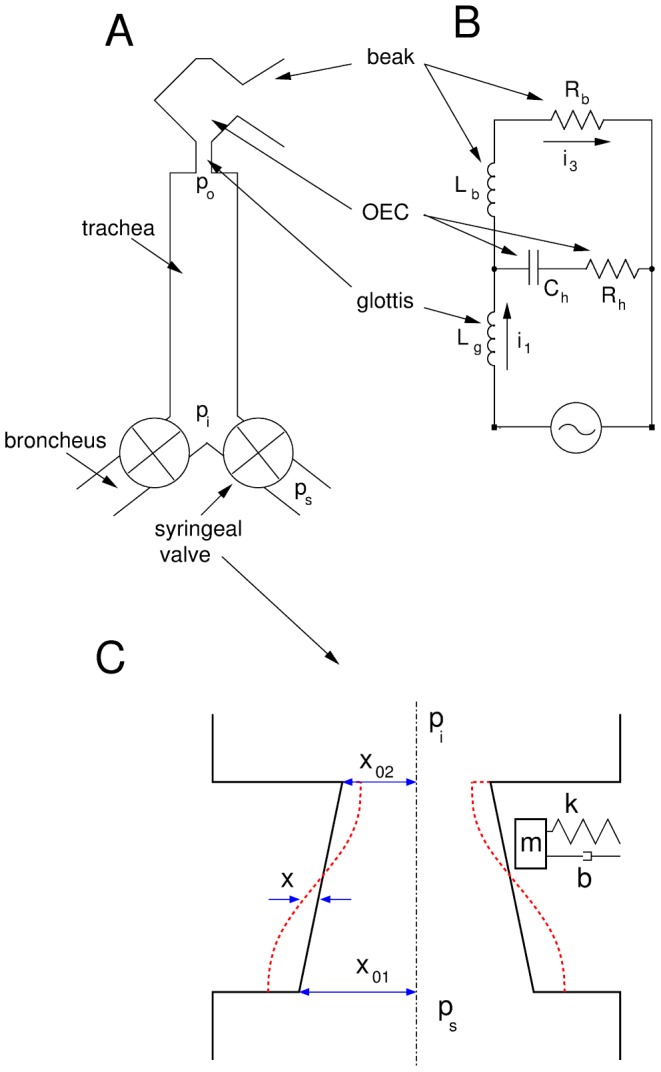
Figure 1

+ +

Sounds are produced in the syringeal valves, and then filtered through the vocal tract. In the syrinx, the labia oscillate modulating the airflow. They support two coordinated modes of oscillation: an upward propagating superficial wave, and an oscillation around their mass centers (C). In the vocal tract we highlight trachea, glottis, OEC and beak. Pressure Inline graphic is the subsyringeal pressure, Inline graphic stands for the pressure at the input of the tube and Inline graphic stands for the pressure at the output of the trachea. In order to compute the model, we write the equivalent circuit of the post-tracheal part of the vocal tract (B).

The bipartite syrinx of the oscines is a pair of valves, located at the junction of the bronchi and the trachea (see Figs. 1a and 1c). In each valve, small connective tissue pads, or labia, oscillate for high enough values of the airflow. Songbirds use their labia to produce sound in a similar way humans use vocal folds to produce speech. During vocalization, respiratory airflow sets the labia in an oscillatory regime. The oscillating labia modulate the airflow, resulting in a sound wave that then travels through the vocal tract. The airflow is controlled by the bird via the subsyringeal air sac pressure [11], [19]. The correlation of the electromyographic (EMG) activity of the ventral syringeal muscle (vS) and the fundamental frequency of a vocalization suggests that they control the tension of the oscillating labia [11], [20].

+

The upper vocal tract consists of the air-filled passages that link the syrinx to the environment. It determines much of the distribution of energy of the sound across its harmonic frequency components, defining a perceptual property as important as the timbre [21]–[23]. Its filtering characteristics depend on the acoustic properties of its components. Assuming that the compartments composing the upper vocal tract do not interact acoustically, they are considered individually. The most relevant components are the trachea, the glottis and oropharyngeal-esophageal cavity, and the beak [22], [24].

Model for the source

+

A model to account for the mechanism of sound production in the bird's syrinx that presents a good compromise between level of description and computational complexity was presented in [4], [11]. It is based on Titze's flapping mechanism, one of the simplest models to account for the transfer of the kinetic energy of airflow to vocal fold oscillations in humans [12]. Based on experimental observations, it assumes that the soft pieces of tissue or labia support two modes of vibration: an upward propagating wave and a lateral displacement around their midpoint positions. It has been suggested by videography of the folds during phonation [12], [19], [25] that these modes are coordinated in a way that energy is gained from the airflow in each cycle, making sustained oscillations possible.

+

The kinematic description of this mechanism is carried in terms of the displacement from equilibrium of the midpoint position of each labium Inline graphic. We assume that the profile of the syringeal valve is trapezoidal, as shown in Fig. 1c. The motion of the midpoint position of the labia will obey Newton's second law:
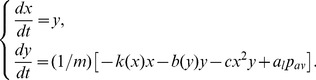
+ + + +
graphic file with name pcbi.1002546.e005.jpg(1)
+

In the right hand side of the second equation, the first term describes the nonlinear elastic restitution of the labium (Inline graphic), the second term represents nonlinear dissipation (Inline graphic), and the third term a nonlinear saturation that bounds the labial motion. The system is driven by the last term, which accounts for the force exerted by the inter-labial pressure (Inline graphic stands for the area of the labium).

+

In the driving term, Inline graphic is the spatial average of the syringeal driving pressure. It is a function of the geometry of the folds that depends on the sub-syringeal pressure Inline graphic, and the ratio of the tracheal and bronchial sections of the labial valve. Since the contribution of the pressure at the input of the tract Inline graphic to the trans-syringeal pressure is much smaller than Inline graphic, it is neglected [5]. This means that the sound source and the vocal tract are not considered to interact acoustically. The coordination of the two oscillation modes supported by the tissue, experimentally observed as a phase difference between the upper and lower extremes of the labia during phonation [19], [25], is taken into account in this function. By introducing a phenomenological parameter Inline graphic that describes the time it takes the wave propagating upward in the labia to cover half its length, the bronchial and tracheal areas of the valve (Inline graphic and Inline graphic) get to be written in terms of this time constant, the midpoint displacement of the labia and the resting (pre-phonatory) positions of the edges of the labia (Inline graphic and Inline graphic) [12]. Finally, a phenomenologically corrected version of the Bernoulli equation is used to write the average syringeal pressure in terms of the ratio of the sections and the sub-syringeal pressure [11], [12]:

+ + + +
graphic file with name pcbi.1002546.e018.jpg(2)
+

Putting equations (1) and (2) together, an extended “flapping” model ruling the dynamics of the labia in the Zebra finch syrinx is complete.

+

In this model, acoustic features of the solutions are determined by physiologically meaningful parameters. Assuming that the coefficients in the restitution term of system (1) are proportional to the tension of the ventral syringeal muscles (vS), this model is capable of producing synthetic, realistic birdsong. The rationale behind this assumption is that the contraction of these muscles handles the stiffness of the labia by stretching them [11]. In [13], EMG activity recordings from electrodes implanted in the vS muscles were used to obtain a time dependent parametrization of the restitution (Inline graphic), and air sac pressure data for Inline graphic. In this way, birdsong can be synthesized by driving the model with actual physiological data.

Model for the vocal tract

+

The oscillating labia in the syrinx modulate the airflow producing sound, which is modified as it goes through the vocal tract. Relevant acoustic features, such as the spectral content of vocalizations, are determined by the geometry of the vocal tract [5], [14], [26]. Important elements modulating birdsong in the vocal tract are the trachea, the oropharyngeal-esophageal cavity (OEC) and the beak, as noticed by Nowicki [21] and Fletcher et. al. +[22], [24].

+

In order to produce realistic synthetic vocalizations, we introduce a model of the vocal tract as a dynamical system, which includes a tube approximating the trachea and a Helmholtz resonator to represent the OEC. The sound produced in the syrinx enters this system, and we are able to compute the sound radiated to the atmosphere.

+

The trachea, by its effect and its physiology, is approximated by a tube that is closed in the syringeal end and open at the glottis. The pressure at its input Inline graphic is determined by two main contributions: one originated from fluctuations originated in the syrinx, and the other caused by reflections at the open end. Considering both contributions, which are derived in [8], the pressure at the input of the trachea reads

+ + + +
graphic file with name pcbi.1002546.e022.jpg(3)
+

where Inline graphic is proportional to the mean velocity of the flow, and Inline graphic the time it takes a sound wave entering the tube to get to the open end and be partially reflected back with coefficient Inline graphic.

+

The transmitted part of the pressure fluctuation Inline graphic forces the air at the glottis, approximated by the neck of the Helmholtz resonator that stands for the OEC. The mass of air at the glottis, forced into the cavity, is subject to a restitution force exerted by the larger mass of air in it.

+

In acoustics, it is common to write an analog electronic computational model to describe a system of filters. The acoustic pressure is represented by an electric potential and the volume flow by the electric current [27]. In this framework, short constrictions are inductors, and cavities (smaller than the wavelengths) are well represented by capacitors. The equations for the equivalent circuit of the post-tracheal part of the vocal tract, shown in Fig. 1b, read:

+ + + +
graphic file with name pcbi.1002546.e027.jpg(4)
+

where the electric components relate to geometric parameters of acoustic elements. Such relationships, which are standard in acoustics, can be found in [14], [27]. The pressure fluctuations at the glottal end of the trachea Inline graphic relate linearly to the electric tension Inline graphic driving the circuit. Following the same scheme, the electrical potential at the resistor standing for the beak Inline graphic is the analogue of the pressure fluctuations at the output of the beak Inline graphic. In our model, this quantity is the sound radiated by the vocal organ.

Dynamical analysis of the model

+

The mathematical model of the vocal organ represented by equations (1, 2, 3 and 4), rather than an attempt to obtain a statistical a filter or a set of causal rules between a coded motor command and a behavior, is a physical description of the complex peripheral effector. By studying the nonlinear dynamics of this model, specially that of its oscillatory solutions, we find nontrivial relationships between paths in parameter space and acoustic characteristics of sounds synthesized by it.

+

In this model, the non-interacting vocal tract acts as a passive filter; sounds produced in the syrinx are altered by it only on the relative weight of their harmonic components. This is why the dynamical analysis searching for qualitatively different oscillatory solutions is done on the equations ruling the dynamics of the syrinx. A thorough description of the set of solutions and bifurcations of the system (1,2) was carried out in [5], [28], and a phase portrait was constructed for the Inline graphic parameter space. This set is the most plausible to determine acoustic properties of sounds, since it relates to the restitution constant of the oscillating labia and the intensity of the force exerted by the airflow. These parameters are also identified with physiological instructions used by the bird for motor control [2], [11], [29].

+

Within the rich dynamical scenario displayed by the system, two distinct mechanisms giving rise to oscillatory solutions stand out: a Hopf and a Saddle Node on an Invariant Cycle (SNIC) bifurcations. They are sketched in Fig. 2, together with a schematic representation of the solutions and their spectral properties. Through a sub-critical Hopf bifurcation, one fixed point loses its stability and a small, stable limit cycle is created [30]. Oscillations are born with zero amplitude and finite frequency, therefore the sounds produced in this way are tonal. When a saddle and a non-saddle fixed point collide on a limit cycle, a SNIC bifurcation occurs at which oscillations with finite amplitude and infinite period are born [30]. Sounds produced by this mechanism have consequently low frequency and their spectral content is rich.

+
Figure 2. Sketch of the bifurcations found in the model of the syrinx leading to oscillatory solutions.
+

Figure 2

+ +

When parameter Inline graphic crosses a SNIC bifurcation, two fixed points collide within a limit cycle (A). The limit cycle is born with large period and rich spectral content, as sketched for the temporal series of the Inline graphic variable and its corresponding spectrogram. When parameter Inline graphic crosses a Hopf bifurcation, a stable fixed point loses stability against a newborn limit cycle (B). Close to the bifurcation, this limit cycle exhibits small period and ideally tonal spectral content, as sketched for the temporal series of the Inline graphic variable and its corresponding spectrogram. Both bifurcations occur at distinct regions in the Inline graphic parameter space [5], [28].

In addition to providing an orientation in the task of seeking the relevant control parameters, the dynamical analysis of the model makes way for the real-time implementation of the model by reducing its computational cost while retaining the relevant dynamics [13]. A polynomial coordinate transformation around a singular point in the parameter space is usually applied to dynamical systems to reduce the system to a normal form, leaving only the nonlinear terms needed to reproduce the set of bifurcations around that singularity [31]. Our model described by eqs. (1, 2) presents a Takens-Bogdanov singularity, where the SNIC and the Hopf bifurcation lines meet tangentially. The reduction to the normal form around that point eliminates many nonlinear terms and takes the system to a form where computation is much cheaper. When doing so, it retains the bifurcations that lead to oscillatory behavior. The new system reads:

+ + + +
graphic file with name pcbi.1002546.e038.jpg(5)
+

where a proper mapping of air sac pressure and tension into the unfolding parameters Inline graphic allows us to recover the qualitative dynamics. In [13] the relationship was explicitly computed; the basic operations involved are: a translation of the values of Inline graphic where a Takens Bogdanov bifurcation takes place in the physical model to Inline graphic, a multiplicative scaling, and a rotation of Inline graphic.

On-line synthesis driven by a freely behaving bird

+

The mathematical model for the vocal organ, the reduction of the system ruling the dynamics of the sound source, and the identification of the pertinent parameters accounting for its motor control, they all make way for the construction of a bio-prosthetic device. The parameters determining acoustic properties of vocalizations in the normal form (5) are physiologically meaningful and the set of differential equations is easy enough to compute in a portable platform such as a Digital Signal Processor. By fitting the parameters and integrating the system in real-time, synthetic song can be produced in a device controlled by the motor instructions elicited by a freely behaving bird.

+

In many bio-prosthetic solutions, the physiological motor gestures used to drive the device are degraded respect to those recorded in the intact subjects [15]. One application of this device is the performance of altered auditory feedback experiments [32]–[34]. In experiments enabled by this device, the bird's own auditory feedback can be replaced by synthetic birdsong computed in real-time. Since the synthetic feedback is produced by the integration of the model when fed with actual physiological motor gestures elicited by a freely behaving bird, alterations of the feedback are possible that are consistent with alterations in the motor gestures intended to produce them. Here, the prosthetic vocal organ is driven by a bird that is muted via the insertion of a cannula through its inter-clavicular air sac. Phonation is prevented as the airflow is bypassed away from the syrinx. As a side effect, the pressure pattern registered on the muted bird differs from that recorded in the intact animal.

+

The device reconstructs the intended motor gesture from this degraded pressure gesture to trigger integration of the model. When the pressure pattern corresponding to the syllables comprising a motif are identified, the mathematical model for the vocal organ is computed with the appropriate paths in parameter space, to produce the corresponding synthetic output.

+

Implementation

+

The electronic syrinx is capable of reproducing synthetic birdsong in real-time when driven by the air sac pressure of a freely behaving, muted bird. The pressure gesture is recorded, together with the bird's song, in order to fit the parameters of the model. The bird is then muted via a bypass of airflow away from the syrinx and its pressure gesture is digitized and fed to the Digital Signal Processor (DSP), where the model is implemented. An algorithm that reconstructs the pressure gesture of the intact bird is also implemented, to trigger the integration of the model on when the gesture corresponding to the first syllable of a motif is detected and off when it corresponds. Below there is a description of the procedure.

Record of the pressure gesture

+

The bird is cannulated. A cannula (Silastic laboratory tubing, Inline graphic I.D., Inline graphic O.D.) is inserted through an incision in the thoracic air sac. The other end of the cannula is connected to a Fujikura FPMC-07PGR piezoelectric transducer, amplified and digitized and recorded at Inline graphic, simultaneously with the sound (recorded with a Takstar SGC568 microphone) produced by the bird. The bird is placed in an acoustic box and sound and pressure are recorded while it spontaneously sings.

Reconstruction of the motor gesture

+

These data are then used to fit the physiologically meaningful parameters of the vocal organ model in its normal form (system (5)): the time-varying (Inline graphic, Inline graphic) series are constructed so that the synthetic sound produced upon integration of the model matches the fundamental frequency and spectral content of the recorded song.

+

The characteristics of sounds produced by integrating the normal form of the model are determined by paths in the Inline graphic parameter space, which are transformations of the subsyringeal pressure and the activity of the ventral syringeal muscle [13], [14]. In order to produce synthetic vocalizations, the motor gesture is reconstructed from the recorded sound, looking for the excursions Inline graphic that lead to solutions of matching properties. The fitting procedure and the reconstruction of the motor gesture from the recorded song are detailed in [14].

+

Two important features that we seek to match are the spectral richness and the fundamental frequency of the vocalizations. One way of quantifying the spectral richness is to compute the Spectral Content Index (Inline graphic) of a sound segment [5]. It measures how spread is the energy of a sound relative to its fundamental frequency, being its minimum Inline graphic for perfectly tonal sounds.

+

Parameter Inline graphic in system (5) determines the temporal scale. With this and the parameters in the description of the vocal tract fixed, a fundamental frequency and SCI Inline graphic corresponds to every point in the Inline graphic space. The dependence of the sound properties on the parameters is understood in terms of the distance, in parameter space, from the lines of bifurcation of the model. The further a point is from the Hopf and the SNIC bifurcation, the higher its corresponding fundamental frequency and spectral content index [5], [28].

+

The optimal value of the scaling factor Inline graphic was found minimizing the accumulated distance in the acoustic features space Inline graphic between Inline graphic recorded segments (Inline graphic long) of birdsong and their targeting syntheses (see details in [14]). For every value of Inline graphic within a range, sounds corresponding to a grid of points in Inline graphic space were synthesized, and their fundamental frequency and spectral content index were computed. For each recorded segment, the synthetic sound minimizing the distance in Inline graphic space was found. The sum of these minimum distances was carried over all the recorded segments, for every Inline graphic in the range. The value of Inline graphic for which this overall distance is smallest is the optimal.

+

Setting also the parameters of the tract so that the resonance of the OEC lies close to Inline graphic and the tube representing the trachea is Inline graphic long, we reconstruct the motor gesture that synthesizes the bird's motif. To do so, the recorded song (sampled at Inline graphic) was decomposed into a sequence of Inline graphic segments. For each segment, the SCI and fundamental frequency were computed. A search in the parameter space Inline graphic was performed until values were found which allow to synthesize sounds with the most similar acoustic features possible for the available parameter range. To do so, the fundamental frequency was computed for a grid in the parameter space, and the set of pairs Inline graphic that produced synthetic sounds the closest to the fundamental frequency of the recording was selected. Within that set, the value of Inline graphic minimizing the distance in SCI value was chosen.

+

By these means and upon smoothing to interpolate the values of the parameters within each segment, a table of values of the reconstructed motor gestures is obtained for every segment of the bird's motif. When the model is driven by them, synthetic song comparable to the one that was recorded is produced. An example of the fitted parameter series is illustrated in Fig. 3B, along with the actual song (Fig. 3A) and the motif synthesized by the model (Fig. 3D).

+
Figure 3. Illustration of the parameter fitting and calibration procedure.
+

Figure 3

+ +

The thoracic air sac pressure is recorded together with the song; the pressure and corresponding sound of a bout are shown in (A). With these records, the temporal series Inline graphic that originate the syllables corresponding to the motif are constructed (B). After muting the bird and registering the pressure gesture as it attempts to produce a motif, the detection algorithm is tuned. In (C) we show the degraded pressure gesture, together with the correlation with the chosen segment of the intact pressure gesture. The segments pointed out by arrows indicate the detection of the intention to sing a motif. Song is synthesized during these periods by integration of the model with the parameters Inline graphic found previously. In (D), we show the pressure gesture of the muted bird and the output of the trigger/integrate algorithm.

In [14], values of Inline graphic and Inline graphic reconstructed in this way were used to estimate the values of air sac pressure and activity of the ventral syringeal muscle (Inline graphic), through a change of sign [13] and multiplication by a scaling factor. When the reconstructed gestures were compared against the actual, recorded values, the agreement was strong.

Muting of the bird

+

The bird is then muted via the insertion of an open cannula (Braintree Scientific MRE 05, Inline graphic I.D., Inline graphic O.D.) through the interclavicular air sac. Airflow is deviated away from the syringeal valve, and phonation is prevented. Muting achieved in this way introduces as a side effect a degradation of the registered pressure, in a degree that is not systematic (for example, it is not constant in time for each subject, it is not an obvious algebraic transformation of the intact pressure gesture and its similarity with it varies from bird to bird).

+

The pressure pattern of the muted bird is then recorded as the bird attempts to produce song by producing the gesture corresponding to calls, introductory notes, and motifs.

Control of the model via the degraded pressure gesture

+

The recordings of the intact and degraded pressure gestures (Inline graphic and Inline graphic respectively) are used to tune the algorithm that will calculate the correlation of the muted pressure gesture with the intact pressure gesture to recognize the beginning of the first syllable of a motif. A test segment of length Inline graphic of the pressure gesture of the intact bird is selected, which contains the last part of the preceding introductory note and the first part of the first syllable of the motif. For each sample of the altered pressure gesture, a window of length Inline graphic (ending at that point) is taken and its cross-correlation Inline graphic with the test segment of the intact gesture is computed.

+

The length Inline graphic of the test segment of the intact pressure gesture is kept fixed, once determined. To determine it, we do an off-line exploration to select the segment that best enables discrimination of the beginning of the song bout, while minimizing the delay in the detection. The test segment should include as few samples of the first part of the motif as possible. The reason for this is that, when dealing with the stream of data in real-time, those samples required for the detection introduce a delay between the moment the bird attempts to sing and the beginning of the synthesis. In this exploration we seek the segment that complies with this condition and that can be distinguished from the calls and the introductory notes. To do so, we observe about Inline graphic calls and introductory notes, and Inline graphic motifs. We look for the test segment for which the mean cross-correlation at the beginning of a motif is at least Inline graphic times the mean cross-correlation at calls and introductory notes.

+

This ensures that a correlation threshold can be set that leaves high probability of detection of the bout with low probability of false triggering (false inference of the onset of a motif from a call or any other note). Assuming that the cross-correlation values in the calls and introductory notes and the cross-correlation values in the beginning of a motif follow normal distributions with distinct mean and variance, these probabilities can be estimated. In the example shown here, the pressure gesture of a muted bird was recorded as it attempted to elicit Inline graphic calls or introductory notes and Inline graphic motifs. With the selected test segment, the mean cross-correlation for introductory notes and calls was slightly higher than Inline graphic times the mean cross-correlation for the motifs. In this case, a threshold could be set for which the estimated probability of missing the trigger (computed as the area of the distribution of the correlation for the motifs to the left of the threshold) was close to Inline graphic. At the same time, the probability of false triggering (computed as the area of the distribution of the correlation for the calls and introductory notes to the right of the threshold) was close to Inline graphic.

+

The criterion for the selection of these quantities responds to the times of the procedure and the rate of success. The number of motifs used for calibration is the data available after one recording session of Inline graphic, which takes place the day after the bird is muted. The proposed correlation threshold allows for the detection of the motif in most cases, while almost completely avoiding false triggering.

+

In Fig. 3C, we show the cross-correlation along a segment of the pressure gesture of a muted bird. The segment includes two bouts, each made of one motif starting after a different number of introductory notes. When the correlation threshold is reached, integration of the model is triggered, as shown in Fig. 3D. In this example (bird R01), the test segment of the intact pressure gesture included only the first Inline graphic ms of the motif.

+

We also tune an algorithm that detects the interruption of the song, comparing properties of the muted pressure gesture with thresholds on absolute value and variation of the intact gesture during the subsequent motif. The song bout of a Zebra finch is highly stereotyped. Once a motif starts, a fixed sequence of syllables is followed, and a bout consists of the repetition of this motif, with the eventual interleaving of an introductory note between one and the next [1]. In order to control the electronic syrinx, it suffices to infer when a motif starts and when it is interrupted. Until the interruption is detected, the adequate vocalization is synthesized by integrating the model with the corresponding sequence of parameter values. The sequence is followed in segments of Inline graphic, checking at the end of each window if integration of the next segment or silence corresponds. The end of phonation occurs when the pressure gesture remains below a certain threshold after registering a descending slope.

+

The method used to trigger the integration of the model introduces a delay. A segment of the first syllable is used to detect the onset of a motif in the muted bird's pressure gesture. The length of this segment determines the time it takes the synthesis to begin after the bird has attempted to produce the syllable. The synthesis, which begins after the detection, produces the song that corresponds immediately after that segment. In this way, the delay does not introduce a shift in time in the feedback. Instead, the part of the motif used for detection is skipped.

+

The model with the constructed parameter paths (Inline graphic) and the detection algorithms are then programmed in a DSP developing platform (Texas Instruments DSK6713). This platform contains a memory, a set of AD/DA converters for input and output and a floating point DSP running at Inline graphic. The muted bird is placed in the acoustic box and its pressure gesture is registered and fed to the DSP, where the detection algorithm runs in real-time. The recorded pressure gesture, sampled at Inline graphic, goes through the detection algorithm. When the beginning of the motif is inferred from the muted pressure gesture, the model is numerically integrated with the corresponding values of the parameters. Numerical integration of the model is carried out via the Euler method at Inline graphic steps, in a way that output can be generated at Inline graphic. This output, corresponding to the sound produced by the syrinx, is used to compute the pressure at the output of the trachea and sent to another DSP that computes the dynamical equations that account for the vocal tract. The synthetic sound produced by these means is then converted into an analog signal, amplified and played through a speaker, placed in the acoustic box, about Inline graphic from the bird. The setup is illustrated in Fig. 4.

+
Figure 4. Sketch of the experimental setup where the muted bird drives the electronic vocal organ.
+

Figure 4

+ +

The pressure gesture of the bird is recorded simultaneously with its song. Then, the parameters driving the normal form to produce synthetic song are reconstructed, and the bird is muted. The bird is then connected to the electronic syrinx via its thoracic air sac pressure, which is digitized and fed to the DSP. In the DSP, an algorithm detects the onset of the first syllable of the motif in the degraded gesture of the muted bird. Upon detection, the model is integrated in real-time while the attempt of the bird to continue with the motif is inferred from the motor gesture. The computed pressure fluctuations at the output of the beak are converted to an analog signal and played through a speaker located Inline graphic away from the bird.

The sound registered in the box via the microphone, the direct analog output of the DSP system and the altered pressure gesture are digitized and recorded at Inline graphic.

Results

+

Subject-driven online synthesis

+

The device succeeds in synthesizing song online when driven by the pressure gesture of a muted bird. From the altered motor gesture, the algorithm infers the segment of a motif intended by the bird and computes the model to produce the vocalizations. An example is illustrated in Fig. 5.

+

Figure 5. Intact song and subject-driven, synthetic song.

+

Figure 5

+ +

Intact pressure gesture and sonogram, with different colors and opacity of shading indicating the different syllables, and an arrow indicating the segment of the first syllable used for detection (upper panels). When the muted bird drives the syrinx, we see in the sonogram that synthetic sound is produced after the first syllable is detected and until recognition of the interruption of the motif (lower panels).

The upper panels of the figure display the recorded subsyringeal pressure and sonogram of a segment of a bout with its preceding introductory call. A song bout of this bird (B06) is composed of a number of introductory notes (O) and the repetition of a simple motif containing two syllables (A and B), indicated by different colors and opacity of shading in Fig. 5. An initial segment of syllable A (marked with clearer shading in the figure) is used to detect the intention to elicit a motif in the pressure gesture of the muted bird. The part that is produced upon triggering of the synthesis appears in a darker shade of the same color. These recordings were used to fit the parameters of the model to produce synthetic vocalizations showing a match in fundamental frequency and spectral content.

+

The bird is then muted and placed in the setup to drive the electronic vocal organ with its pressure gesture. In the lower panel of Fig. 5 we show the pressure gesture of the muted bird and the sonogram of the sound recorded by a microphone placed close (about Inline graphic) to the bird and the speaker. It can be noted in the sonogram that no sound is produced during the bird's attempts to phonate an introductory note. When the pressure motor gesture corresponds to the first syllable in the bout (syllable A), the instruction is recognized and the corresponding song is synthesized and played through the speaker. In the first bout, the bird only elicits the gesture corresponding to the first syllable, and then stops. In this case the algorithm detects the interruption and turns off the integration. In the second bout, the bird continues with the second syllable and drives the electronic syrinx to the end of the motif.

+

This example illustrates how this device works, and shows that it is successful in synthesizing the song motif as the bird drives it. We evaluate its success by counting the times the motif was properly detected and synthesized, and how many times a false trigger occurred. During a session of Inline graphic hours (the second day after the muting took place), a muted bird elicited about Inline graphic calls, out of which less than Inline graphic generated false triggering of synthetic song. In most cases the false trigger event was recognized by the algorithm and silenced after less than Inline graphic. The rate of success in detecting the beginning of a bout was of about Inline graphic in Inline graphic attempted bouts elicited by the bird.

+

Despite the variability of the altered pressure gesture in the subsequent days (Inline graphic days after the muting), a brief calibration before each daily session allowed the rates of success and false triggers to be maintained. To do this calibration, the pressure gesture was recorded during Inline graphic and these data were used to re-set the cross-correlation thresholds, while keeping the test segment of the intact pressure gesture previously selected.

Perspectives for BMI

+

We show here that realistic vocal behavior is synthesized in real-time by our device, as it is controlled by the spontaneous behavior of a muted bird, a physiological signal (its air sac pressure) that is degraded in respect to the one recorded in the intact bird. The computing platform is a low cost, portable processor, and the initial rate of success is high. This is an encouraging example of the plausibility of a kind of interface between the central motor pattern generator and the synthetic, bio-mimetic behavior. DSP technology is being implemented in a variety of biologically inspired problems, and together with Field Programmable Gate Array technology (FPGA) is likely to become a standard solution for a variety of bio-mimetic applications [15], [35].

+

Brain computer and brain machine interfaces (BCI and BMI) typically read physiological data and attempt to decode motor instructions that drive peripheral devices in order to produce synthetic behavior [15], [17], [35], [36]. Because we have a physical model of the peripheral effector, the origins of the complexity of the behavior were linked to smooth paths in a low dimensional parameter space. Following the identification of the pertinent parameters and their physiological link to the pattern generator (activity of the ventral syringeal muscle and sub-syringeal air sac pressure), a further simplification of the system was carried out, on dynamical grounds, by eliminating irrelevant nonlinear terms (performing a reduction of the model to its normal form). This led to the possibility of implementing our bio-prosthetic device on a programmable electronic platform. Since the computing capabilities of the platform are greatly enhanced by the low costs of our implementation, technological advances in this front will have great impact on the complexity of the peripheral biomechanical system that can be emulated.

Discussion

+

Model-based bio-prosthesis

+

We have built a device that emulates complex motor behavior when driven by a subject by its actual (yet degraded) physiological motor gestures. It successfully reproduces the result of the stereotyped motor gesture that leads to the behavior, i.e., the diverse and complex set of sounds comprising the bird's song bout. The realistic synthetic vocalizations are produced in real-time, by computing a mathematical model of the vocal organ on a portable Digital Signal Processor.

+

The relative computational and technological simplicity of the device relies on the current level of understanding of the peripheral biomechanical effector [1], [2], [12], [24]. We have been able to construct a physical model of the syrinx that presents the adequate level of description and converges to a low dimensional (as low as two dimensions) dynamical system. The deterministic model of the vocal organ on which our device is based is not a statistical attempt to capture causal relationships between motor commands and behavior; instead, it is a hierarchization of the interactions within the biomechanical periphery and with the pattern generator. It aims to identify the dynamical mechanisms by which the behavior is produced.

+

Furthermore, exploration of the model leads to the finding that much of the diversity and complexity of the behavior can be explained in terms of the dynamical features of this nonlinear system [5], [28], requiring only simple instructions of the nervous system to produce a rich variety of vocalizations. Just as it is identified that a low dimensional system reproduces the main features of the complexity of the vocal organ, it can also be concluded that the control parameters are few and their behavior is simple (i.e., the physiological motor gestures linked to the paths in Inline graphic space are smooth). In this way, the parameter space of the model not only suggests the pertinent physiological instructions determining the main properties of the output but also how they are expected to behave. Paths in parameter space reconstructed in order for the model to produce vocalizations matching experimental recordings are indeed effective in predicting the physiological motor gestures [14].

+

In addition, knowledge of nonlinear dynamics allows us to find the simplest system with equivalent oscillatory behavior. The reduction of the low dimensional mathematical model for the syrinx to its normal form reduces the computational requirements and makes way for the implementation on a real-time computing solution, such as a DSP.

Conclusion

+

Realistic vocal behavior is synthesized online, controlled by the motor gesture of a freely behaving muted bird, which is a physiological signal that is degraded respect to the one recorded in the intact bird. This was achieved by computing in real time a mathematical model describing the mechanisms of sound production in the interface between the motor pattern generator and the behavior, the highly nonlinear vocal organ. The computing platform is a low cost, portable processor. This successful avian vocal prosthesis is an encouraging example of the plausibility of a kind of interface between the central motor pattern generator and the synthetic, bio-mimetic behavior. An advance towards models in which certain complex features of the motor behavior are understood in terms of the underlying nonlinear mechanisms of the peripheral effectors has the potential to enhance solutions of brain-bio-mimetic effector interfaces in many ways.

Acknowledgments

+

We thank María de los Ángeles Suarez for her excellent technical assistance. EMA also thanks I. Vissani for useful comments.

Footnotes

+
+

The authors have declared that no competing interests exist.

+

This work was funded by NIH (grant R01-DC-006876), CONICET (grant PICT-2010-2767) UBA and Fundación Bunge y Born (EA holds a Premio Fundación Bunge y Born postdoctoral fellowship). The funders had no role in study design, data collection and analysis, decision to publish, or preparation of the manuscript.

+

References

+
    +
  • +1.Zeigler P, Marler P. Neuroscience of birdsong. Cambridge, Massachusetts: Cambridge University press; 2004. [Google Scholar]
  • +
  • +2.Mindlin G, Laje R. The Physics of Birdsong. Springer; 2005. [Google Scholar]
  • +
  • +3.Doupe AJ, Kuhl PK. Birdsong and human speech: Common themes and mechanisms. Annu Rev Neurosci. 1999;22:567–631. doi: 10.1146/annurev.neuro.22.1.567. [DOI] [PubMed] [Google Scholar]
  • +
  • +4.Gardner T, Cecchi G, Magnasco M, Laje R, Mindlin GB. Simple motor gestures for birdsongs. Phys Rev Lett. 2001;87:208101. doi: 10.1103/PhysRevLett.87.208101. [DOI] [PubMed] [Google Scholar]
  • +
  • +5.Sitt JD, Amador A, Goller F, Mindlin GB. Dynamical origin of spectrally rich vocalizations in birdsong. Phys Rev E Stat Nonlin Soft Matter Phys. 2008;78:011905. doi: 10.1103/PhysRevE.78.011905. [DOI] [PubMed] [Google Scholar]
  • +
  • +6.Zollinger SA, Suthers RA. Motor mechanisms of a vocal mimic: implications for birdsong production. Proc Biol Sci. 2004;271:483–491. doi: 10.1098/rspb.2003.2598. [DOI] [PMC free article] [PubMed] [Google Scholar]
  • +
  • +7.Zollinger SA, Riede T, Suthers RA. Two-voice complexity from a single side of the syrinx in northern mockingbird Mimus polyglottos vocalizations. J Exp Biol. 2008;211:1978–1991. doi: 10.1242/jeb.014092. [DOI] [PMC free article] [PubMed] [Google Scholar]
  • +
  • +8.Arneodo EM, Mindlin GB. Source-tract coupling in birdsong production. Phys Rev E. 2009;79:061921. doi: 10.1103/PhysRevE.79.061921. [DOI] [PubMed] [Google Scholar]
  • +
  • +9.Arneodo EM, Perl YS, Mindlin GB. Acoustic signatures of sound source-tract coupling. Phys Rev E. 2011;83:041920. doi: 10.1103/PhysRevE.83.041920. [DOI] [PMC free article] [PubMed] [Google Scholar]
  • +
  • +10.Ishizaka K, Flanagan J. Synthesis of voiced sounds from a two-mass model of the vocal cords. Dowden Hutchinson and Ross; 1973. [Google Scholar]
  • +
  • +11.Laje R, Gardner TJ, Mindlin GB. Neuromuscular control of vocalizations in birdsong: A model. Phys Rev E. 2002;65:051921. doi: 10.1103/PhysRevE.65.051921. [DOI] [PubMed] [Google Scholar]
  • +
  • +12.Titze IR. The physics of small-amplitude oscillation of the vocal folds. J Acoust Soc Am. 1988;83:1536–1552. doi: 10.1121/1.395910. [DOI] [PubMed] [Google Scholar]
  • +
  • +13.Sitt JD, Arneodo EM, Goller F, Mindlin GB. Physiologically driven avian vocal synthesizer. Phys Rev E. 2010;81:031927. doi: 10.1103/PhysRevE.81.031927. [DOI] [PubMed] [Google Scholar]
  • +
  • +14.Perl YS, Arneodo EM, Amador A, Goller F, Mindlin GB. Reconstruction of physiological instructions from zebra finch song. Phys Rev E. 2011;84:051909. doi: 10.1103/PhysRevE.84.051909. [DOI] [PMC free article] [PubMed] [Google Scholar]
  • +
  • +15.Schwartz A, Cui X, Weber D, Moran D. Brain-controlled interfaces: movement restoration with neural prosthetics. Neuron. 2006;52:205–220. doi: 10.1016/j.neuron.2006.09.019. [DOI] [PubMed] [Google Scholar]
  • +
  • +16.Cichocki A, Washizawa Y, Rutkowski T, Bakardjian H, Phan AH, et al. Noninvasive bcis: Multiway signal-processing array decompositions. Computer. 2008;41:34–42. [Google Scholar]
  • +
  • +17.Carmena J, Lebedev M, Crist R, O'Doherty J, Santucci D, et al. Learning to control a brain–machine interface for reaching and grasping by primates. PLoS biol. 2003;1:e42. doi: 10.1371/journal.pbio.0000042. [DOI] [PMC free article] [PubMed] [Google Scholar]
  • +
  • +18.Parra L, Spence C. Convolutive blind separation of non-stationary sources. IEEE T Speech Audi P. 2000;8:320–327. [Google Scholar]
  • +
  • +19.Larsen ON, Goller F. Role of syringeal vibrations in bird vocalizations. Proc Biol Sci. 1999;266:1609. [Google Scholar]
  • +
  • +20.Goller F, Larsen ON. A new mechanism of sound generation in songbirds. Proc Natl Acad Sci U S A. 1997;94:14787–14791. doi: 10.1073/pnas.94.26.14787. [DOI] [PMC free article] [PubMed] [Google Scholar]
  • +
  • +21.Nowicki S. Vocal tract resonances in oscine bird sound production: evidence from birdsongs in a helium atmosphere. Nature. 1987;325:53–5. doi: 10.1038/325053a0. [DOI] [PubMed] [Google Scholar]
  • +
  • +22.Riede T, Suthers RA, Fletcher NH, Blevins WE. Songbirds tune their vocal tract to the fundamental frequency of their song. Proc Natl Acad Sci U S A. 2006;103:5543–5548. doi: 10.1073/pnas.0601262103. [DOI] [PMC free article] [PubMed] [Google Scholar]
  • +
  • +23.Assaneo MF, Trevisan MA. Computational model for vocal tract dynamics in a suboscine bird. Phys Rev E. 2010;82:031906. doi: 10.1103/PhysRevE.82.031906. [DOI] [PubMed] [Google Scholar]
  • +
  • +24.Fletcher NH, Riede T, Suthers RA. Model for vocalization by a bird with distensible vocal cavity and open beak. J Acoust Soc Am. 2006;119:1005–1011. doi: 10.1121/1.2159434. [DOI] [PubMed] [Google Scholar]
  • +
  • +25.Fee MS, Shraiman B, Pesaran B, Mitra PP. The role of nonlinear dynamics of the syrinx in the vocalizations of a songbird. Nature. 1998;395:67–71. doi: 10.1038/25725. [DOI] [PubMed] [Google Scholar]
  • +
  • +26.Titze I. Principles of voice production. National Center for Voice and Speech; 2000. [Google Scholar]
  • +
  • +27.Coppens A, Frey A, Kinsler L, Sanders J. Fundamentals of acoustics. 1982 [Google Scholar]
  • +
  • +28.Amador A, Mindlin GB. Beyond harmonic sounds in a simple model for birdsong production. Chaos. 2008;18:043123. doi: 10.1063/1.3041023. [DOI] [PubMed] [Google Scholar]
  • +
  • +29.GOLLER F, COOPER BG. Peripheral motor dynamics of song production in the zebra finch. Ann N Y Acad Sci. 2004;1016:130–152. doi: 10.1196/annals.1298.009. [DOI] [PubMed] [Google Scholar]
  • +
  • +30.Strogatz SH. Nonlinear dynamics and chaos. Cambridge, Massachusetts: Perseus Publishing; 2000. [Google Scholar]
  • +
  • +31.Guckenheimer J, Holmes P. Nonlinear Oscilations, Dynamical Systems, and Bifurcations of Vector Fields. New York Berlin Heidelberg Tokyo: Springer-Verlag; 1983. [Google Scholar]
  • +
  • +32.Brainard MS, Doupe AJ. Auditory feedback in learning and maintenance of vocal behaviour. Nat Rev Neurosci. 2000;1:31–40. doi: 10.1038/35036205. [DOI] [PubMed] [Google Scholar]
  • +
  • +33.Cooper BG, Goller F. Partial muting leads to age-dependent modi_cation of motor patterns underlying crystallized zebra finch song. J Neurobiol. 2004;61:317–332. doi: 10.1002/neu.20062. [DOI] [PubMed] [Google Scholar]
  • +
  • +34.Sakata J, Brainard M. Real-time contributions of auditory feedback to avian vocal motor control. J Neurosci. 2006;26:9619–9628. doi: 10.1523/JNEUROSCI.2027-06.2006. [DOI] [PMC free article] [PubMed] [Google Scholar]
  • +
  • +35.Darmanjian S, Cieslewski G, Morrison S, Dang B, Gugel K, et al. A recon-figurable neural signal processor (nsp) for brain machine interfaces. 2006. pp. 2502–2505. In: Engineering in Medicine and Biology Society, 2006. EMBS'06. 28th Annual International Conference of the IEEE. IEEE. [DOI] [PubMed]
  • +
  • +36.Chapin J, Moxon K, Markowitz R, Nicolelis M, et al. Real-time control of a robot arm using simultaneously recorded neurons in the motor cortex. Nat Neurosci. 1999;2:664–670. doi: 10.1038/10223. [DOI] [PubMed] [Google Scholar]
  • +

+

Articles from PLoS Computational Biology are provided here courtesy of PLOS

+ + + +
+
+
+
+ + + + + + +
+
+ + + +
+

RESOURCES

+ +
+

+ +

+
+ +
+

+ +

+ + +

+ +

+ + + +
+ +
+ + + +
+
+ + + + + + + + + +
+
+
+ + + + + + + + + + + + + + + + + + + + + + + + + + + + + + + + + + + + + + + + + + + + + + + + + + + diff --git a/research/syrinx-modeling/sources/arneodo-perl-mindlin-2011-acoustic-source-tract-coupling.html b/research/syrinx-modeling/sources/arneodo-perl-mindlin-2011-acoustic-source-tract-coupling.html new file mode 100644 index 0000000..04e3bd0 --- /dev/null +++ b/research/syrinx-modeling/sources/arneodo-perl-mindlin-2011-acoustic-source-tract-coupling.html @@ -0,0 +1,2510 @@ + + + + + + + + + + + + + + + + + + + + + + + + + + + + + + + + + + + + + + + + + + + + Acoustic signatures of sound source-tract coupling - PMC + + + + + + + + + + + + + + + + + + + + + + + + + + + + + + + + + + + + + + + + + + + + + + + + + + + + + + + + + + + + + + Skip to main content + + + + + + +
+
+
+
+
+ +
+ + + + + + + + + + + + + + + + + + + + + + + + + + + + +
+
+ + +
+
+ + + + + + + + +
+
+ + + +
+
+
+ + NCBI home page + + + + + + + + + + + + + + + + + + + + + + + + + + + + + + + +
+ + + + + + + + + + + + + + + + + + + + + + + + + + + + + + + + + +
+ +
+
+ + + + + + + +
+ + + + + +
+
+
+ + +
+ +
+
+ + + + + + + + +
+ + + + + + + + +
+
+
+
+
+
+ +
+
+
+ +
+ + +
NIHPA Author Manuscripts logoLink to NIHPA Author Manuscripts
+
. Author manuscript; available in PMC: 2014 Feb 3.
+
+Published in final edited form as: Phys Rev E Stat Nonlin Soft Matter Phys. 2011 Apr 25;83(4 0 1):041920. doi: 10.1103/PhysRevE.83.041920 +
+
+

Acoustic signatures of sound source-tract coupling

+Ezequiel M Arneodo +1, Yonatan Sanz Perl +1, Gabriel B Mindlin +1 +
+
    +
  • +
  • +
  • +
+
+ + + +
+
PMCID: PMC3909991  NIHMSID: NIHMS548466  PMID: 21599213 +
+ +

Abstract

+

Birdsong is a complex behavior, which results from the interaction between a nervous system and a biomechanical peripheral device. While much has been learned about how complex sounds are generated in the vocal organ, little has been learned about the signature on the vocalizations of the nonlinear effects introduced by the acoustic interactions between a sound source and the vocal tract. The variety of morphologies among bird species makes birdsong a most suitable model to study phenomena associated to the production of complex vocalizations. Inspired by the sound production mechanisms of songbirds, in this work we study a mathematical model of a vocal organ, in which a simple sound source interacts with a tract, leading to a delay differential equation. We explore the system numerically, and by taking it to the weakly nonlinear limit, we are able to examine its periodic solutions analytically. By these means we are able to explore the dynamics of oscillatory solutions of a sound source-tract coupled system, which are qualitatively different from those of a sound source-filter model of a vocal organ. Nonlinear features of the solutions are proposed as the underlying mechanisms of observed phenomena in birdsong, such as unilaterally produced “frequency jumps,” enhancement of resonances, and the shift of the fundamental frequency observed in heliox experiments.

I. INTRODUCTION

+

Birdsong is one of the preferred animal models to study complex, learned, motor behavior [1]. Reasons for this choice lie on the parallels found, in many species of birds, between the mechanisms of acquisition of song and the learning of human speech [2]. Songbirds, as well as humans, must hear a tutor during a sensitive period of time in which they develop the adequate motor gestures that produce the proper vocalizations of the adult.

+

The complex vocalizations that compose the adult song come as a result of the interaction between a nervous system, which generates motor instructions, and a biomechanical periphery. Even though much progress has been made in understanding the motor control mechanisms at both levels [3,4], little is certain about how responsible for that complexity is the highly nonlinear biomechanical periphery or the neural activity generating the patterns.

+

The avian vocal organ, the syrinx, is composed in oscine birds of two sound sources. Each source has a set of tissues (labia) that enter a regime of sustained oscillations when driven by an airflow, which is in its turn controlled by the bird via the subsyringeal air sac pressure [5,6]. The human voice is produced in a very similar way: There is one source in the larynx, made up of a set of vocal folds that oscillate when driven appropriately [7].

+

The dynamics of the source, nonlinear in its nature, exhibits complex phenomena that might create complexities in the vocalizations even when driven by simple physiological instructions. In a recent work, Zollinger et al. investigated the occurrence of such nonlinear phenomena in the vocal organ of the northern mockingbird (Mimus polyglottos) in an attempt to assess to what degree the intrinsic nonlinearities of the vibratory sound-generating structures in the vocal organ contribute to song complexity [8]. Among their various findings, we highlight the unilateral occurrence of nonlinear phenomena, such as frequency jumps (i.e., jumps in the frequencies of the vocalizations). They observed that these events were consistent neither with fluctuations of the air sac pressure nor with the syringeal airflow, supporting the hypothesis that their occurrence did not require complex motor gestures.

+

Between the sound source and the environment stands the tract. The interglottal pressure, which provides the force driving the oscillations of the labia, depends on the pressure at the input of the tract. In this way, the tract is capable of affecting the labial motion. In humans, the dynamics of the vocal folds has been observed to be independent of the tract (except in some exceptional situations [9,10]). Beyond the sound source-filter hypothesis, however, the consideration of the interactions between the source and the filter adds a great deal of complexity to the biomechanical periphery responsible for sound generation [11,12].

+

A theoretical analysis of the nonlinear phenomena of the source-tract interacting system was carried out in a previous work [13]. One of the most popular models to account for the transfer of energy of an airflow to the tissue capable of displaying self-sustained oscillations is the two-mass model, introduced by Ishizaka and Flanagan [14], in which the dynamics of the vibrating tissue is described in terms of two masses and a set of springs. In Ref. [13], a sound source modeled as a two-mass system was coupled to a tract (modeled as a tube). A numerical exploration exhibited the characteristic features of a chaotic dynamical system [13]. When the coupling is strong enough, instabilities appear and bifurcations leading to, for instance, coexistence of periodic solutions are observed. In this kind of model it is difficult, however, to discern whether the complexity of the behavior is originated by the source-tract interaction. Since one deals with a four-dimensional model for the source (two dimensions for each of the masses), complex dynamics might occur even when the interaction with the tract is neglected. Additional difficulties arise in this approach when analytical calculations are attempted to unveil the dynamical origins of the nonlinear phenomena found in the numerical explorations.

+

With the aim of finding if complexity can occur only due to source-tract interaction, we presented in previous work a minimal model in which the source, when uncoupled to the tract, could only undergo a Hopf bifurcation [12]. In this way, any additional nonlinear phenomena taking place when the coupling was added to the model could be identified as a consequence of the interaction with the tract. In particular, by taking the system to a highly dissipative limit and studying the phase equations of the system, analytical expressions for the periodicity of the solutions could be found. Conditions for the coexistence of periodic solutions could be established for a parameter accounting for the length of the tract, and a mechanism for the occurrence of jumps in the frequency of vocalizations was proposed.

+

The motor gestures that determine the fundamental frequencies of vocalizations of songbirds are coordinated with the geometry of several parts of the vocal tract, such as the length of the trachea, the volume of the oropharyngeal-esophageal cavity, or the beak aperture [3,15,16]. In many of the reported experiments, however, this coordinated activity does not result in nonlinear effects as obvious as jumps in frequency. In order to determine the contributions of the source-tract coupling to the complexity of birdsong it is helpful to derive its effects on the amplitude of the sound, which is the most direct observable of birdsong.

+

Keeping this in mind, we study here the model presented in Ref. [12] in a way that allows us to observe nonlinear phenomena in the amplitude of the sound. This model holds the advantage that phenomena associated with the coupling are easily identified. Working in the weakly nonlinear limit, we derive analytical expressions for the amplitude of the sound. With these expressions we are able to explore systematically the effects on it introduced by the coupling, paying special attention to the regions where the frequencies of the sound produced in the source are close to the resonances of the tract.

+

The organization of this work goes as follows. In Sec. II, we describe our model and a selection of results, obtained by numerical exploration, which can be related to acoustic features of the solutions. In Sec. III, we deal analytically with the model in the weakly nonlinear limit. We discuss the acoustic properties of synthetic birdsong generated by our model in Sec. IV, focusing on the features that appear when going beyond the source-filter approximation. Finally, we present our conclusions in Sec. V.

II. THE MODEL

+

As we did in a previous work, we introduce a model for the source based on Titze’s “flapping mechanism,” in which the motion of the labia are ruled by a second-order equation [12]. This model is a simplified version of the one presented in Ref. [6], which was built on a previous model proposed by Titze to account for the oscillation of human vocal folds [17]. It assumes that each labium supports both an upward propagating surface wave, which is often observed as a phase difference between the upper and lower ends of the fold, and a lateral oscillation of its center of mass. Requiring that the labia have a more convergent profile when they are moving away from each other than when they are closing in, the force made on them by the glottal pressure will be greater in the opening phase than in the closing phase. In this way, the folds are capable of performing a “flapping” motion that enables a net transfer of energy from the airflow to sustain oscillations in the labia. This can be mathematically written in terms of Newton’s second law for the departure from equilibrium of the center of mass of a labium, x: +

+
{x.=yy.=-kx-βy-cx2y+pi+(ps-pi)f(x,y),
+

where, in the second equation, the first term describes the elastic restitution of the labium, the second term represents dissipation, and the third term a nonlinear saturation that bounds the labial motion. The system is driven by the last two terms. They account for the average interglottal pressure, written in terms of the subsyringeal pressure ps, and the pressure at the input of the tract pi (all pressures in this work are defined per unit mass per unit area of the labium). In the driving term, f (x,y) is a function of the geometry of the folds that depends on the ratio of the cranial and bronchial areas of the labial valve. The experimentally observed phase difference between the upper and lower portions of the labia is introduced in this function [6,11,12,17]. An equivalent way of stating the requirements for flapping motion is that the average pressure between the labia is closer to the bronchial pressure when the labia present a convergent profile, and closer to atmospheric pressure when they are divergent. The force goes therefore in the same direction as the velocity of displacement of the labia, which might overcome the dissipation for high enough subsyringeal pressure. These requirements are met if f (x,y) is proportional to the velocity of the labia, i.e., f (x,y) = y/vchar, with vchar a characteristic velocity [6]. In contrast to the more detailed two-mass models, our system restricts the dynamics of the source to a simple spatial mode. In a previous work, we explored its dynamics in the (ps,k) parameter space and found that it is capable of accounting for the mechanisms of sound production of the northern cardinal (Cardinalis cardinalis) [18]. Despite its simplicity, the simplified model proved realistic enough to synthesize birdsong when driven by actual physiological recordings of subsyringeal pressure and ventral muscular activity [19].

+

With the proposed f (x,y) = y/vchar, the system has a fixed point at (x,y) = (0,0). After a change of scales (t → t/γ and y → γy), and setting vchar = 1 for simplicity, we write

+ + + +
{x.=yy.=-kγ2x+γ(ps-β)y-γcx2y+γpi(γ-y).(1)
+

To assume that the source-filter separation hypothesis holds means that the pressure at the input of the tract is considered negligible in the driving part of the system. This is expressed by setting pi = 0 in (1). For certain values of the parameters (ps,β), the driving force overcomes the dissipation, and a Hopf bifurcation occurs: The fixed point becomes unstable, and a limit cycle is born with zero amplitude and finite frequency [20]. Beyond the bifurcation, the midpoint of the labia oscillates around their equilibrium position.

+

Coupling between the source and the tract is introduced by pi ≠ 0. When the dynamics of pi = pi (x,y,t) is introduced, complexity is added to the equations of motion of the labia. If the labial valve is coupled to a tube, the pressure at the input of the tract pi will be affected by the reflections of the sound wave at its output. There is a contribution to the driving term that comes from a feedback that depends on the value of pi at a previous time depending on the length L of the tract. We derived in Ref. [12] a functional form of pi that accounts for this feedback. We assume two main contributions to the supraglottal pressure pi: one due to the fluctuations originated in the glottis and injected into the tube, and the other one due to the feedback. For flow fluctuations of the order of kHz and tube section of the order of mm, the contribution of the fluctuating glottal flow Ug can be written as p+ = ρ0vs Ug /Ai, where ρ0 is the unperturbed air density, Ai the section of the input of the tract, and vs the speed of sound. The average speed of the air in the glottis is given by a phenomenologically corrected Bernoulli’s law, +Vm=2psktρ0, in which kt stands for the trans-glottal pressure coefficient [17]. The glottal flow can be approximated as Ug = Vmam, where the glottal area am is proportional to the displacement from equilibrium of the midpoint of the labia x. We can therefore write the contribution to pi due to fluctuations in the glottal flow as +p+=αpsx, where α is inversely proportional to the area of the tube. The other contribution to the pressure at the input of the tract comes from the reflection at the output. We model the tract as a tube of length L, open at the end that is the furthest from the source. A sound wave entering the tube will be partially transmitted at the other end and partially reflected with a coefficient r. The reflection of a sound wave entering the tube at a given time will contribute to the pressure at the input of the tract with a delay of τ = 2L/vs (the time it takes the wave to propagate to the other end and back), and opposite sign. Considering both contributions, the supraglottal pressure can be written as

+ + + +
pi(t)=αpsx-rpi(t-τ).(2)
+

In previous work [12], motivated by the experimentally observed coordination between the geometry of the avian vocal tract and the fundamental frequencies of vocalizations [1,15,21], we performed a numerical search for qualitatively different solutions of system (1) and (2) in the region where the resonant frequency of the tract was close to the fundamental frequency of the unperturbed source.

+

For strong enough coupling, we found a region of coexistence of periodic solutions. Working in the high-dissipation limit, a phase equation was derived for the dynamics of the source. Then, introducing the coupling to the tract as a perturbation to the phase dynamics, a bifurcation leading to the appearance of a coexistence region of periodic solutions was identified [12].

+

The coexistence of periodic solutions found was proposed as a mechanism by which frequency jumps can be achieved as a result of the coordination between the activities of the source and the tract. Beyond this effect in the frequencies of vocalizations, we are interested in nonlinear phenomena leaving their signature in the most direct observable of birdsong, i.e., the recorded sound amplitude.

+

Here we search for qualitative changes introduced by the coupling in the amplitude of sounds generated in the system. The acoustic pressure at the input of the tract is pi (t). Hence the partially transmitted wave at the output of the tract at a given time t is p(t) = (1 − r)pi (t − τ/2). This quantity is the acoustic pressure at the output of the system. To find the amplitude of a synthesized sound we compute p(t) by numerically integrating Eqs. (1) and (2) and, after a long enough transient (i.e., long enough for oscillations with constant amplitude to be observed), find the maximum of its norm. This quantity, |p|max, is hereafter called the “sound amplitude.” We focus on the region where the fundamental frequency of the sound produced by the unperturbed source f0 = ω0/2π is close to the resonance of the tract, which is where we previously found coexistence [12]. Since we focus on the qualitative changes introduced by the source-tract coupling in the dynamics of the system, we set the parameters to dimensionless values that enable us to spot bifurcations in the oscillatory solutions through the numerical exploration. We find a nontrivial behavior of the amplitude, depending on the strength of the coupling coefficient α. These findings are summarized in Figs. 1 and 2. In Fig. 1 we plot +∣p∣max2 versus (k,α). Each point represents the value of +∣p∣max2, computed for a grid of different initial conditions (x0,y0). When the coupling is considered, the values of k at which the maximum sound amplitude occurs shift, and their corresponding peaks grow. Both the shift and the enhancement of the peaks are observed even for smaller values of α than the ones required for the bifurcation leading to coexistence to take place. Consequently, phenomena associated with source-tract coupling are more likely to be identified in the amplitude of the vocalizations, where their signature is not restricted to a constrained region in the parameter space. A region of coexistence appears for strong enough coupling, as is evident in Fig. 2. In this picture, the squared amplitudes for a particular α are plotted for the coupled system, together with the results of computing the same quantity when the contribution of the supraglottal pressure is neglected in the forces driving the source. When the source-filter hypothesis is assumed, there is no bifurcation leading to coexistence. Moreover, no shift is observed in the frequency at which the peak occurs, and its corresponding amplitude is smaller than when the coupling is considered.

+

FIG. 1.

+

FIG. 1

+ +

Sound amplitude against k for different values of the coupling coefficient α. As the coupling increases, the amplitude at the resonance grows. For large enough α, a coexistence region sets in, where two oscillatory solutions with different amplitudes are possible. Parameters used for numerical integration were (γ, ps, β, c, r) = (7000π, 0.1, 0.01, 1 × 10⁻⁶, 0.71) in dimensionless units, τ = 1.43 × 10⁻⁴ s.

FIG. 2.

+

FIG. 2

+ +

(Color online) Detail of sound amplitude against k and comparison with the source-filter uncoupled system. Crosses represent the amplitude of sounds originated in a source-filter system. Dots represent sounds generated in the source-tract coupled system. Empty dots highlight the region of coexistence of periodic solutions: At those values of k, the amplitude of the sound will be either of two values, depending on the initial conditions. Parameters used for numerical integration were (γ, ps, β, c, r, α) = (7000π, 0.1, 0.01, 1 × 10⁻⁶, 0.71, 0.0014) in dimensionless units, τ = 1.43 × 10⁻⁴ s.

Numerical observations motivate analytical work. In order to find out the dynamical origin of the amplitude effects of source-tract coupling, we will reduce the system (1) and (2) to a simpler set of equations preserving the dynamics of the amplitude of oscillatory solutions. We propose here to study the weakly nonlinear limit of the system, in which the nonlinearities introduce a deviation from the periodic solutions of the linear part of the system [20,22]. In this limit we are able to obtain analytical expressions for the mentioned deviations, both in amplitude and in the phase of the oscillations. Different oscillatory solutions will appear when the nonlinear perturbations are introduced. Moreover, the types of solutions found when the nonlinearities include the source-tract coupling might be different from those found when the nonlinearities contain only the dynamics of the source. For this reason, we concentrate on the system

+ + + +
x¨+ω02x=μ[x.-c∼x2x.+(1-x.)α∼∑n=0∞(-r)nx(t-nτ)],(3)
+

which is essentially the same as the one described by Eqs. (1) and (2), with γ = 1, μ = ps − β,c̃ = c/μ, +α∼=psα/μ,ω02=k.

III. ANALYSIS OF THE MODEL

+

The advantage of studying system (3) in the weakly nonlinear limit (μ ≪ 1) is that, as the nonlinear part is seen as a perturbation, trajectories will be deviations from harmonic oscillations. Conditions can be found for those trajectories to be oscillatory. Moreover, bifurcations can be found leading to, for instance, coexistence of oscillatory solutions. Equation (3) can be written equivalently as

+ + + +
{x.=yy.=-ω02x+μ[y-c∼x2y+(1-y)α∼∑n=0∞(-r)nx(t-nτ)].(4)
+

Before introducing any approximations, we begin by proposing the change of variables

+
{x=aeiωt+a¯e-iωty=iωaeiωt-iωa¯e-iωt,
+

where a = a(t) is a new, complex variable, and ā stands for its complex conjugate. By replacing variables in system (4) we can derive an equation for ȧ: +

+ + + +
2iωa.=(ω2-ω02)(a+a¯e-2iωt)+μf(a,a¯,eiωt,e-iωt).(5)
+

At this point, no approximations have been made, and this last equation is identical to (4). If μ = 0, the system has a fixed point at ω = ω0, where a is constant and oscillations are harmonic. When we consider the case where the dissipation and the nonlinearities are small μ ≪ 1, solutions at ω ≈ ω0 The relation between a and its time derivative should read ȧ ≪ aω. In this way, the change in a over one period of oscillation can be neglected. If these assumptions hold, many terms in the system can be eliminated, leading to a simpler equation that retains the dynamics. Equation (5) can be written in the form

+
a.=μ2iω∑n=0∞Fn(a,a¯)eiωnt,
+

where the right-hand side of the equation is the Fourier series of the right-hand side of (5), with coefficients

+
Fn=1T∫tt+T[ω2-ω02μ(a+a¯e-2iωt′)+μf(a,a¯,eiωt′,e-iωt′)]e-inωt′dt′.
+

This expansion is exact if a is constant. If a changes slowly, a = a(μt), its change over one period of the oscillation T is small, and we can consider it approximately constant when evaluating the integral. Since we are interested only in the slow changes in a, we keep only the nonoscillating terms in the expansion. By means of this standard procedure, we eliminate all the nonresonant terms in the equation, which are those that would have zero average over one cycle of oscillation of the slow varying a. After this and upon the introduction of the new The second change of variables is mistaken, it should read +a→A=ac∼. dimensionless equation for the dynamics of the deviation from harmonic oscillations A(t′) = ρ(t′)eiφ(t′): +

+ + + +
{ρ.=ρ[1+αpsr(ps-β)ωsin(ωτ)1+r2+2rcos(ωτ)]-ρ3φ.=ω02-ω2(ps-β)ω-αps(ps-β)ω1+rcos(ωτ)1+r2+2rcos(ωτ).(6)
+

The search for oscillatory solutions to the system (1) and (2) now reduces to a search for fixed points in (6). Thus, observing the bifurcations in the fixed points of (ρ,φ), we can find qualitative changes in the oscillatory behavior of x, and by these means of the squared amplitude of the sound produced by the source-tract system per unit α,

+ + + +
∣p∣max2=(1-r)2psρ∗21+2rcos(ωτ)+r2,(7)
+

where ρ* is the value of ρ at a fixed point: +

+
ρ∗2=1+αpsr(ps-β)ωsin(ωτ)1+r2+2rcos(ωτ),
+

with ω satisfying

+ + + +
ω02=g(ω)=ω2+αps1+rcos(ωτ)1+r2+2rcos(ωτ).(8)
+

With these expressions we can identify the conditions under which three, one, or no fixed points exist for ω ≈ ω0. Moreover, the stability of the solution can be determined analytically. These results are summarized in Fig. 3. Given a value of ω that satisfies condition (8), the system will present a stable fixed point if +∂g∂ω>0, unstable if +∂g∂ω<0. Function g(ω) increases from ω = 0, in a way that fixed points will be stable unless it happens that g(ω) presents a maximum at some value satisfying +∂g∂ω=0,∂2g∂ω2<0. At this maximum, a saddle-node bifurcation occurs, and three fixed points coexist: two stable and one unstable. If that maximum is found, g(ω) also presents a minimum for a larger value of +ω(∂g∂ω=0,∂2g∂ω2>0atthatpoint). A stable and an unstable fixed point will collide in a new saddle-node bifurcation. The existence of this pair of saddle-node bifurcations requires that g(ω) presents a maximum. Consequently, it is possible to find, for fixed (r,ω), the smallest value of α for which the conditions (8) and +∂2g∂ω2>0 can be satisfied. These critical values of (α,ω0) happen at a cusp bifurcation. For every fixed point of a, the source-tract system oscillates. In Fig. 4 we plot the square of the amplitude of the oscillations per unit α [computed via Eq. (7)] corresponding to the fixed points displayed in Fig. 3.

+

FIG. 3.

+

FIG. 3

+ +

(Color online) Angular frequencies of fixed points of system (6). The dark bold lines indicate stable fixed points, where condition (8) is met and +∂g∂ω>0. Thinner, lighter lines indicate unstable fixed points, at which +∂g∂ω<0. The lines in the (α, ω0) plane delimit the region of coexistence of fixed points. On these lines +∂g∂ω=0, indicating the occurrence of saddle-node bifurcations of fixed points. The point where they meet is where a cusp bifurcation occurs: that is, the critical value for (α, ω0) at which coexistence is possible. Parameters used were (ps, β, r, τ) = (5.1, 0.1, 0.51, 1.0) in dimensionless units.

FIG. 4.

+

FIG. 4

+ +

(Color online) Sound amplitude of stationary oscillatory solutions. The dark, bold lines indicate stable oscillatory solutions. Thinner, lighter lines indicate unstable limit cycles. The lines in the (α, ω0) plane delimit the region of coexistence of fixed points. On these lines, +∂g∂ω=0 indicating the occurrence of saddle-node bifurcations of fixed points. The point where they meet is where a cusp bifurcation occurs. Parameters used were the same as in Fig 3.

In the search for signatures of source-tract coupling in the amplitude of the sound generated by the complete system, we compare the previous results to those obtained when the source-filter independence is assumed to hold. In this latter case, fixed points of a occur at (ρ* = 1, ω = ω0). Consequently there are no bifurcations leading to coexistence of limit cycles. Moreover, the amplitude of oscillations per unit α does not depend on α. The resulting amplitudes are displayed in the top panel of Fig. 5. In the middle panel of the figure, the squared amplitudes, computed for the same values of parameters for the acoustically coupled system, are displayed together with the cusp lines in the same way we discussed in the previous paragraph. We also included in this panel a dotted line to illustrate another phenomenon originated by the coupling: the shift of phonation threshold. The existence of limit cycles in the coupled system depend on Eq. (8) to be satisfied. For a fixed set of (α,ps,r,τ), values of ω0 below a certain threshold do not lead to oscillations. These threshold values were computed and plotted as a dotted line on the (α, ω0) plane. The bottom panel of the figure illustrates the qualitative differences between the sound amplitudes coming out of a coupled system and the ones produced in a source-filter sound generator. A value of α is selected, and the squared amplitudes per unit α plotted for both approximations. The coupled system displays coexistence of stable solutions with different amplitude, a shift and enhancement of the resonance peaks, and the introduction of an α-dependent phonation threshold.

+

FIG. 5.

+

FIG. 5

+ +

(Color online) Amplitudes (squared, per unit α) of sounds originated in source-filter and source-tract coupled systems. Sounds coming out of a source-filter system (top panel). Sounds coming out of a source-tract coupled present coexistence of stable solutions. The thick, dark lines represent stable solutions, the thinner, lighter lines indicate unstable solutions. Regions of coexistence of solutions are indicated by the intersecting lines in the (α, ω0) plane. Phonation thresholds are indicated by the dotted line in the (α, ω0) plane (middle panel). Comparison of amplitudes of sounds elicited by both systems for α = 7.0, as indicated by the arrow in the middle panel (lower panel). Parameters used were the same as in Fig 3.

IV. ACOUSTIC FEATURES OF THE SOLUTIONS

+

Source-tract coupling introduces complexity in the system of equations describing the dynamics of the vocal organ. Even considering simple dynamics for the source, the source-tract coupled system presents a nontrivial bifurcation diagram, including a cusp bifurcation leading to a region of coexistence of periodic solutions. In the previous section, we also found dynamical mechanisms leading to phenomena affecting the amplitude of the oscillatory solutions, as well as a shift in the values of parameters required for a Hopf bifurcation to take place.

+

Characteristics of the oscillatory solutions depend on parameters accounting for physiological variables of the system. In this way, the complexity of the solutions, leaving their signature in the acoustic properties of the vocalizations produced, can be controlled by simple, coordinated motor gestures in the source-tract system.

+

The activity of the muscle syringealis ventralis vS is directly correlated to the fundamental frequency of the sound produced in the syrinx [23], in a way that leads to the hypothesis that this physiological variable is responsible for the active control of the stiffness of the labia [parameter k in Eq. (1)] [6,19]. In addition, the activity of the vocal tract has been reported to be coordinated with the frequency of the vocalizations [15,24]. Beyond the source-tract separation approximation, vocalizations with nontrivial acoustic features can be generated by simple paths in the space of the parameters accounting for motor gestures controlling the labial tension k, subsyringeal pressure ps and vocal tract length L.

+

Among these vocalizations stand the unilaterally produced frequency jumps. These are syllables in which the fundamental frequency changes abruptly and have been observed in the northern mockingbird [25]. We proposed in a previous work a mechanism by which the bird exploits the coexistence of periodic solutions to produce them [12]. A region of coexistence in parameter space can be crossed by smoothly varying the parameter accounting for the length of the tract L, hence achieving the frequency jump with a simple motor gesture.

+

The coordination of the vocal tract and the syringeal activity is one of the mechanisms by which birds emphasize the fundamental frequency of the vocalization. By adjusting the length L of the trachea, the frequency of the sound produced by the vibrations of the labia in the syrinx is matched by the resonance of the tube through which the sound is filtered ν = vs /(4L). The introduction of the source-tract coupling in the model predicts, for certain values of the parameters, an enhancement of this effect: Resonant sounds in the source-tract coupled system present higher amplitudes than in the source-filter approximation. In Fig. 2, synthetic sounds were generated with identical systems, one of them coupled, the other uncoupled. For a fixed L, the frequency of the oscillation generated in the labia was varied (by sweeping in the parameter accounting for their stiffness k), and the amplitude of the oscillation was computed. In the source-tract coupled system simulations, resonances occur at a higher fundamental frequency and are stronger.

+

To illustrate the differences in spectral content of vocalizations produced in both approximations, we synthesize vocalizations by numerical integration of system (1) and (2). (A modified version of Eq. (1) in which pi = 0 is integrated to produce the source-filter vocalization.) We introduce a very simple pressure pattern, consisting merely of an increase beyond the value at which the folds begin to oscillate and, after a time interval, a return to subthreshold. During that time, vocalization takes place. The length of the tract remains fixed, adjusted so that its resonant frequency matches the fundamental frequency of the sound produced by the source alone. The vocalizations are plotted in Fig. 6 (acoustic pressure and sonogram). It is remarkable that the energy of the source-tract coupled system concentrates the energy in the fundamental frequency f0 and in every harmonic (f0,2f0,3f0, …). In contrast, the peaks of energy in the source-filter syllable occur as expected in a sound filtered by an open-closed tube with L = vs /(4f0), namely, at (f0,3f0, …). The quadratic term introduced by the feedback in the driving part of system (1) is responsible for this effect.

+

FIG. 6.

+

FIG. 6

+ +

(Color online) Synthetic vocalizations produced by numerical integration of Eqs. (1) and (2), considering source-filter independence (left panels) and source-tract interaction (right panels). Sound (top panels) is produced when the system is driven by a simple pressure gesture (bottom panels). The sonograms (middle panels) show that the spectral content of the vocalizations are qualitatively different. Parameters used for numerical integration were (γ, β, c, r, α) = (7000π, 0.01, 1 × 10⁻⁶, 0.71, 0.0014) in dimensionless units, τ = 1.43 × 10⁻⁴ s.

Experiments have been performed in some species to study how the vocal pathway modifies the sound generated in the source, in which the ambient where the birds phonated was filled with heliox [24,26]. The change of atmosphere carries an increase in sound velocity of up to 550 m/s. If the source and the tract do not interact, the fundamental frequencies of the vocalizations recorded should not be modified as the velocity of sound increases. By simulating a heliox experiment with synthetic sounds generated by a source-tract coupled system, we expect to be able to make quantitative predictions on the changes in fundamental frequency and spectral content to be observed as the sound velocity is increased.

+

With this in mind, we generated a series of synthetic sounds with all the parameters of system (1) and (2) fixed except for vs, which ranged from 341 to 520 m/s. The fundamental frequency of sounds originated in the uncoupled system remained constant over the simulated heliox experiment, as expected. No shift was observed in the fundamental frequency or the higher resonances, but only a change in the ratio of the peaks (see Fig. 7, left panels). The sounds synthesized using the source-tract coupled system increased in fundamental frequency as the sound velocity increased. Furthermore, the shift in the amplitude peaks became larger the higher the frequency at which they appeared (see Fig. 7, right panels).

+

FIG. 7.

+

FIG. 7

+ +

(Color online) Fundamental frequencies of synthetic vocalizations and power spectrum for varying medium density. Fundamental frequencies of sounds do not change with the air density if the source and the filter do not interact (top left panel). When the source is coupled to the tract, there is a drift in the fundamental frequency (top right panel). The arrows A and B in the upper panels indicate two different air densities, at which the power spectra of the synthetic sounds were computed (bottom panels). The power spectrum of the source-filter synthetic sound changes only the relative values between the resonance peaks when the density of the air is changed (bottom left panel), whereas a shift is observed in the peaks of the source-filter vocalizations (bottom right panel). Parameters used for numerical integration were (γ, β, c, r, α) = (7000π, 0.01, 1 × 10⁻⁶, 0.71, 0.0014) in dimensionless units, τ = 9.6 cm/vs.

Small shifts in frequencies have been observed when the density of the air is reduced by mixing it with heliox [24]. We showed here that even with a simple description of the dynamics of the folds, a shift in frequency is to be expected upon a change in the density of the atmosphere; responsible for this effect is the delayed feedback introduced by the coupling to the tract.

V. CONCLUSIONS

+

In this work we have studied the dynamics of a simple interacting sound source-tract system. Our model consists of an oscillator coupled to a simple tube. Vocal tracts are actually much more complex and include, for instance, the beak and the oropharyngeal-esophageal cavity, whose activities have been reported to be coordinated with that of the sound source [15,27]. They affect, however, the filtering of the sound; their contributions to the feedback are negligible. We have found that when the frequencies of the sounds generated in the source are close to the resonant frequencies of the tube, a shift and an enhancement of the resonance peaks occur. For some values of the parameters, we also found coexistence of stable periodic solutions. This implies the possibility of having rapid changes in the acoustic output of the system, in both amplitude and frequency, even for smooth changes in the parameters.

+

The parameters accounting for the physiology of the sound source-tract system were set to dimensionless values at which the effects of the coupling were noticeable as qualitative changes in the dynamics. By these means, we were capable of finding bifurcations in the system leading to acoustic phenomena consistent with observations [8]. The difficulties in estimating labial mass, or values for the muscle tensions involved, make it difficult to advance beyond qualitative analysis.

+

The mathematical model proposed to account for the dynamics of the uncoupled sound source presents little complexity, namely, just the possibility of oscillating by going through a Hopf bifurcation. It is then the interaction between the source and the tract that is responsible for the additional phenomena discussed here.

+

Complexity is introduced in the acoustic features of the vocalizations when the interaction of the source and the tract is taken into consideration. In our model, the tract does not play the role of a passive filter, but it interacts with the source, introducing a delayed feedback pi in the driving term of the fold oscillations. The delayed feedback introduced by the interaction of the tract and the source is responsible for quantifiable effects in the acoustic properties of the vocalizations, such as the position and relative intensities of the resonant peaks when the fundamental frequency of the sound produced is close to the frequency associated to the tube. The weakly nonlinear approximation made in this work pursued the goal of determining the underlying dynamical mechanisms leading to these effects, as well as proposing ways to quantify the degree of source-tract coupling from the observed vocalizations. The use of a minimal model pursued the goal of identifying what part of the complexity of the sounds was due to the nonlinearities of the source, and which was due to the interaction with the tract.

+

The complex vocalizations elicited by songbirds come as the result of the interaction of a nervous system and a biomechanical periphery. In this work, we contribute to the task of determining where such complexity is originated. This issue has been addressed in Refs. [1,4,8]. It is hypothesized that complexity in vocalizations might not require complex active neural control, but can be achieved by the driving of a highly nonlinear periphery with simple motor instructions. The mechanism proposed here supports the idea that, in order to understand the complexity of birdsong, it is necessary to study in parallel the central neural control and the dynamics of the periphery.

References

+
    +
  • +1.Zeigler P, Marler P. Neuroscience of Birdsong. Cambridge University Press; Cambridge, MA: 2004. [Google Scholar]
  • +
  • +2.Doupe AJ, Kuhl PK. Annu Rev Neurosci. 1999;22:567. doi: 10.1146/annurev.neuro.22.1.567. [DOI] [PubMed] [Google Scholar]
  • +
  • +3.Goller F, Cooper BG. Ann NY Acad Sci. 2004;1016:130. doi: 10.1196/annals.1298.009. [DOI] [PubMed] [Google Scholar]
  • +
  • +4.Mindlin G, Laje R. The Physics of Birdsong. Springer; Berlin: 2005. [Google Scholar]
  • +
  • +5.Larsen ON, Goller F. Proc Biol Sci. 1999;266:1609. [Google Scholar]
  • +
  • +6.Laje R, Gardner TJ, Mindlin GB. Phys Rev E. 2002;65:051921. doi: 10.1103/PhysRevE.65.051921. [DOI] [PubMed] [Google Scholar]
  • +
  • +7.Goller F, Larsen ON. Proc Natl Acad Sci USA. 1997;94:14787. doi: 10.1073/pnas.94.26.14787. [DOI] [PMC free article] [PubMed] [Google Scholar]
  • +
  • +8.Zollinger SA, Riede T, Suthers RA. J Exp Biol. 2008;211:1978. doi: 10.1242/jeb.014092. [DOI] [PMC free article] [PubMed] [Google Scholar]
  • +
  • +9.Titze I, Riede T, Popolo P. J Acoust Soc Am. 2008;123:1902. doi: 10.1121/1.2832339. [DOI] [PMC free article] [PubMed] [Google Scholar]
  • +
  • +10.Titze IR. J Acoust Soc Am. 2008;123:2733. doi: 10.1121/1.2832337. [DOI] [PMC free article] [PubMed] [Google Scholar]
  • +
  • +11.Laje R, Mindlin GB. Phys Rev E. 2005;72:036218. doi: 10.1103/PhysRevE.72.036218. [DOI] [PubMed] [Google Scholar]
  • +
  • +12.Arneodo EM, Mindlin GB. Phys Rev E. 2009;79:061921. doi: 10.1103/PhysRevE.79.061921. [DOI] [PubMed] [Google Scholar]
  • +
  • +13.Hatzikirou H, Fitch WT, Herzel H. Acta Acustica united with Acustica. 2006;92:468. [Google Scholar]
  • +
  • +14.Ishizaka K, Flanagan J. Synthesis of Voiced Sounds from a Two-Mass Model of the Vocal Cords. Dowden Hutchinson and Ross; New York: 1973. [Google Scholar]
  • +
  • +15.Riede T, Suthers RA, Fletcher NH, Blevins WE. Proc Natl Acad Sci USA. 2006;103:5543. doi: 10.1073/pnas.0601262103. [DOI] [PMC free article] [PubMed] [Google Scholar]
  • +
  • +16.Assaneo MF, Trevisan MA. Phys Rev E. 2010;82:031906. doi: 10.1103/PhysRevE.82.031906. [DOI] [PubMed] [Google Scholar]
  • +
  • +17.Titze IR. J Acoust Soc Am. 1988;83:1536. doi: 10.1121/1.395910. [DOI] [PubMed] [Google Scholar]
  • +
  • +18.Mindlin GB, Gardner TJ, Goller F, Suthers R. Phys Rev E. 2003;68:041908. doi: 10.1103/PhysRevE.68.041908. [DOI] [PubMed] [Google Scholar]
  • +
  • +19.Sitt JD, Arneodo EM, Goller F, Mindlin GB. Phys Rev E. 2010;81:031927. doi: 10.1103/PhysRevE.81.031927. [DOI] [PubMed] [Google Scholar]
  • +
  • +20.Strogatz SH. Nonlinear Dynamics and Chaos. Perseus Publishing; Cambridge, MA: 2000. [Google Scholar]
  • +
  • +21.Suthers RA, Margoliash D. Curr Opin Neurobiol. 2002;12:684. doi: 10.1016/s0959-4388(02)00386-0. [DOI] [PubMed] [Google Scholar]
  • +
  • +22.Erneux T, Grasman J. Phys Rev E. 2008;78:026209. doi: 10.1103/PhysRevE.78.026209. [DOI] [PubMed] [Google Scholar]
  • +
  • +23.Goller F, Suthers RA. Nature (London) 1995;373:63. [Google Scholar]
  • +
  • +24.Nowicki S. Nature (London) 1987;325:53. doi: 10.1038/325053a0. [DOI] [PubMed] [Google Scholar]
  • +
  • +25.Zollinger SA, Suthers RA. Proc R Soc London B. 2004;271:483. doi: 10.1098/rspb.2003.2598. [DOI] [PMC free article] [PubMed] [Google Scholar]
  • +
  • +26.Brittan-Powell E, Dooling R, Larsen O, Heaton J. J Acoust Soc Am. 1997;101:578. doi: 10.1121/1.418121. [DOI] [PubMed] [Google Scholar]
  • +
  • +27.Fletcher NH, Riede T, Suthers RA. J Acoust Soc Am. 2006;119:1005. doi: 10.1121/1.2159434. [DOI] [PubMed] [Google Scholar]
  • +
+ + + +
+
+
+
+ + + + + + +
+
+ + + +
+

RESOURCES

+ +
+

+ +

+
+ +
+

+ +

+ + +

+ +

+ + + +
+ +
+ + + +
+
+ + + + + + + + + +
+
+
+ + + + + + + + + + + + + + + + + + + + + + + + + + + + + + + + + + + + + + + + + + + + + + + + + + + + + + diff --git a/research/syrinx-modeling/sources/elemans-2025-transitions-and-tricks.html b/research/syrinx-modeling/sources/elemans-2025-transitions-and-tricks.html new file mode 100644 index 0000000..d46cbeb --- /dev/null +++ b/research/syrinx-modeling/sources/elemans-2025-transitions-and-tricks.html @@ -0,0 +1,2918 @@ + + + + + + + + + + + + + + + + + + + + + + + + + + + + + + + + + + + + + + + + + + + + Transitions and tricks: nonlinear phenomena in the avian voice - PMC + + + + + + + + + + + + + + + + + + + + + + + + + + + + + + + + + + + + + + + + + + + + + + + + + + + + + + + + + + + + + + + + + Skip to main content + + + + + + +
+
+
+
+
+ +
+ + + + + + + + + + + + + + + + + + + + + + + + + + + + +
+
+ + +
+
+ + + + + + + + +
+
+ + + +
+
+
+ + NCBI home page + + + + + + + + + + + + + + + + + + + + + + + + + + + + + + + +
+ + + + + + + + + + + + + + + + + + + + + + + + + + + + + + + + + +
+ +
+
+ + + + + + + +
+ + + + + +
+
+
+ + +
+ +
+
+ + + + + + + + +
+ + + + + + + + +
+
+
+
+
+
+ +
+
+
+ +
+ + +
Philosophical Transactions of the Royal Society B: Biological Sciences logoLink to Philosophical Transactions of the Royal Society B: Biological Sciences
+
. 2025 Apr 3;380(1923):20240007. doi: 10.1098/rstb.2024.0007 +
+
+

Transitions and tricks: nonlinear phenomena in the avian voice

+Ana Amador +1,2,✉, Gabriel B Mindlin +1,2,✉, Coen P H Elemans +3,✉ +
+
    +
  • +
  • +
  • +
+
+ + + +
+
PMCID: PMC11966160  PMID: 40176510 +
+

Abstract

+

Birds evolved a novel vocal organ, the syrinx, that exhibits a high anatomical diversity. In the few species investigated, the syrinx can contain up to three pairs of functional syringeal vocal folds, acting as independent sound sources, and eight pairs of muscles. This rich variety in vocal structures and motor control results in a wide range of nonlinear phenomena (NLPs) and interactions that are distinct to avian vocal physiology, with many fascinating mechanisms yet to be discovered. Here, we review the occurrence of classical signatures of nonlinear dynamics, such as NLPs, including frequency jumps and transitions to chaos in birds. However, birds employ several additional unique tricks and transitions of inherent nonlinear dynamical nature that further enrich their vocal dynamics and are relevant for understanding the motor control of their vocalizations. Particularly, saddle-node in limit cycle (SNILC) bifurcations can switch sounds from tonal to harmonically rich and change the physiological control of fundamental frequency. In mammalian phonation, these bifurcations are mostly explored in the context of register transitions but could be equally relevant to altering vocal fold dynamical behaviour. Due to their diverse anatomy compared to mammals, birds provide unique opportunities to explore rich nonlinear dynamics in vocal production.

+

This article is part of the theme issue ‘Nonlinear phenomena in vertebrate vocalizations: mechanisms and communicative functions’.

+

Keywords: vocal communication, MEAD, vocal learning, vocal motor control

1. Introduction

+

Bird vocalizations are crucial for mate choice, resource competition, territorial defence and fitness [1,2]. Within the 11 000 species of birds, there is a tremendous diversity in vocal signals. While some species use a variety of simple calls, other taxa are capable of acoustic imitation learning and stringing together highly complex sequences of syllables [3].

+

Birds do not generate sound with vocal folds in their larynx but instead evolved a completely new vocal organ, the syrinx, that is located around the tracheobronchial junction (figure 1). The syrinx evolved either with the occurrence of birds around 65 Ma or even before [8,9]. The syrinx as an evolutionary novelty coincided with an explosive radiation of species numbers [4]. In contrast to the mammalian larynx, the morphological diversity of the avian vocal organ is exceptionally high in extant species [7,10,11]. It ranges from a simple tube with thickened walls without any intrinsic syrinx muscles, in common ostriches (Struthio camelus) [12,13], to highly modified tracheobronchial structures with two or even three sound sources under fine control of up to 16 muscles as in most songbirds [8,14,15]. This rich variation in source number and motor control gives rise to a rich palette of nonlinear phenomena (NLPs) and interactions uniquely found in avian voice physiology, with many exciting mechanisms awaiting discovery.

+

Figure 1.

+

The high diversity of evolved sound sources in birds compared to all vertebrates.

+ +

The high diversity of evolved sound sources in birds compared to all vertebrates. (a) Evolution of sound sources in vertebrates based on Kingsley et al, [4]. (b) The syrinx can have 0–3 sound sources. There is currently no evidence for sound production in the avian larynx. (c) Examples of syringeal morphologies with physiologically confirmed sound sources: 0 (white stork), 1 (pigeons, parrots), 2 (songbirds) and 3 (suboscine ‘tracheophones’). Asterisks indicate the location of the sound sources. Rock dove and cockatiel syrinx from Elmans et al. [5]; zebra finch syrinx render made with three-dimensional PDF from Düring et al. [6]; syrinx of the red-billed scythebill (Campylorhamphus trochilirostris), a tracheophone after Ames [7]. Figure made in BioRender and Adobe Illustrator.

Here, we review the occurrence of classical signatures of nonlinear dynamics, such as NLPs, including frequency jumps and transitions to chaos in birds. In addition, coupled oscillators can give rise to additional behaviours rooted in nonlinear dynamics that may not be so salient but equally relevant for understanding vocal motor control. Due to their diverse anatomy compared to mammals, birds employ several additional unique tricks and transitions of inherent nonlinear dynamical nature to further enrich their vocal dynamics. The large anatomical diversity in birds thus provides unique opportunities to explore rich nonlinear dynamics in vocal production.

2. Vocal source diversity

+

For the purpose of this article, we consider a sound source to be tissue that demonstrates flow-induced (self-sustained) oscillations and thereby causes pressure and flow fluctuations in the tract downstream. These fluctuations can be approximated as acoustic mono/di/quadrupoles which are termed sound sources in acoustics. However, here we refer to the tissues as sound sources.

+

The 450-year history of studying syrinx anatomy since Duverney [16] includes many speculations on sound source location across taxa. Birds were thought to make sounds via aerodynamic whistles or small amplitude vibrations of thin membranes leading to low harmonic content of vocalizations in many species. Only in the last 20 years, mounting evidence has pointed towards sound sources following myoelastic aerodynamic principles; endoscopic observations in parrots and songbirds demonstrated vibrations [17] and glottal-like closure [18], independent of sound frequency with air density [19]. In vitro and ex vivo studies of phonation finally established the presence of caudocranial tissue waves essential to sustain self-sustained oscillations according to myoelastic-aerodynamic theory (MEAD) [5,20] just as in mammalian vocal folds. The shared physical mechanism underlying voiced sound production between birds and mammals further strengthened the applicability of nonlinear dynamical systems and their characteristic signature transitions, including NLPs.

+

There is currently experimental (imaging or bronchial flow) evidence for at least three configurations of sound sources in birds (figure 1). Because of the high diversity of syringeal anatomy, the vibrating structures have also received many names within and between different taxa. We will here use the term syringeal vocal folds for all oscillating syringeal tissues. First, this is to simplify terminology. Second, we do this also because the low-dimensional models that are instrumental in understanding the nonlinear dynamical behaviour of vocal systems do not and cannot differentiate between laryngeal or syringeal vibrating structures and are equally applicable to both. In figure 1, we show examples of the diversity within vocal sound sources:

+
    +
  • +—

    Absent functional syringeal sound source (figure 1b, zero sound sources). Several mute species of birds with little anatomical adaptation in tracheobronchial bifurcation. For example, the white stork (Ciconia ciconia) [10,21] and new-world vultures [10,22].

    +
  • +
  • +—

    Single syringeal sound source consisting of two bilateral syringeal vocal folds (figure 1b, c, one sound source). Examples are rock dove (Columba livia) and cockatiel (Nymphicus hollandicus) [5,17]. Intrinsic syringeal muscles insert into the syringeal vocal folds directly in Barbary doves (Streptopelia risoria) [23] or on cartilages and syringeal vocal folds in budgerigars (Melopsittacus undulatus) [24].

    +
  • +
  • +—

    Dual syringeal sound sources, one in each bronchus (figure 1b, c, two sound sources). These sources typically consist of a pair of bilaterally asymmetrically shaped syringeal vocal folds that can be connected to tracheobronchial rings and cartilaginous extension. These latter structures are mobile, and their position, rotation and tension are controlled by a highly variable number of muscles; from single (e.g. oilbirds (Steatornis caripensis) [25]) to eight pairs of syringeal muscles (e.g. zebra finch (Taeniopygia guttata) [6]). Taxa with dual sound sources include oscines, suboscines, penguins and oilbirds [7,10]. In some species, the left and right sources are highly asymmetrical in tissue properties, e.g. providing a complementary extended frequency range in Bengalese finches (Lonchura striata var. domestica) or canaries (Serinus canaria) [5,26].

    +
  • +
  • +—

    Triple syringeal sound sources, one in each bronchus and an additional tracheal membrane (figure 1b, c, three sound sources). Endoscopic imaging established three sound modulators in the several species of suboscines called ‘tracheophones’, whose syrinx contains an additional tracheal membrane [27]. Anatomical evidence suggests that a tracheal sound source may be present in more taxa, including Furnariidae, Thamnophyilidae, Formicariidae, Rhinocryptidae and whistling ducks (Dendrocygna spp. [7,10]), but this remains to be tested.

    +
  • +
+

The two sound source configuration is currently thought to be ancestral [8], but this depends on agreement on the number of sources in ostriches [9] and is not relevant for the concepts presented here.

3. Acoustic filters in birds

+

The position of the syrinx at the tracheobronchial junction has several consequences for the vocal filter and potentially nonlinear dynamics of the source. The upper vocal tract includes the oral and nasal cavities as in mammals, but also the larynx and the entire trachea from syrinx to larynx. Apart from parrots [28], most birds have an immobile tongue that does not allow formant tracking by tongue motion. However, northern cardinals (Cardinalis cardinalis) and zebra finches can shape a resonant cavity downstream from their larynx, the oro-oesophageal cavity (OEC), to track the resonance of the fundamental frequency generated at the source [29–31]. Dynamical modelling also showed that zebra finches use the OEC filter to emphasize a certain band of harmonics essential for recognizing their own song in neurophysiological experiments [32]. This OEC filter is potentially generally present and used by songbirds and perhaps even all birds, but this remains unknown. If so, the OEC filter could play an important role in making birds sound like birds by steeply reducing the harmonics produced in the source.

+

Vocal tract acoustic filters may add complexity to the sounds and specific harmonic modulations, but also richer sound dynamics may emerge from source–tract interaction found in mammals [33]. Indeed, computational models suggest that some acoustic signatures may emerge from source–tract coupling (e.g. [34,35]). However, in the few species investigated, there is little experimental evidence that vocal tract configurations can change syringeal dynamics. The syringeal sound source vibrations are thus not strongly coupled to the upper vocal tract resonances, and source and track are typically considered uncoupled. This lack of experimental evidence certainly does not exclude the possibility that such interactions occur, as supported by voice break due to tracheal elongation during growth [36]. However, we will focus here on NLPs generated by the sound source alone without vocal tract interactions.

4. Evidence of NLPs caused by sound sources

+

(a). Single source

+

Some of the classical NLPs have also been proposed to occur in birds. Here we list first the NLPs attributed to a single source (either single source species or one source of a dual source species).

+

(i). Period doubling/subharmonics

+

Additional frequency bands occur often in the spectrograms of bird vocalizations, e.g. in the northern mockingbird (Mimus polyglottos) [37] and African penguins (Spheniscus demersus) [38]. However, their dynamical origins have rarely been investigated. Notably, subharmonics were suggested to occur in adult song of zebra finches [39] and used to match fundamental frequency during song learning in juvenile zebra finches [40]. However, close investigation of the song in 130 adult zebra finch individuals using topological analysis of the acoustic waveforms before and after the bifurcation falsified the presence of true period doublings in zebra finch song ([41]; figure 2a, right panel). Only in one call was evidence found for a true period doubling. Rapid acoustic transitions in the order of milliseconds were instead attributed to modulation of frequency by superfast syringeal muscles [45] or left–right switching [46,47]).

+
Figure 2.
+

Established NLPs as signatures of nonlinear dynamical systems in bird phonation.

+ +

Established NLPs as signatures of nonlinear dynamical systems in bird phonation. (a) Single source/double oscillators. Left: asymmetry in left and right vocal syringeal vocal folds in Patagioenas pigeons that cause substantial roughness (bottom panel) in comparison to a more symmetric pair of vocal folds in a sister species (top panel) [42]. Middle: deterministic chaos in sulfur-crested cockatoos (Cacatua galerita) [43] as commonly observed in mammals (see other contributions in this special issue). Right: period doublings are often visible in spectrograms, but topological analysis using recurrence and phase-space plots did not support proper period doublings in zebra finches [41]. (b) Left: dual source left and right frequency specialization is a salient feature of many songbirds as demonstrated by in vivo bilateral bronchial flow measurements in canaries [26]. Right: left–right coupling between two different frequencies produces sidebands in chickadees [44] that disappear after unilateral nerve cuts. (c) Three sound source interactions in several species of suboscine ‘tracheophones’ lead to pulsatile amplitude modulation (AM) (left) that disappears when the third source is experimentally disabled (right) [27].

(ii). Deterministic chaos

+

Confirmed transitions to chaotic regimes seem surprisingly uncommon in birds compared with mammalian screams and cries [38,48], but their prevalence across birds has not been quantified systematically. The first mention of NLPs and deterministic chaos was in zebra finch phonation in vitro [39], however, these conclusions were later falsified and attributed to erroneous flow conditions in the experiments (41). The calls of parrots can be loud and noisy. Acoustic analysis using various tools from nonlinear dynamics (e.g. Lyapunov exponents and recurrence plots) suggested deterministic chaos in two species of cockatoos (figure 2a, middle panel) [43]. Noisy sounds are produced on one side of the dual source syrinx in the northern mockingbird [37], but these signals were not tested with nonlinear tools to be deterministic chaotic signals. In mammals, the prevalence of deterministic chaos is caused by increased driving pressure and source level. Interestingly, the screaming piha (Lipaugus vociferans) and the three-wattled bellbird (Procnias albus)—currently the loudest birds and among the loudest terrestrial vertebrates with source levels of 116 and 125 dB re 20 µPa at 1 m, respectively [49,50]—have calls that are low in harmonics and without obvious signs of deterministic chaos. These species may have specific anatomical and physiological adaptations to produce loud calls that remain currently unknown; however, it is reasonable to assume the calls are made with high driving pressures. If correct, this suggests that even at high driving pressures, the syrinx of these species operates in regimes without deterministic chaos.

(iii). Biphonation

+

Literally defined as two (bi) simultaneous, harmonically unrelated sound frequencies (phonation), there are multiple ways biphonation could potentially manifest itself physically within a one-source syrinx. In spectrograms, there is ample evidence for biphonation (e.g. [38,51]). The syrinx in rock doves consists of a pair of opposed syringeal vocal folds that move in synchrony in vitro [5,20]. Spot-winged pigeons (Patagioenas maculosa), however, show side bands in their spectrogram indicative of biphonation (figure 2a, bottom left panel). A low-dimensional dynamical model suggested that a large size/mass asymmetry between the left and right syringeal vocal folds prevents their synchronization, leading to independent dynamics of each syringeal vocal fold [42]. In contrast, a sister species, the picazuro pigeon (Patagioenas picazuro) with more symmetrical syringeal vocal folds capable of synchronizing, produces more tonal sounds (figure 2a, top left panel). Thus, desynchronization of the two syringeal vocal folds could lead to biphonation [42]. In northern mockingbirds, one source of the dual-source syrinx is also reported to produce sidebands in the spectrogram [37]. This species could potentially use desynchronization as a biphonation mechanism, but this remains untested.

+

In humans (Homo sapiens), there is evidence for multiple dorsoventral modes on vocal folds [52,53], and the co-occurrence of such multiple modes can manifest as sidebands in the acoustics. However, simultaneously occurring different vibrational modes that lead to biphonation have not been observed in birds to our best knowledge.

(b). Dual source

+

The species with two bilateral sources that are physically close provide additional complexity.

+

(i). Biphonation

+

There are multiple ways biphonation can manifest itself physically with a two-source syrinx. First, the two sources vibrate at two different frequencies without any physical coupling, which will result in two independent frequency contours in the acoustic signal. This phenomenon is common and one of the salient features of birdsong by oscine songbirds (figure 2b, left panel). Second, two sources vibrate at two different frequencies with some degree of physical coupling, which will show up in the spectrogram as sideband modulation around a carrier frequency [38,54]. It was shown in black-capped chickadees (Parus atricapillus) almost 40 years ago [44] that unilateral nerve lesions could eliminate phonation in one of the sources (figure 2b, right panel).

(ii). Entrainment/injection locking

+

When two mechanical oscillators have similar resonance frequencies and are physically close, they can become mechanically coupled by energy injections. Such injection locking, or injection pulling, can force one oscillator to oscillate at the resonance frequency of the other depending on the coupling strength [55,56]. Because the two syrinx sides are physically close, we cannot exclude that the two sides become mechanically coupled by injection locking if the two sides have tissue resonance frequencies that are sufficiently similar. This is similar to the phenomenon in single-source biphonation in spot-winged pigeons as described above [42].

(iii). Period doubling/subharmonics

+

Measurements of bilateral airflow in zebra finches suggested that with both left and right sources vibrating at the same frequency but π radians out of phase also manifests in the sound as a period doubling [46]. Zebra finches are capable of generating low-frequency pulse tones with each of their two sound sources. If the two sound sources are synchronized and oscillate in phase, the total sound generated will have a period equal to the time difference between successive pulses. Since the two sources are in phase, the period in the sound time trace matches the periodic motion of each labium. However, if the oscillations are out of phase by π radians, the radiated sound will be the superposition of the sounds generated by each source, and the time difference between successive peaks will be half the period of each sound source. Consequently, if the system parameters change such that an out-of-phase solution loses stability and the system transitions to in-phase dynamics, it will appear as though a period-doubling bifurcation has occurred. However, the observed change is due to the synchronization of the two sound sources, not a true period-doubling bifurcation.

(c). Triple source

+

‘Tracheophones’ are a suboscine group that does not exhibit vocal learning [57]. Until recently, it was believed that they phonated with tracheal membranes instead of the two independent sources found in other passerines [10]. However, a recent study revealed that several species of suboscines possess three sound sources [27]: two oscine-like labial pairs and the unique tracheal membranes, representing the largest number of sound sources described for a vocal organ (figure 2c). Endoscopic observations showed that the ventral and dorsal tracheal membranes were drawn into the tracheal lumen upon pressurization and began oscillating under specific flow conditions. Additionally, it was found that birds in this group possess a labial sound source in each bronchus. Various experimental manipulations and modelling demonstrated that in an intact tracheophone syrinx, all three sound sources can interact nonlinearly to produce complex acoustic features (see [27] for further details).

5. Biomechanical models of song production in birds

+

The mechanics of voice production are well described by coupled oscillators, and these give rise to the well-known NLPs as described above and throughout this special issue (e.g. [52,56]). These abrupt behaviour or state changes are thus deeply rooted in nonlinear dynamics. However, coupled oscillators can give rise to additional behaviours caused by their nonlinear dynamics that have large effects on vocal output. Although not characterized by transient, salient features such as frequency jumps or period doubling, these behavioural transitions are equally relevant for understanding vocal motor control and communicative systems.

+

Here, we will present different phenomena in voice production that can be explained by nonlinear dynamical models of coupled oscillators:

+
    +
  • +—

    switching from a tonal to a spectrally rich sound source;

    +
  • +
  • +—

    switching between frequency modulation mechanisms via nonlinear material properties;

    +
  • +
  • +—

    forcing of source-synchronization by superfast muscles.

    +
  • +
+

The use of low-dimensional dynamical models has been particularly fruitful for uncovering the rich dynamics found in sound production in birds. A low-dimensional model based on minimal assumptions can highlight the essential biological elements that generate complex vocal behaviours. Additionally, it can provide insights into the degree to which the complexities of behaviour arise from nervous control versus biomechanical factors.

+

(a). Switching from tonal to spectrally rich sound sources

+

The physical mechanism underlying voiced sound production is shared between birds and mammals [5]. Self-sustained oscillations of the soft tissue are generated when the airflow provides sufficient energy to the system to overcome dissipation (figure 3a). A minimal model for song production assumes that two basic modes are active: a flapping-like motion and a lateral displacement of the tissues, appropriately out of phase [60–66]. To minimize the number of parameters involved in the description, the dynamical model can be reduced to its normal form. The normal form is a minimal mathematical representation of the dynamics that presents the same bifurcation diagram as the original model [67,68]. In this way, if the variable x describes the departure from the equilibrium point of the mid-point position of the tissue (figure 3a), its dynamics can be described using the following differential equations:

+

Figure 3.

+

Other features of nonlinear dynamics that affect source behaviour.

+ +

Other features of nonlinear dynamics that affect source behaviour. (a) The oscillating tissue is modelled as a mass, m , with damping, b , and restitution force, k, together with other nonlinear terms in equations (5.1) and (5.2). (b) The bifurcation diagram of the dynamical system described in equations (5.1) and (5.2) is set with the parameters (P, k) proportional to bronchial pressure and tissue tension, respectively. The insets represent the phase portraits indicating different dynamical regimes: 1, one attracting fixed point; 2, limit cycle; 3, three fixed points: saddle, node and repulsor. The bars indicate Hopf (H) bifurcation and SNILC (S) bifurcation. In region 2, the oscillations indicate that phonation occurs. (c) The synthetic sounds generated by the dynamical model (equations (5.1) and (5.2)) could be almost tonal when emerging from a Hopf bifurcation (H, top panel) or spectrally rich if a SNILC bifurcation is involved (S, middle panel). (d) Linear correlation between pressure P and sound frequency during song in kiskadee with full motor control (top panel), a denervated kiskadee, i.e. no syringeal muscle control (middle panel) and a synthetic song generated with the dynamical system (bottom panel). (e) A nonlinear restitution force allows frequency modulation with P as opposed to a linear force. (f) This property is used to generate synthetic copies of the kiskadee songs using recorded air sac pressure that is proportional to P. Figures reproduced with permission from [58–60].

+ + +
dxdt=y,(5.1)
+ + + +
dydt=−P(t)γ2−k(t)γ2 x−γ2x3−γ x2y+γ2x2−γxy,(5.2)
+

where γ is a time scale factor, and k(t) and P(t) are time-dependent parameters proportional to the tissue tension and to the bronchial pressure, respectively. This model captures the physiological mechanism of sound initiation in birds or mammals: increasing bronchial pressure past the phonation threshold pressure generates self-sustained oscillations of the (syringeal) vocal folds that modulate the airflow to produce sound.

+

In this model, phonation onset can occur in two distinct dynamical ways: through a Hopf bifurcation [56] or a saddle-node in limit cycle (SNILC) bifurcation (figure 3b). The Hopf bifurcation generates tonal sounds characterized by sinusoidal oscillations, and these oscillations are born with a defined frequency and zero amplitude. As the control parameter (in this case P(t)) moves away from the bifurcation point into the oscillatory regime, the amplitude increases (figure 3c, top panel).

+

The SNILC bifurcation is called saddle-node bifurcation in the human voice literature [33,69,70]. Due to the different naming, the parallel use has remained overlooked. The SNILC bifurcation generates oscillations that are born with an infinite period and a rich spectrum (figure 3c, middle panel). The bifurcation occurs when a stable stationary state (node) is annihilated by an unstable state (saddle), generating a limit cycle. When the control parameter P(t) takes the system through the bifurcation, the variable x(t) starts to oscillate and spends a significant amount of time in the phase-space region where the saddle-node annihilation occurred. This is due to the presence of a saddle-node remnant [71]. When the parameter space is close to the bifurcation point, the system predominantly visits the remnant of the saddle-node pair, causing the periodic solution to resemble a sharp peak during a small fraction of its period. Consequently, this mechanism produces oscillations with rich spectral content (figure 3c, middle panel). As the control parameter moves further away from the bifurcation point, the oscillation becomes more tonal and the frequency increases.

+

Zebra finch vocalizations generally include both tonal and spectrally rich sounds. The spectral content and fundamental frequency of the sound elements unveil a specific relationship, which could emerge from source dynamics, therefore being less dependent on direct control of the upper vocal tract (see [68] for further details). Such a speculative hypothesis requires experimental validation. The response of selective neurons in the cortical areas of the song system to synthetic songs and the response in syringeal muscles were examined and compared to the response to the bird’s own song [32,72,73]. Additionally, the response of wild birds defending their territories was tested using recordings of conspecific birds and synthetic songs of the same themes [74]. In all these experiments, physiological and behavioural responses elicited by synthetic songs were similar to those produced by real songs, showing that low-dimensional models captured essential features of the song. In this way, dynamical models can be used as tools to study songbird production and perception.

(b). Switching between frequency modulation mechanisms via nonlinear material properties

+

Around the Hopf bifurcation, dynamical models for vocal production transition from silent to phonating. The bronchial pressure drives the model through the bifurcation and determines the source level, but the pressure has only a small effect on the frequency of the oscillation fo. This is consistent with experimental observations in human and avian phonation, where bronchial pressure does not have a large effect on fo [32,75,76]. Around this bifurcation, fo is controlled with the value of the parameter k(t), related to tissue tension that can be controlled with syringeal muscles [77,78].

+

On the other hand, the dynamical properties of the SNILC bifurcation are different. In two-mass models in humans and one-mass models in birds, the SNILC bifurcation transitions between different vibratory regimes of the masses. In human models, SNILC is used to model transitions between vocal registers (e.g. [69,70]). Interestingly, in models describing vocalizations of the great kiskadee (Pitangus sulphuratus), the SNILC bifurcation allows the fundamental frequency (fo) of the oscillations to be modulated by the bronchial pressure [59]. This behaviour is very distinct from the Hopf bifurcation. In this species, muscle activity does not control fo and bronchial pressure is used for fo modulations (figure 3d). The novel key element introduced in the model to reproduce this feature was a nonlinear restitution force: Frestitution=k1x+k2x3 (figure 3e). When the control parameter P(t) is increased near a SNILC bifurcation, the fo of the oscillations depends on the value of P(t) (figure 3e). Measurements of air sac pressure in singing kiskadees were used as input parameters to generate synthetic kiskadees song matching fo for all the syllables (figure 3f). For further details, see Amador et al. [59].

+

The change from control of fo from stiffness parameter k to pressure parameter p can thus be explained by simply changing the mechanical properties of the vocal fold tissue from linear to nonlinear. Vocal fold tissues in both mammals [79] and birds [80,81]—or any biological tissues for that matter—have intrinsically nonlinear stress–strain properties that can be approximated to be linear over a short range around their resting length. The above dynamical models thus strongly suggest that SNILC bifurcations may also play a major role in the dynamical behaviours of mammalian vocal folds.

(c). Forcing of source synchronization by superfast muscles

+

In songbirds, syringeal muscles, particularly the ventral syringealis muscle, modulate the fundamental frequency of vocalizations [5,77,81]. In great kiskadees, however, syringeal muscles do not modulate fundamental frequency [82], which raised the question of what the function of syringeal muscles in this species is. Syringeal muscle electromyography showed that peaks of muscle activity correlated with sound amplitude modulation in the range of 160−190 Hz [82]. The simultaneous study of the electromyographic syringeal activity shows bursts of activity occurring at the same rate as the modulation of the sound envelope. These modulations, resulting from the lack of synchrony between the sound sources, are accentuated by the action of the obliquus ventralis muscle. A series of denervation experiments showed that this muscle produces a controlled detuning between the two sound sources during the execution of certain syllables of the song (see details in [82]). These amplitude modulations are at low frequencies compared with the phonation frequencies but are likely generated by superfast syringeal muscles that can achieve modulation rates of up to 200−250 Hz [45].

+

The myosin isoform that enables superfast contraction by avian syringeal muscles (MYH13) is encoded by an ancient gene, shared by all tetrapods [83,84]. Superfast syringeal muscles are thus very likely present in all birds, and the ability to force synchronization between sources may be much more common than currently known.

6. Conclusions

+

The syrinx exhibits rich and complex dynamical behaviour, enabling a wide range of acoustic features and modulations. The syrinx has several sources of potential NLPs, and we conclude that many of these are exploited in avian communication and sound production. The classical period-doubling and deterministic chaos transitions typically observed in mammals seem not as common in birds, but only very few species have been investigated. Other signatures of nonlinear dynamics are clearly present. For instance, the locking between the syringeal vocal folds can exhibit a certain degree of asymmetry, and the different spectral properties of syringeal vocal fold oscillations have been found to be consistent with various bifurcations.

+

Because MEAD principles underlie vocalizations in both birds and mammals, the framework of nonlinear dynamics and low-dimensional dynamical models are powerful tools for hypothesis generation to study the underlying physiology and motor control of vocal production in both groups. The diverse anatomy of the syrinx offers distinctive opportunities to investigate complex nonlinear dynamics in vocal production.

Contributor Information

+

Ana Amador, Email: anita@df.uba.ar.

+

Gabriel B. Mindlin, Email: gabo@df.uba.ar.

+

Coen P. H. Elemans, Email: coen@biology.sdu.dk.

Ethics

+

This work did not require ethical approval from a human subject or animal welfare committee.

Data accessibility

+

This article has no additional data.

Declaration of AI use

+

We have not used AI-assisted technologies in creating this article.

Authors’ contributions

+

A.A.: conceptualization, funding acquisition, investigation, visualization, writing—original draft, writing—review and editing; G.B.M.: conceptualization, funding acquisition, investigation, writing—original draft, writing—review and editing; C.P.H.E.: conceptualization, investigation, visualization, writing—original draft, writing—review and editing.

+

All authors gave final approval for publication and agreed to be held accountable for the work performed therein.

Conflict of interest declaration

+

We declare we have no competing interests.

Funding

+

This work was supported by Novo Nordisk grant NFF20OC0063964 to C.P.H.E, and by UBACyT, ANCyT and CONICET grants to A.A. and G.B.M.

References

+
    +
  • +1. +Kroodsma DE, Byers BE. 1991. +The function(s) of bird song. Am. Zool. +31, 318–328. ( 10.1093/icb/31.2.318) [DOI] [Google Scholar]
  • +
  • +2. +Vehrencamp SL, Bradbury J. 1998. +Principles of animal communication. Sunderland, MA: Sinauer Associates. [Google Scholar]
  • +
  • +3. +Kroodsma D. 2004. +The diversity and plasticity of birdsong. In Nature’s music: the science of birdsong (eds Marler PR, Slabbekoorn H). San Diego, CA: Academic Press. ( 10.1016/B978-012473070-0/50007-4) [DOI] [Google Scholar]
  • +
  • +4. +Kingsley EP, et al. 2018. +Identity and novelty in the avian syrinx. Proc. Natl Acad. Sci. USA +115, 10209–10217. ( 10.1073/pnas.1804586115) + [DOI] [PMC free article] [PubMed] [Google Scholar]
  • +
  • +5. +Elemans CPH, et al. 2015. +Universal mechanisms of sound production and control in birds and mammals. Nat. Commun. +6, 8978. ( 10.1038/ncomms9978) + [DOI] [PMC free article] [PubMed] [Google Scholar]
  • +
  • +6. +Düring DN, Ziegler A, Thompson CK, Ziegler A, Faber C, Müller J, Scharff C, Elemans CP. 2013. +The songbird syrinx morphome: a three-dimensional, high-resolution, interactive morphological map of the zebra finch vocal organ. BMC Biol. +11, 27. ( 10.1186/1741-7007-11-1) + [DOI] [PMC free article] [PubMed] [Google Scholar]
  • +
  • +7. +Ames PL. 1971. +The morphology of the syrinx in passerine birds. Bull. Peabody Mus. Nat. Hist +37, 1–194. [Google Scholar]
  • +
  • +8. +Longtine C, et al. 2024. +Homology and the evolution of vocal folds in the novel avian voice box. Curr. Biol. +34, 461–472.( 10.1016/j.cub.2023.12.013) + [DOI] [PubMed] [Google Scholar]
  • +
  • +9. +Clarke JA, et al. 2016. +Fossil evidence of the avian vocal organ from the Mesozoic. Nature +538, 502–505. ( 10.1038/nature19852) + [DOI] [PubMed] [Google Scholar]
  • +
  • +10. +King AS. 1989. +Functional anatomy of the syrinx. Form Funct. Birds +4, 105–192. [Google Scholar]
  • +
  • +11. +Setterwall CG. 1901. +Syrinx hos polymyoda passeres. Lund, Sweden: Gleerupska Universitetsbokhandeln. [Google Scholar]
  • +
  • +12. +Chiappone M, Rodriguez‐Saltos C, Legendre LJ, Li Z, Clarke J. 2024. +Ostrich (Struthio camelus) syrinx morphology and vocal repertoire across postnatal ontogeny and sex: implications for understanding vocal evolution in birds. J. Anat. +244, 541–556. ( 10.1111/joa.13992) + [DOI] [PMC free article] [PubMed] [Google Scholar]
  • +
  • +13. +Yildiz H, Bahadir A, Akkoç A. 2003. +A study on the morphological structure of syrinx in ostriches (Struthio camelus). Anat. Histol. Embryol. +32, 187–191. ( 10.1046/j.1439-0264.2003.00462.x) + [DOI] [PubMed] [Google Scholar]
  • +
  • +14. +Amador A, Mindlin GB. 2023. +The dynamics behind diversity in suboscine songs. J. Exp. Biol. +226, b227975. ( 10.1242/jeb.227975) [DOI] [PubMed] [Google Scholar]
  • +
  • +15. +Düring DN, Elemans CPH. 2016. +Embodied motor control of avian vocal production. In Vertebrate sound production and acoustic communication: Springer handbook of auditory research (eds Suthers RA, Fitch TW, Fay RR, Popper AN), pp. 119–157. Cham, Switzerland: Springer International Publishing. ( 10.1007/978-3-319-27721-9_5) [DOI] [Google Scholar]
  • +
  • +16. +Duverney M. 1689. +Diverses observations anatomiques, II. In Historie de l’Adademie Royale 1686-1699, pp. 6–7, vol. 2. Paris, France. [Google Scholar]
  • +
  • +17. +Larsen ON, Goller F. 2002. +Direct observation of syringeal muscle function in songbirds and a parrot. J. Exp. Biol. +205, 25–35. ( 10.1242/jeb.205.1.25) + [DOI] [PubMed] [Google Scholar]
  • +
  • +18. +Jensen KK, Cooper BG, Larsen ON, Goller F. 2007. +Songbirds use pulse tone register in two voices to generate low-frequency sound. Proc. R. Soc. B +274, 2703–2710. ( 10.1098/rspb.2007.0781) [DOI] [PMC free article] [PubMed] [Google Scholar]
  • +
  • +19. +Nowicki S. 1987. +Vocal tract resonances in oscine bird sound production: evidence from birdsongs in a helium atmosphere. Nature +325, 53–55. ( 10.1038/325053a0) + [DOI] [PubMed] [Google Scholar]
  • +
  • +20. +Jiang W, Rasmussen JH, Xue Q, Ding M, Zheng X, Elemans CPH. 2020. +High-fidelity continuum modeling predicts avian voiced sound production. Proc. Natl Acad. Sci. USA +117, 4718–4723. ( 10.1073/pnas.1922147117) + [DOI] [PMC free article] [PubMed] [Google Scholar]
  • +
  • +21. +Aksünger Karaavcı F, Koçyiğit A, Kanik B. 2024. +Morphological comparison of larynx, syrinx and trachea of some wild birds. Harran Üniversitesi Vet. Fakültesi Derg. +13, 48–55. ( 10.31196/huvfd.1444521) [DOI] [Google Scholar]
  • +
  • +22. +Beddard FE. 1890. +Notes on the anatomy of the condor. Proc. Zool. Soc. Lond. +1890, 142–147. [Google Scholar]
  • +
  • +23. +Elemans CPH, Spierts ILY, Hendriks M, Schipper H, Müller UK, van Leeuwen JL. 2006. +Syringeal muscles fit the trill in ring doves (Streptopelia risoria L.). J. Exp. Biol. +209, 965–977. ( 10.1242/jeb.02066) + [DOI] [PubMed] [Google Scholar]
  • +
  • +24. +Abdel-Maksoud FM, Hussein MM, Hamdy A, Ibrahim IAA. 2020. +Anatomical, histological, and electron microscopic structures of syrinx in male budgerigars (Melopsittacus undulatus). Microsc. Microanal. +26, 1226–1235. ( 10.1017/s1431927620024460) + [DOI] [PubMed] [Google Scholar]
  • +
  • +25. +Suthers RA, Hector DH. 1985. +The physiology of vocalization by the echolocating oilbird, Steatornis caripensis. J. Comp. Physiol. +156, 243–266. ( 10.1007/bf00610867) [DOI] [Google Scholar]
  • +
  • +26. +Suthers RA, Vallet E, Tanvez A, Kreutzer M. 2004. +Bilateral song production in domestic canaries. J. Neurobiol. +60, 381–393. ( 10.1002/neu.20040) + [DOI] [PubMed] [Google Scholar]
  • +
  • +27. +Garcia SM, Kopuchian C, Mindlin GB, Fuxjager MJ, Tubaro PL, Goller F. 2017. +Evolution of vocal diversity through morphological adaptation without vocal learning or complex neural control. Curr. Biol. +27, 2677–2683.( 10.1016/j.cub.2017.07.059) + [DOI] [PMC free article] [PubMed] [Google Scholar]
  • +
  • +28. +Beckers GJL, Nelson BS, Suthers RA. 2004. +Vocal-tract filtering by lingual articulation in a parrot. Curr. Biol. +14, 1592–1597. ( 10.1016/j.cub.2004.08.057) + [DOI] [PubMed] [Google Scholar]
  • +
  • +29. +Riede T, Suthers RA, Fletcher NH, Blevins WE. 2006. +Songbirds tune their vocal tract to the fundamental frequency of their song. Proc. Natl Acad. Sci. USA +103, 5543–5548. ( 10.1073/pnas.0601262103) + [DOI] [PMC free article] [PubMed] [Google Scholar]
  • +
  • +30. +Ohms VR, Snelderwaard PCh, ten Cate C, Beckers GJL. 2010. +Vocal tract articulation in zebra finches. PLoS One +5, e11923. ( 10.1371/journal.pone.0011923) + [DOI] [PMC free article] [PubMed] [Google Scholar]
  • +
  • +31. +Ohms VR, Beckers GJL, ten Cate C, Suthers RA. 2012. +Vocal tract articulation revisited: the case of the monk parakeet. J. Exp. Biol. +215, 85–92. ( 10.1242/jeb.064717) + [DOI] [PMC free article] [PubMed] [Google Scholar]
  • +
  • +32. +Amador A, Perl YS, Mindlin GB, Margoliash D. 2013. +Elemental gesture dynamics are encoded by song premotor cortical neurons. Nature +495, 59–64. ( 10.1038/nature11967) + [DOI] [PMC free article] [PubMed] [Google Scholar]
  • +
  • +33. +Herbst CT, Elemans CPH, Tokuda IT, Chatziioannou V, Švec JG. 2023. +Dynamic system coupling in voice production. J. Voice ( 10.1016/j.jvoice.2022.10.004) [DOI] [PubMed] [Google Scholar]
  • +
  • +34. +Laje R, Mindlin GB. 2005. +Modeling source–source and source–filter acoustic interaction in birdsong. Phys. Rev. E +72, 036218. ( 10.1103/PhysRevE.72.036218) [DOI] [PubMed] [Google Scholar]
  • +
  • +35. +Arneodo EM, Perl YS, Mindlin GB. 2011. +Acoustic signatures of sound source–tract coupling. Phys. Rev. E 83, 041920. ( 10.1103/PhysRevE.83.041920) [DOI] [PMC free article] [PubMed] [Google Scholar]
  • +
  • +36. +Abs VM. 1980. +Zur bioakustik des Stimmbruchs bei Vögeln. Zool. Jb. Physiol. +84, 289–382. [Google Scholar]
  • +
  • +37. +Zollinger SA, Riede T, Suthers RA. 2008. +Two-voice complexity from a single side of the syrinx in northern mockingbird Mimus polyglottos vocalizations. J. Exp. Biol. +211, 1978–1991. ( 10.1242/jeb.014092) + [DOI] [PMC free article] [PubMed] [Google Scholar]
  • +
  • +38. +Morandi I, Zanoli A, Tenneriello C, Terranova F, Balestra F, Cadman M, Ludynia K, Favaro L. 2025. +Nonlinear vocal phenomena in African penguin begging calls: occurrence, significance and potential applications. Phil. Trans. R. Soc. B +380, 20240019. ( 10.1098/rstb.2024.0019) [DOI] [PMC free article] [PubMed] [Google Scholar]
  • +
  • +39. +Fee MS, Shraiman B, Pesaran B, Mitra PP. 1998. +The role of nonlinear dynamics of the syrinx in the vocalizations of a songbird. Nature +395, 67–71. ( 10.1038/25725) + [DOI] [PubMed] [Google Scholar]
  • +
  • +40. +Tchernichovski O, Mitra PP, Lints T, Nottebohm F. 2001. +Dynamics of the vocal imitation process: how a zebra finch learns its song. Science +291, 2564–2569. ( 10.1126/science.1058522) + [DOI] [PubMed] [Google Scholar]
  • +
  • +41. +Elemans CPH, Laje R, Mindlin GB, Goller F. 2010. +Smooth operator: avoidance of subharmonic bifurcations through mechanical mechanisms simplifies song motor control in adult zebra finches. J. Neurosci. +30, 13246–13253. + [DOI] [PMC free article] [PubMed] [Google Scholar]
  • +
  • +42. +Alonso RG, Kopuchian C, Amador A, Suarez M de los A, Tubaro PL, Mindlin GB. 2016. +Difference between the vocalizations of two sister species of pigeons explained in dynamical terms. J. Comp. Physiol. +202, 361–370. ( 10.1007/s00359-016-1082-3) + [DOI] [PMC free article] [PubMed] [Google Scholar]
  • +
  • +43. +Fletcher NH. 2000. +A class of chaotic bird calls? +J. Acoust. Soc. Am. +108, 821–826. ( 10.1121/1.429615) + [DOI] [PubMed] [Google Scholar]
  • +
  • +44. +Nowicki S, Capranica RR. 1986. +Bilateral syringeal interaction in vocal production of an oscine bird sound. Science +231, 1297–1299. ( 10.1126/science.3945824) + [DOI] [PubMed] [Google Scholar]
  • +
  • +45. +Elemans CPH, Mead AF, Rome LC, Goller F. 2008. +Superfast muscles control sound production in songbirds. PLoS One +3, e2581. ( 10.1371/journal.pone.0002581) + [DOI] [PMC free article] [PubMed] [Google Scholar]
  • +
  • +46. +Goller F, Cooper BG. 2004. +Peripheral motor dynamics of song production in the zebra finch. Ann. NY Acad. Sci. +1016, 130–152. ( 10.1196/annals.1298.009) + [DOI] [PubMed] [Google Scholar]
  • +
  • +47. +Suthers RA. 1990. +Contributions to birdsong from the left and right sides of the intact syrinx. Nature New Biol. +347, 473–477. ( 10.1038/347473a0) [DOI] [Google Scholar]
  • +
  • +48. +Muir J, Herbst C, Hawes J, O’Mahoney T, Dunn J. 2025. +Nonlinear phenomena in mammalian vocal communication: an introduction and scoping review. Phil. Trans. R. Soc. B +380, 20240017. [DOI] [PMC free article] [PubMed] [Google Scholar]
  • +
  • +49. +Jakobsen L, Christensen-Dalsgaard J, Juhl PM, Elemans CPH. 2021. +How loud can you go? Physical and physiological constraints to producing high sound pressures in animal vocalizations. Front. Ecol Evol +9, 657254. ( 10.3389/fevo.2021.657254) [DOI] [Google Scholar]
  • +
  • +50. +Podos J, Cohn-Haft M. 2019. +Extremely loud mating songs at close range in white bellbirds. Curr. Biol. +29, R1068–R1069. ( 10.1016/j.cub.2019.09.028) + [DOI] [PubMed] [Google Scholar]
  • +
  • +51. +Lefèvre R, Armichaud O, Özcan D, Briefer E. 2025. +Biphonation in animal vocalizations: insights into communicative functions and production mechanisms. Phil. Trans. R. Soc. B +380, 20240011. ( 10.1098/rstb.2024.0011) [DOI] [PMC free article] [PubMed] [Google Scholar]
  • +
  • +52. +Svec JG, Zhang Z. 2025. +Application of nonlinear dynamics theory to understanding normal and pathologic voices in humans. Phil. Trans. R. Soc. B +380, 20240018. ( 10.1098/rstb.2024.0018) [DOI] [PMC free article] [PubMed] [Google Scholar]
  • +
  • +53. +Ptok M. 2008. +Ungewöhnliche Ursachen einer Biphonation. HNO +56, 479–483. ( 10.1007/s00106-008-1700-7) + [DOI] [PubMed] [Google Scholar]
  • +
  • +54. +Elemans CPH, Muller M, Heeck K. 2008. +Spectrogram analysis of mechanical events in sound production of animals. Bioacoustics +18, 183–212. [Google Scholar]
  • +
  • +55. +Maxwell A, Adam I, Larsen PS, Sørensen PG, Elemans CPH. 2021. +Syringeal vocal folds do not have a voice in zebra finch vocal development. Sci. Rep. +11, 6469. ( 10.1038/s41598-021-85929-5) + [DOI] [PMC free article] [PubMed] [Google Scholar]
  • +
  • +56. +del Olmo M, Schmal C, Herzel H. 2025. +Exploring nonlinear phenomena in animal vocalizations through oscillator theory. Phil. Trans. R. Soc. B +380, 20240015. ( 10.1098/rstb.2024.0015) [DOI] [PMC free article] [PubMed] [Google Scholar]
  • +
  • +57. +Touchton JM, Seddon N, Tobias JA. 2014. +Captive rearing experiments confirm song development without learning in a tracheophone suboscine bird. PLoS One +9, e95746. ( 10.1371/journal.pone.0095746) + [DOI] [PMC free article] [PubMed] [Google Scholar]
  • +
  • +58. +Amador A, Mindlin GB. 2008. +Beyond harmonic sounds in a simple model for birdsong production. Chaos +18, 043123. ( 10.1063/1.3041023) + [DOI] [PubMed] [Google Scholar]
  • +
  • +59. +Amador A, Goller F, Mindlin GB. 2008. +Frequency modulation during song in a suboscine does not require vocal muscles. J. Neurophysiol. +99, 2383–2389. ( 10.1152/jn.01002.2007) + [DOI] [PubMed] [Google Scholar]
  • +
  • +60. +Mindlin GB. 2013. +The physics of birdsong production. Contemp. Phys. +54, 91–96. ( 10.1080/00107514.2013.810852) + [DOI] [PMC free article] [PubMed] [Google Scholar]
  • +
  • +61. +Gardner T, Cecchi G, Magnasco M, Laje R, Mindlin GB. 2001. +Simple motor gestures for birdsongs. Phys. Rev. Lett. +87, 208101. ( 10.1103/physrevlett.87.208101) + [DOI] [PubMed] [Google Scholar]
  • +
  • +62. +Elemans CPH, Zaccarelli R, Herzel H. 2008. +The biomechanics and neuromuscular control of vocalisation in a non-songbird. Interface +5, 691–703. ( 10.1098/rsif.2007.1237) + [DOI] [PMC free article] [PubMed] [Google Scholar]
  • +
  • +63. +Mindlin GB, Laje R. 2005. +The physics of birdsong. Berlin, Germany: Springer Science & Business Media. [Google Scholar]
  • +
  • +64. +Titze IR. 1988. +The physics of small-amplitude oscillation of the vocal folds. J. Acoust. Soc. Am. +83, 1536–1552. ( 10.1121/1.395910) + [DOI] [PubMed] [Google Scholar]
  • +
  • +65. +Titze IR, Martin DW. 1994. +Principles of voice production. Saddle River, NJ: Prentice Hall. [Google Scholar]
  • +
  • +66. +Zaccarelli R, Elemans CPH, Fitch WT, Herzel H. 2006. +Modelling bird songs: voice onset, overtones and registers. Acta Acust. United Acust. +92, 741–749. [Google Scholar]
  • +
  • +67. +Guckenheimer J, Holmes P. 1990. +Nonlinear oscillations, dynamical systems, and bifurcations of vector fields. vol. 42. New York, NY: Springer-Verlag. [Google Scholar]
  • +
  • +68. +Sitt JD, Amador A, Goller F, Mindlin GB. 2008. +Dynamical origin of spectrally rich vocalizations in birdsong. Phys. Rev. E +78, 011905. ( 10.1103/PhysRevE.78.011905) [DOI] [PubMed] [Google Scholar]
  • +
  • +69. +Tokuda IT, Zemke M, Kob M, Herzel H. 2010. +Biomechanical modeling of register transitions and the role of vocal tract resonators. J. Acoust. Soc. Am. +127, 1528–1536. ( 10.1121/1.3299201) + [DOI] [PubMed] [Google Scholar]
  • +
  • +70. +Herbst C, Elemans CPH. 2025. +Vocal registers expand signal diversity in vertebrate vocal communication. Phil. Trans. R. Soc. B +380, 20240006. ( 10.1098/rstb.2024.0006) [DOI] [PMC free article] [PubMed] [Google Scholar]
  • +
  • +71. +Strogatz SH. 2018. +Nonlinear dynamics and chaos: with applications to physics, biology, chemistry, and engineering. Boca Raton, FL: CRC Press. [Google Scholar]
  • +
  • +72. +Amador A, Mindlin GB. 2021. +Synthetic birdsongs as a tool to induce, and listen to, replay activity in sleeping birds. Front. Neurosci. +15, 647978. ( 10.3389/fnins.2021.647978) + [DOI] [PMC free article] [PubMed] [Google Scholar]
  • +
  • +73. +Bush A, Döppler JF, Goller F, Mindlin GB. 2018. +Syringeal EMGs and synthetic stimuli reveal a switch-like activation of the songbird’s vocal motor program. Proc. Natl Acad. Sci. USA +115, 8436–8441. ( 10.1073/pnas.1801251115) + [DOI] [PMC free article] [PubMed] [Google Scholar]
  • +
  • +74. +Bistel R, Amador A, Mindlin GB. 2024. +Response of wild songbirds to songs synthesized with a low-dimensional model. Phys. Rev. E +109, 054410. ( 10.1103/physreve.109.054410) + [DOI] [PubMed] [Google Scholar]
  • +
  • +75. +Riede T, Goller F. 2010. +Peripheral mechanisms for vocal production in birds—differences and similarities to human speech and singing. Brain Lang. +115, 69–80. ( 10.1016/j.bandl.2009.11.003) + [DOI] [PMC free article] [PubMed] [Google Scholar]
  • +
  • +76. +Ritschard M, Brumm H. 2011. +Effects of vocal learning, phonetics and inheritance on song amplitude in zebra finches. Anim. Behav. +82, 1415–1422. ( 10.1016/j.anbehav.2011.09.026) [DOI] [Google Scholar]
  • +
  • +77. +Goller F, Suthers RA. 1996. +Role of syringeal muscles in controlling the phonology of bird song. J. Neurophysiol. +76, 287–300. ( 10.1152/jn.1996.76.1.287) + [DOI] [PubMed] [Google Scholar]
  • +
  • +78. +Mindlin GB, Gardner TJ, Goller F, Suthers R. 2003. +Experimental support for a model of birdsong production. Phys. Rev. E +68, 041908. ( 10.1103/physreve.68.041908) [DOI] [PubMed] [Google Scholar]
  • +
  • +79. +Titze I, Riede T, Mau T. 2016. +Predicting achievable fundamental frequency ranges in vocalization across species. PLoS Comput. Biol. +12, e1004907. ( 10.1371/journal.pcbi.1004907) + [DOI] [PMC free article] [PubMed] [Google Scholar]
  • +
  • +80. +Düring DN, Knörlein BJ, Elemans CPH. 2017. +In situ vocal fold properties and pitch prediction by dynamic actuation of the songbird syrinx. Sci. Rep. +7, 11296. ( 10.1038/s41598-017-11258-1) + [DOI] [PMC free article] [PubMed] [Google Scholar]
  • +
  • +81. +Adam I, Maxwell A, Rößler H, Hansen EB, Vellema M, Brewer J, Elemans CPH. 2021. +One-to-one innervation of vocal muscles allows precise control of birdsong. Curr. Biol. +31, 3115–3124.( 10.1016/j.cub.2021.05.008) + [DOI] [PMC free article] [PubMed] [Google Scholar]
  • +
  • +82. +Döppler JF, Amador A, Goller F, Mindlin GB. 2020. +Dynamics behind rough sounds in the song of the Pitangus sulphuratus. Phys. Rev. E +102, 062415. ( 10.1103/physreve.102.062415) + [DOI] [PubMed] [Google Scholar]
  • +
  • +83. +Mead AF, et al. 2017. +Fundamental constraints in synchronous muscle limit superfast motor control in vertebrates. eLife +6, e29425. ( 10.7554/eLife.29425) + [DOI] [PMC free article] [PubMed] [Google Scholar]
  • +
  • +84. +Schiaffino S, Hughes SM, Murgia M, Reggiani C. 2024. +MYH13, a superfast myosin expressed in extraocular, laryngeal and syringeal muscles. J. Physiol. +602, 427–443. ( 10.1113/JP285714) + [DOI] [PubMed] [Google Scholar]
  • +

Associated Data

+

This section collects any data citations, data availability statements, or supplementary materials included in this article.

+

Data Availability Statement

+

This article has no additional data.


+

Articles from Philosophical Transactions of the Royal Society B: Biological Sciences are provided here courtesy of The Royal Society

+ + + +
+
+
+
+ + + + + + +
+
+ + + +
+

RESOURCES

+ +
+

+ +

+
+ +
+

+ +

+ + +

+ +

+ + + +
+ +
+ + + +
+
+ + + + + + + + + +
+
+
+ + + + + + + + + + + + + + + + + + + + + + + + + + + + + + + + + + + + + + + + + + + + + + + + + + + + + + diff --git a/research/syrinx-modeling/sources/elemans-etal-2009-mechanical-syrinx.html b/research/syrinx-modeling/sources/elemans-etal-2009-mechanical-syrinx.html new file mode 100644 index 0000000..0d3d363 --- /dev/null +++ b/research/syrinx-modeling/sources/elemans-etal-2009-mechanical-syrinx.html @@ -0,0 +1,847 @@ + + + + + + + + + + + + + + + + Amplitude and frequency modulation control of sound production in a mechanical model of the avian syrinx + - Research Portal - Wageningen University & Research + + + + + + + + + + + + + + + + + + + + + + + + + + + + + + + + + + + + + + + + + + + + + + + + + + + + + + + + + + + + + + + + + + +
+
+ +Skip to main navigation + + Skip to search + +Skip to main content + + + + + + + + + +
+ +
+ + + + + +
+ + + + + +
+
+
+

Amplitude and frequency modulation control of sound production in a mechanical model of the avian syrinx

+
+ + +

Research output: Contribution to journal › Article › Academic › peer-review

+
+ + + + + + + + + + + + + + + + +
+ +
+ +
+ +
+ + + + 18 + +   Link opens in a new tab + + Citations +(Scopus) +
+ + +
+ + +
+ + + +
+ +
+ +
+ +
+ +
+ + +
+ +
+ + + +
+ +
+ +
+
+
+
+ + +

Abstract

+
Birdsong has developed into one of the important models for motor control of learned behaviour and shows many parallels with speech acquisition in humans. However, there are several experimental limitations to studying the vocal organ – the syrinx – in vivo. The multidisciplinary approach of combining experimental data and mathematical modelling has greatly improved the understanding of neural control and peripheral motor dynamics of sound generation in birds. Here, we present a simple mechanical model of the syrinx that facilitates detailed study of vibrations and sound production. Our model resembles the `starling resistor', a collapsible tube model, and consists of a tube with a single membrane in its casing, suspended in an external pressure chamber and driven by various pressure patterns. With this design, we can separately control `bronchial' pressure and tension in the oscillating membrane and generate a wide variety of `syllables' with simple sweeps of the control parameters. We show that the membrane exhibits high frequency, self-sustained oscillations in the audio range (>600 Hz fundamental frequency) using laser Doppler vibrometry, and systematically explore the conditions for sound production of the model in its control space. The fundamental frequency of the sound increases with tension in three membranes with different stiffness and mass. The lower-bound fundamental frequency increases with membrane mass. The membrane vibrations are strongly coupled to the resonance properties of the distal tube, most likely because of its reflective properties to sound waves. Our model is a gross simplification of the complex morphology found in birds, and more closely resembles mathematical models of the syrinx. Our results confirm several assumptions underlying existing mathematical models in a complex geometry
+
Original languageEnglish
Pages (from-to)1212-1224
JournalJournal of Experimental Biology
Volume212
Issue number8
DOIs
Publication statusPublished - 2009
+ + + + + + +

Keywords

  • voice-producing element
  • self-excited oscillations
  • vocal-fold vibration
  • collapsible tubes
  • nonlinear dynamics
  • numerical-simulation
  • 2-mass model
  • flow-through
  • zebra finch
  • laryngectomized patients
+ +
+ + +
+
+
+ +
+
+
+

+ + Fingerprint +

+ + Dive into the research topics of 'Amplitude and frequency modulation control of sound production in a mechanical model of the avian syrinx'. Together they form a unique fingerprint. + +
+ + + +
+
+ + + + + + + + + + + + + + + + + + + + + + + + + +
+
+
+

Cite this

+
    + + + + + + + + + + + + + + + +
+
+ + + + + + + + + + + + + + + + + +
+
+ +
+
+ + + + + + + + + + + + + + + + + + + + + + + + +
+
+ +
+ +
+ + + + + + + + + + + + + + + + + + + diff --git a/research/syrinx-modeling/sources/elemans-etal-2015-universal-mechanisms.html b/research/syrinx-modeling/sources/elemans-etal-2015-universal-mechanisms.html new file mode 100644 index 0000000..1706da1 --- /dev/null +++ b/research/syrinx-modeling/sources/elemans-etal-2015-universal-mechanisms.html @@ -0,0 +1,2854 @@ + + + + + + + + + + + + + + + + + + + + + + + + + + + + + + + + + + + + + + + + + + + + Universal mechanisms of sound production and control in birds and mammals - PMC + + + + + + + + + + + + + + + + + + + + + + + + + + + + + + + + + + + + + + + + + + + + + + + + + + + + + + + + + + + + + + + + + + + + + + + + + + + + + + + + + + + Skip to main content + + + + + + +
+
+
+
+
+ +
+ + + + + + + + + + + + + + + + + + + + + + + + + + + + +
+
+ + +
+
+ + + + + + + + +
+
+ + + +
+
+
+ + NCBI home page + + + + + + + + + + + + + + + + + + + + + + + + + + + + + + + +
+ + + + + + + + + + + + + + + + + + + + + + + + + + + + + + + + + +
+ +
+
+ + + + + + + +
+ + + + + +
+
+
+ + +
+ +
+
+ + + + + + + + +
+ + + + + + + + +
+
+
+
+
+
+ +
+
+
+ +
+ + +
Nature Portfolio logoLink to Nature Portfolio
+
. 2015 Nov 27;6:8978. doi: 10.1038/ncomms9978 +
+
+

Universal mechanisms of sound production and control in birds and mammals

+CPH Elemans +1,2,3,a, JH Rasmussen +1,*, CT Herbst +4,*, DN Düring +1,*, SA Zollinger +5, H Brumm +5, K Srivastava +6,7, N Svane +1, M Ding +8, ON Larsen +1, SJ Sober +6, JG Švec +4 +
+
    +
  • +
  • +
  • +
+
+ + + +
+
PMCID: PMC4674827  PMID: 26612008 +
+

Abstract

+

As animals vocalize, their vocal organ transforms motor commands into vocalizations for social communication. In birds, the physical mechanisms by which vocalizations are produced and controlled remain unresolved because of the extreme difficulty in obtaining in vivo measurements. Here, we introduce an ex vivo preparation of the avian vocal organ that allows simultaneous high-speed imaging, muscle stimulation and kinematic and acoustic analyses to reveal the mechanisms of vocal production in birds across a wide range of taxa. Remarkably, we show that all species tested employ the myoelastic-aerodynamic (MEAD) mechanism, the same mechanism used to produce human speech. Furthermore, we show substantial redundancy in the control of key vocal parameters ex vivo, suggesting that in vivo vocalizations may also not be specified by unique motor commands. We propose that such motor redundancy can aid vocal learning and is common to MEAD sound production across birds and mammals, including humans.


+

+Inline graphicIn contrast to the larynx of mammals, birds produce sound using a unique vocal organ called the syrinx. Using ex vivo preparations, Elemans et al. show that, despite large anatomical differences, sound production across a range of avian taxa is via the myoelastic-aerodynamic mechanism, the same mechanism involved in human speech.


+

In contrast to laryngeally vocalizing mammals, ∼10,000 species of extant birds vocalize with a uniquely avian vocal organ, the syrinx, located at the tracheobronchial junction and suspended in an air sac of the respiratory system1. The syrinx is structurally highly diverse across species1, but how morphological diversity reflects functional diversity remains unexplored. In addition, while songbirds are a widely used experimental animal model for neural mechanisms underlying vocal imitation learning2,3, we lack the empirical evidence to precisely map motor function onto neural circuitry4. Addressing these questions requires empirical quantification of syringeal dynamics as a function of control parameters in different species under physiologically realistic, controlled conditions. However, imaging the syrinx in vivo remains a challenge5,6, and we thus still lack this quantification of syringeal dynamics and control parameters.

+

Earlier endoscopic imaging identified syringeal vibratory tissues in songbirds and non-songbirds5,6, arguing against purely aerodynamical whistle mechanisms in which sound is produced without periodic movement of the vocal apparatus. Many mathematical models for birdsong7,8,9,10,11 assume that syringeal sound production is based on a myoelastic-aerodynamic (MEAD) system12,13,14,15. However, conclusive empirical evidence for MEAD is lacking4,16. The MEAD framework explains the physical mechanism underlying laryngeal sound production in mammals12,13,14,15,17. In brief, self-sustaining laryngeal vocal fold oscillations are maintained through fluid-tissue interactions and (myo)elastic restoring forces generated within the tissues12,13,14,15, preventing the need for muscle contractions at the rate of tissue vibration or other periodic input18. Expiratory airflow is mechanically converted by vocal folds into pulse-like airflow, which causes air pressure disturbances constituting the acoustic excitation of the system13. The mechanical properties and recruitment of different layers of vibrating tissues affect their resonance properties, which in combination with aerodynamic driving forces determine the frequency and mode of oscillation19,20,21,22.

+

According to MEAD theory, the medio-lateral vibration of the inner vocal fold surface (vibrational component 1 (VC1)) that gates airflow23 can only be self-sustaining if moving around a stable equilibrium position and if no net energy loss occurs per oscillation cycle13,24. The latter requires the presence of an aerodynamic force that changes magnitude with direction of vocal fold motion and thus is asymmetric over the oscillation cycle13. One possibility is that during self-sustained vocal fold vibration the required asymmetric aerodynamic force is produced by time-varying supraglottal pressure due to inertia of air in the vocal tract23. Such a mechanism would result in uniform medio-lateral vibration of the vocal folds24. However, models suggest that this mechanism limits the range of fundamental frequencies (F0) produced14. Another, more robust possibility is that the asymmetric aerodynamic force during self-sustained vocal fold vibration is produced by out-of-phase motion of the superior and inferior edge of the vibrating tissue (vibrational component 2 (VC2))13,25. VC1 and VC2 are the respective medio-lateral and caudo-cranial components of a tissue surface wave, or mucosal wave, that travels on the inner vocal fold surface along the expiratory air stream and facilitates aerodynamic energy transfer into tissue24. The wave phase changes cause the vocal folds to change shape from convergent during opening to divergent during closing parts of the cycle24. Because the intraglottal pressure is higher for the convergent shape than for the divergent shape26,27, the vocal folds are pushed apart during opening and pulled together during closing14,24,25. VC2 presence thus indicates that intraglottal pressure forms the asymmetric forcing function over opening and closing phases of vibration25 essential to self-sustained oscillation. Sound excitation events in mammals occur mainly at glottal closure and/or opening, when airflow abruptly stops or starts28,29,30.

+

Although isolated aspects of syringeal dynamics have been studied in birds5,6,31,32,33,34,35, the asymmetric forcing function essential to maintain self-sustained oscillation has not yet been identified, and the caudo-cranial tissue-wave component VC2—a crucial underlying assumption in modelling studies7,9,36—has not been demonstrated experimentally in the intact syrinx under appropriate physiological conditions16. Furthermore, it is unknown how syringeal dynamics relate to sound generating events within a single oscillatory cycle. These essential features of syringeal dynamics required to confirm MEAD have yet to be established16.

+

The translation of vocal motor commands into acoustic output depends on neural activity, musculature, morphology and physical mechanism of sound production4,16,37. These variables define a multi-dimensional parameter space that the brain needs to explore and navigate to control vocal output. In birds, these control variables have been studied in vivo by correlating acoustical parameters, for example, F0, with physiological parameters, for example, lung pressure or muscle activity, taking advantage of the highly stereotyped vocal patterns employed by adult birds38. This approach can inform us about a particular solution an individual uses to control its vocal output. However, if the control space is redundant (that is, there is more than one possible solution to achieve a specific vocal target, for example, F0), as commonly observed in motor control systems39, studying stereotyped in vivo behaviour provides limited insight in the behaviour of the entire system as we only observe the final solution the individual uses that may not be unique. Furthermore if vocal control parameters covary it may be difficult to establish causal relationships. To understand how the brain controls vocal behaviour therefore requires systematic quantification of the system's behaviour across its multi-dimensional parameter space. However, we currently lack an experimental paradigm to systematically study physiological control of the vocal system in birds.

+

Here, we present a novel ex vivo paradigm of the syrinx, which allows unprecedented experimental control and high-resolution imaging during sound production. First, to investigate if the MEAD physical mechanism of self-sustained oscillations as observed in mammals is applicable to birds, we test the hypotheses that a caudo-cranial travelling tissue surface wave is present and that this tissue wave is associated with sound production events. Second, to determine whether vocalizations are encoded by unique motor commands we test the hypothesis that the physiological control space of the syrinx ex vivo is redundant for key acoustic parameters. We show that birds employ the MEAD mechanism for sound production and that key vocal parameters exhibit redundant control ex vivo. We propose that motor redundancy may accelerate vocal learning and is common to MEAD sound production across birds and mammals.

+

Results

+

Physical mechanism of sound production

+

We developed an experimental paradigm that allows imaging of syringeal dynamics under controlled conditions ex vivo (Methods section; Supplementary Fig. 1). To test our first hypothesis, if the MEAD physical mechanism of self-sustained oscillations is applicable to birds (Fig. 1a), we took advantage of the diversity in syringeal morphology across species and first studied the domestic pigeon syrinx (Fig. 1b) because of its relatively simple morphology. We found self-sustained syringeal oscillations when both bronchial and air sac pressures were >0.5 kPa (N=12). The lateral vibratory masses (LVMs)7 were visualized using transillumination of the syrinx (Fig. 1c). Within an oscillation cycle the LVM inner wall changed shape from divergent during closing, rectangular during full collision and to convergent during opening (Fig. 1c, Supplementary Movie 1). A consistent phase shift in LVM position, confirmed by simultaneous micro-electroglottography (μEGG) recordings (Methods section), was present along the caudo-cranial axis (Fig. 1d). Spatiotemporal analysis of the LVM inner wall displacement and syringeal opening identified both components VC1 and VC2 of a tissue travelling wave along the caudo-cranial axis (Fig. 1e). Furthermore, we observed medio-lateral, that is, laterally travelling, tissue waves on the cranial surface of the LVMs (Fig. 1f), which are continuations of the caudo-cranial waves accompanying the LVM opening, and commonly observed on mammalian vocal folds (Supplementary Fig. 2). Sound pressure excitation occurred both during opening and closing events (Fig. 1g). The presence of both VC1 and VC2 components confirms our hypotheses that a caudo-cranial travelling tissue surface wave is present and that this wave is associated with sound producing events in pigeons.

+

Figure 1. The MEAD theory explains sound production in the domestic pigeon (Columba livia) syrinx.

+

Figure 1

+ +

(a) Schematic illustration of vocal organs in mammals (larynx) and birds (syrinx) showing the two vibrational components essential to MEAD theory: medio-lateral oscillation (VC1), and caudo-cranial phase differences (VC2). The latter are related to a tissue surface wave moving cranially and cause the inner wall of the vibratory tissue to be divergent during closing (solid line, black arrows) and convergent during opening motion (dashed line, white arrows). The syrinx is suspended in the ICAS. Three pressures act on the syrinx: subsyringeal (psub), suprasyringeal (psupra) and ICAS pressure (pICAS). (b) Annotated micro-CT scan of the pigeon syrinx showing LVM (yellow) and their inner edges (right, green; left, red), muscle (pink) and tracheal rings (T1–4). (c) Transilluminated syrinx filmed at 4 kHz with traced outlines of right (green) and left (red) LVM during closing, collision and opening phases of oscillation. The region shown is indicated by the dotted box in b. White arrows indicate movement. Circles indicate μEGG electrode pairs channel A (cyan fill) and B (black fill). (d) Two DKG (compiled at dotted lines in c) and simultaneous μEGG recordings show consistent caudo-cranial time delay of syringeal closure between the caudal line DKG2 and cranial line DKG1 (ΔtDKG) as well as between the caudal and cranial μEGG signals (ΔtμEGG). (e) Spatiotemporal displacement analysis of the left LVM (top) shows a caudo-cranial travelling tissue wave (dashed line), which is also present in the glottovibrogram of syringeal opening (bottom). (f) Simultaneous tracheal endoscopic VKG confirms opening and closing event timing of the cranial LVM edge, and reveals tissue waves (arrowheads) travelling mediolaterally over the epithelia. (g) Abrupt positive and negative excitation of the acoustic waveform aligns with opening and closing of the LVM cranial edge.

To test whether the presence of a tissue surface wave is a shared trait across birds, we studied syringeal oscillatory behaviour in six additional bird species from five orders. We selected species ranging in size (∼15 g–200 kg) and vocal complexity, each with highly divergent syrinx morphologies, containing one or two paired oscillators and controlled by zero to seven pairs of intrinsic syringeal muscles (Figs 2 and 3). We reconstructed three-dimensional geometries including bone, soft tissue and muscle based on micro-computed tomography (CT) scans (Figs 2a and 3a). Our study species included the largest extant bird (ostrich), a phylogenetically basal paleognathid bird (elegant-crested tinamou) and several neognathids: a parrot (cockatiel), dove (Barbary dove) and two songbirds (zebra finch and Bengalese finch). Medio-lateral vibration components (VC1) were observed in each species using tracheal endoscopy (Figs 2c and 3c). These VC1 vibrations resulted in complete syringeal closure within an oscillatory cycle in each species except for the ostrich, where full closure was never observed, more closely resembling human breathy phonation40.

+

Figure 2. MEAD theory explains syringeal sound production in paleognaths.

+

Figure 2

+ +

(a) Three-dimensional syrinx geometry of the ostrich (Struthio camelus) and elegant-crested tinamou (Eudromia elegans) showing bone (grey), LVM (yellow) and muscles (pink). Both views are ventral. Muscle is rendered transparent in tinamou syrinx to show vibratory tissue. (b) High-speed imaging stills of endoscopic tracheal (ostrich) and transilluminated frontal views (tinamou) of the syrinx at two different phases during the oscillatory cycle. The region and location of these stills is indicated with a dotted box in a. For the ostrich the position of VKG analysis (dotted horizontal line) and DKG analysis (solid white line from point 1–2) presented in panel c is indicated. Transillumination provides sufficient detail to identify inner edges of right (green) and left (red) LVM in tinamou. (c) Evidence for medio-lateral vibrations (VC1) using tracheal endoscopic VKG. In the ostrich predominantly the right side vibrated. Full opening and closure of the cranial edge can be observed in tinamou. (d) Evidence for the caudo-cranial component (VC2) of the tissue wave as demonstrated by DKG for ostrich, and glottovibrogram for tinamou. (e) Synchronised acoustic waveforms.

Figure 3. MEAD theory explains syringeal sound production in neognaths.

+

Figure 3

+ +

(a) Three-dimensional syrinx geometry of the cockatiel (Nymphicus hollandicus, ventral view) and zebra finch (Taeniopygia guttata, dorsal view) showing bone (grey), LVM (yellow) and muscles (pink). Muscle is rendered transparent in zebra finch right hemisyrinx to show vibratory tissue. (b) High-speed imaging stills of frontal transilluminated frontal views of the syrinx at two different phases during the oscillatory cycle at view and location indicated with a dotted box in a. While transillumination does not provide detail on motion in the cockatiel syrinx, it provides sufficient detail to identify inner edges of vibratory tissue in female zebra finches (green). Circles indicate location of μEGG electrodes (cyan, channel A; black, channel B). (c) Tracheal endoscopic VKG shows opening and closing events and thus evidence for medio-lateral vibrations (VC1). In the zebra finch sound production was induced in the right hemisyrinx. (d) Evidence for caudo-cranial component (VC2) of the tissue wave as demonstrated by μEGG phase delays for cockatiel and zebra finch and glottovibrogram analysis for zebra finch. (e) Synchronised acoustic waveforms.

In each species, regardless of syringeal morphology, we confirmed the presence of the caudo-cranial component (VC2) of a travelling tissue wave using spatiotemporal analysis of syringeal inner wall displacement, syringeal opening and/or μEGG (Figs 2d and 3d, Supplementary Movies 1–6). To further test if the tissue wave was present over a range of fundamental frequencies, we subjected the syrinx to bronchial pressure ramps and measured the direction and speed of the tissue wave when present (Methods section). During self-sustained oscillations over a range of F0 values, the tissue wave was always present (Fig. 4) and running from caudal to cranial (indicated by all velocities being positive in Fig. 4). The wave speed did either not vary (pigeon and tinamou; linear regression, P=0.56 (n=10) and P=0.26 (n=10), respectively) or increased significantly with F0 (zebra finch and cockatiel; linear regression, P<0.001 (n=11) and P<<0.001 (n=118) respectively) within a range of 0.5–4.0 m s−1.

+

Figure 4. The caudo-cranial tissue wave is present across a range of fundamental frequencies.

+

Figure 4

+ +

Magnitude of the caudo-cranial component (vVC2) of the travelling tissue-wave's velocity in (a) pigeon and (b) tinamou, (c) zebra finch and (d) cockatiel. The positive velocity values indicate that the wave travelled from caudal to cranial. Wave speed remained constant with F0 in pigeon and tinamou (Linear regression, P=0.56 (n=10) and P=0.26 (n=10), respectively), but increased significantly with F0 in zebra finch and cockatiel (linear regression, P<0.001 (n=11) and P<<0.001 (n=118), respectively).

Furthermore, to investigate the relationship between tissue motion dynamics and sound generation events within a single oscillatory cycle, we quantified the delay between sound excitation events and first opening and closing events of the syringeal passage over a range of F0 values (Fig. 5). In the pigeon, both opening and closing events were precisely accompanied by an acoustic excitation at very short delays of 170 and 90 μs, respectively (Fig. 5a), which are both below the 250 μs temporal accuracy of the opening and closing event timing (that is, one frame duration of high-speed video). The tinamou showed a strong acoustic excitation on syringeal opening, with a delay of 100 μs, also below the 250 μs temporal accuracy of the opening and closing event timing (Fig. 5b). A second, often weaker, excitation occurred 1.63 ms after closing. The zebra finch showed a very precisely timed strong acoustic excitation on syringeal closing at a delay of 40 μs (at a temporal accuracy of 33 μs; Fig. 5c).

+

Figure 5. Sound excitation is associated with syringeal opening and closing events.

+

Figure 5

+ +

The relative duration of the syrinx in open (white bar starting at phase ϕ=0°) and closed (grey bar) state within a single oscillatory cycle (full oscillation equals 360°) over a range of fundamental frequencies in (a) pigeon, (b) tinamou and (c) zebra finch (left) based on transillumination data (Methods section). Sound excitation events are associated with opening (red circles: mean±s.d.) and/or closing (blue circles: mean±s.d.) of the syrinx. The thick vertical black line at the base of each column indicates the duration of a single movie frame relative to the cycle duration and thus the timing accuracy for determining a syringeal closing or opening event. Note that in zebra finch the lines are short due to high frame-rates used (25 kHz). The histograms (right) show that timing of sound excitation is closely associated with syringeal opening (red) and closing (blue) events.

In conclusion, these data confirm our first hypothesis that a caudo-cranial travelling tissue surface wave is present across a range of syringeal morphologies and sizes. Furthermore, our data confirm a close association between opening/closing event timing and sound generation events within single oscillatory cycles across a range of species. Collectively, our data thus provide the essential lacking demonstrations of syringeal dynamics and sound generation events required to conclusively show that MEAD theory is applicable to sound production in birds.

Vocal control redundancy ex vivo +

+

To test our second hypothesis that the physiological control space of the vocal organ is redundant for key acoustic parameters, we systematically investigated the relationship between syringeal control parameters and acoustic output ex vivo. In mammals, the brain can control bronchial pressure and laryngeal muscle activity to modulate aerodynamic forces and vocal fold tissue properties (for example, geometry and elasticity) and attain a target fundamental frequency (F0)12,13,14,15. In birds, in addition to bronchial pressure, pressure in the interclavicular air sac (ICAS) enclosing the syrinx also affects F0, as suggested by models7,9,10 and experimental manipulations10. We first quantified syringeal oscillatory behaviour in different species as a function of bronchial and air sac pressure (Figs 6 and 7a–c). For each species the F0 ranges produced ex vivo corresponded well to the lower-end distribution of spontaneous vocalizations (Figs 6 and 7b,c). We further found that in each investigated species, multiple different combinations of bronchial and ICAS pressures could achieve the same target frequency (iso-F0 contours in Figs 6 and 7c), indicating that F0 control is redundant within the pressure control space. To investigate how much two other important vocal parameters, that is, sound pressure level (SPL) and sound quality, changed with F0, we quantified the SPL and Wiener entropy (WE) along evenly spaced iso-F0 contours. A point on the iso-F0 contour was considered to be redundant in all three acoustic parameters if neither SPL nor WE changed along the iso-F0 contour (Methods section). The percentage of the explored control space that demonstrated redundancy for the three vocal parameters measured 79.8±21.4% (mean±s.d.) for pigeon (N=7), 83.0±7.7% for Barbary dove (N=3), 67.8±4.7% for tinamou (N=3), 71.4±18.9% for cockatiel (N=2), 44.3% for zebra finch right hemisyrinx, 62.4±13.3% for Bengalese finch left hemisyrinx (N=6) and 71.6±18.6% for Bengalese finch left hemisyrinx (N=6). These results demonstrate that F0 control by pressure ex vivo is redundant in subspaces within the pressure control space, and that this redundancy is conserved across species exhibiting a wide range of syringeal morphologies. Therefore, in the ex vivo preparation redundant acoustic output can be achieved by modulating air pressure, without any active control of syringeal muscles.

+

Figure 6. Pressure control of F0 in sound production is redundant across avian taxa.

+

Figure 6

+ +

Spectrograms and oscillograms of spontaneous vocalisation (left) and representative pressure control spaces ex vivo (right) of (a) pigeon (Columba livia), (b) Barbary dove (Streptopelia risoria), (c) cockatiel and (d) Bengalese finch (Lonchura striata domestica). The F0 ranges of sounds produced ex vivo (grey vertical bar right of spectrogram) correspond well to the lower range of spontaneous vocalizations. Pressure control may allow higher F0 values, as indicated by the grey bar fading out. Iso-F0 contours (values in Hz) are overlaid on the pressure control spaces and shown in white when redundant for all three acoustics parameters (F0, SPL and WE), or black when not. In the Bengalese finch, the left hemisyrinx produces higher F0 than the right hemisyrinx, corroborating earlier in vivo studies70. (e) Spectrogram and oscillogram (left) of ostrich mating call, and ex vivo sound production including bronchial pressure (pb) patterns underlying phonation (right). A complete pressure control space was not obtained for this species.

Figure 7. Motor control of F0 in sound production is redundant.

+

Figure 7

+ +

(a) Three-dimensional geometry of the tinamou and zebra finch syrinx with pressure control parameters; bronchial or subsyringeal (psub), and ICAS pressure (pICAS). Stimulated muscles are indicated. (b) Sound spectrogram (top) and oscillogram (bottom) of a tinamou honksqueal call and zebra finch song motif. (c) Representative pressure control spaces ex vivo of one individual. Iso-F0 contour as in previous figure (values in Hz). (d) Sound spectrogram (top) and muscle stimulus (bottom) during syringeal muscle stimulation. Black dots indicate measurements points. (e) Fundamental frequency (F0) is affected by muscle stimulation (blue dots, no stimulation; red dots, maximal stimulation) and pressure. The grey bar indicates the individuals' frequency range achieved by varying only pressure. Pressure control may allow higher F0 values, as indicated by the grey bar fading out. Multiple different combinations result in the same frequency, for example, 500 and 650 Hz in tinamou and zebra finch, respectively, (green horizontal line).

We furthermore examined whether muscular control introduced an additional source of redundancy and quantified the effect of syringeal muscle recruitment on F0 using local micro-stimulation (Fig. 7d). Muscle stimulation caused an F0 increase of 300–750 Hz and 75–200 Hz for tinamou and zebra finch, respectively (Fig. 7e). The F0 range achieved by pressure and muscle recruitment overlapped within each species (tinamou (N=1) and zebra finch (N=5)) and multiple different combinations of muscle recruitment and bronchial pressure resulted in the same F0. These results thus demonstrate that muscular control of F0 is redundant in the ex vivo preparation.

+

Taken together, the above data confirm our second hypothesis that the physiological control space of the vocal organ ex vivo is redundant for key acoustic parameters across a range of syringeal morphologies and sizes.

Discussion

+

Our data establish that birds use MEAD as the primary physical mechanism for sound production with strong similarities to mammalian MEAD systems: First, we demonstrate the presence of a tissue wave that travels from the caudal to cranial end of the syringeal vibratory tissue (Figs 1, 2, 3, 4). This tissue wave thus causes the syringeal vibratory tissue shape to be convergent when opening, and divergent when closing during expiratory sound production, and can be considered analogous to the caudo-cranial mucosal wave observed in mammalian vocal folds. Our data therefore strongly suggest that in birds, just as in mammals, the dominant asymmetric forcing function over the opening and closing phases of vibration essential to maintain self-sustained oscillation is not formed by the mass inertance of the air column in the vocal tract23,24, but by the tissue-wave-induced intraglottal pressure changes. This mechanism reduces the dependency of the self-sustained syringeal oscillations on acoustic resonances of the vocal tract and allows for an expanded F0 range of vocalization14, which in addition to labial morphology41 could aid birds in extending their F0 range. Second, the magnitude range of the tissue-wave speed measured (0.5–3.0 m s−1) is in excellent agreement with values reported for the mammalian larynx30,41,42,43,44,45,46 (human41,43,44,45, 0.5–2.0 m s−1; dog42,46,47, 0.5–2 m s−1; calf45, 0.4 m s−1; and an African elephant30, 1.2 m s−1) suggesting that no scaling effects occur. Third, our data show that in some species (zebra finch, cockatiel) the tissue-wave speed increased with F0, similar to what has been observed in humans47, whereas in other species (pigeon, tinamou) the tissue-wave remained constant with respect to F0 (Fig. 4). The different relationships are possibly related to biomechanical properties of the tissue layers involved in the vibrations or varying aerodynamic forces acting on the vibrating structures. Future work will be required to establish the respective causality. Last, our findings demonstrate that acoustic excitation occurs at opening and/or closing of the syringeal passage (Fig. 5), which strongly suggests a causal relation between tissue vibration and generation of acoustic energy by modulating the glottal airflow as found in the mammalian larynx28,29,30. While in humans the maximum acoustic excitation has been shown to occur mainly at the instant of glottal closure28,29, a recent study reported that in an excised elephant larynx the maximum acoustic excitation occurred at the instant of glottal opening30. The mammalian larynx thus exhibits more diversity than previously thought in what movements cause the predominant acoustic excitation. Our work demonstrates that this diversity is also present in birds and that more comparative studies are needed to explain the causal link between airflow, tissue vibration and acoustic excitation.

+

In conclusion, we find that despite the large diversity present in syringeal morphology of the bird species included in this study, all use MEAD as the primary physical mechanism of sound production, supporting MEAD-based approaches to modelling avian sound production7,8,9,10,11. Moreover, our findings suggest that despite their different evolutionary origins1, laryngeally vocalizing mammals and syringeally vocalizing birds have converged on the same physical mechanism for vocalization.

+

Furthermore, our data show that key acoustic parameters, such as particular F0 values, can be achieved by multiple distinct combinations of respiratory pressure and syringeal muscle recruitment ex vivo (Figs 6 and 7). This finding thus supports the hypothesis that subspaces within the entire physiological control space of the vocal organ ex vivo are redundant for acoustic parameters.

+

Our work represents the first systematic exploration of syringeal behaviour in a controlled environment using pressure differentials up to 2 kPa. Although it remains unresolved to what degree birds can independently control bronchial pressure and ICAS air sac pressure in vivo, ventilation flow across the lungs requires the existence of pressure differences between different parts of the respiratory system48,49,50. Especially in dynamic situations such as vocal behaviour, the passive geometry of the air sac system can lead to substantial pressure differences between air sacs51,52 and indeed transient pressure differences up to 1.0 kPa occur during vocalizations in Barbary doves7,53. These pressure fluctuations can result in local transmural pressure differentials over the syringeal walls and thus in transmural forces on the vibrating tissues7,37. The individual bird can either avoid or exploit such regimes during vocalization. However, regardless of pressure differentials, only bronchial pressure in combination with different levels of recruitment in a single vocal muscle leads to redundancy in F0 (Fig. 7e).

+

How acoustic redundancy of the vocal organ ex vivo reflects the functional motor redundancy in vivo remains to be explored. The speed at which consecutive motor commands can be executed in vivo (either on the same side of the syrinx or when vocal production switches rapidly from one side to the other within a complex syllable) may cause a significant reduction of the available functional redundancy, especially because at least some songbirds possess superfast syringeal muscles that produce peak force in <5 ms (refs 54, 55). Here, we did not investigate the rapid time-varying pressure and muscle recruitment patterns that occur in vivo, and indeed for most species more detailed experimental in vivo data are required to meaningfully explore the high-dimensional control space ex vivo. On the other hand, we show that redundancy emerges when only varying the activity level of a single vocal muscle. Redundancy can thus be expected to increase when the brain can produce a given acoustic output by choosing from a large set of redundant motor commands when coordinating the ∼16 syringeal muscles56 with several thousand motor units57.

+

A recent study used zebra finch song acoustics to infer low-dimensional motor commands11, which were then used to generate synthetic songs that closely resembled the acoustic output of natural vocal behaviour, and evoked auditory responses that closely resembled the pattern of premotor activity. These results led the authors to suggest that premotor area HVC encodes a low-dimensional forward model of gesture dynamics11. In contrast, our data indicate that particular acoustic outputs can be specified by multiple motor states, suggesting that motor commands cannot be uniquely inferred from acoustics. It will therefore be important for future studies to investigate whether the method used in ref. 11 to infer motor commands from acoustic data yields the actual combination of control parameters employed by the bird to generate the sound, rather than a different set of control parameters that redundantly produces the same acoustic output. Similarly, future ex vivo studies employing time-varying stimulus patterns across multiple muscles will allow us to explore the limits of vocal redundancy during sophisticated motor trajectories similar to those in behaving animals. Despite the apparent conflict between our findings and elements of ref. 11, it is important to note that the instantiation of a low-dimensional forward model within HVC—which is multiple synapses upstream from the vocal and respiratory muscles—is not incompatible with a redundant vocal organ. Indeed, one strength of low-dimensional encoding in HVC is that it would allow HVC to represent control parameters (for example, vocal fold tension) without regard to the details of the redundant combinations of muscle contraction states required to achieve that tension.

+

In many fine motor control systems such as arm reaching, the brain must negotiate the so-called motor redundancy problem39, in which a particular behavioural target can be achieved by vast numbers of motor commands. However, one potential advantage to a redundant control space is that it allows the brain to find subspaces of possible motor commands (for example, along the iso-F0 contours in Figs 6 and 7c in our ex vivo paradigm) rather than searching for unique motor commands to achieve the target. Crucially, redundant control spaces allow variability in task-irrelevant directions58,59. In vocal production, the brain may select from within this motor command space to meet other demands, such as acoustic targets in future and/or past syllables. Consequently, we speculate that vocal motor redundancy may simplify trial-and-error learning during song acquisition by allowing the brain to rapidly discover one of many motor solutions60 before learning how to further improve performance by exploiting motor redundancy39. Vocal redundancy may therefore have aided, or even been necessary for, the evolutionary development of vocal learning. Future studies might evaluate this speculation by quantifying whether learned vocalizations exploit vocal redundancy. Furthermore, because many species do not learn their vocalizations and many vocal learners produce innate vocalizations in addition to learned ones, future work might also determine whether innate vocal motor programs similarly exploit redundancy to improve performance.

+

Our ex vivo results suggest that the redundant control of key vocal parameters represents a significant aspect of avian vocal control, and one that merits further investigation. Because redundancy in F0 control by pressure and muscle recruitment is also observed in various simplified computational models of the human larynx13, and songbird syrinx9 as well as in ex vivo dog larynx preparations61,62, we propose that vocal control redundancy is a typical feature of MEAD sound production systems and hence a common feature of vocal production and control in mammals and birds.

Methods

+

Subjects

+

To study sound production mechanisms and the effect of muscle stimulation on sound production, we used 12 adult domestic pigeons (Columba livia; order Columbiformes; nine males, three females), four domestic Barbary doves (Streptopelia risoria; order Columbiformes; three males, one female), three elegant-crested tinamous (Eudromia elegans; order Tinamiformes; two males, one female), two ostriches (Struthio camelus; order Struthioniformes; sex unknown), three cockatiels (Nymphicus hollandicus; order Psittaciformes; two males, one female), six Bengalese finches (Lonchura striata domestica; order Passeriformes; six males) and 19 zebra finches (Taenopygia guttata, order Passeriformes; five adult males; two juvenile males (∼40 dph); 12 females). Ostrich syrinxes were obtained from a local breeding farm. They were transferred to ice immediately after extraction, flash frozen in liquid nitrogen and stored at −80 °C. Bengalese finches were kept in indoor aviaries on a 14-h light:10-h dark light cycle with food and water ad libitum (Emory University, Atlanta, GA, USA). Zebra finches were kept in indoor aviaries on a 12-h light:dark photoperiod with food and water ad libitum (University of Southern Denmark (SDU), Odense, Denmark). All other animals were kept in 3 × 6 × 2 m outdoor aviary with food and water ad libitum (SDU, Odense, Denmark). Pigeons, doves, cockatiels and tinamous were obtained from local breeders. Bengalese finch experiments were carried out at Emory University, and all other experiments at SDU, Denmark. All experiments were conducted in accordance with the Institutional Animal Care and Use Committee of Emory University and of SDU.

Surgical and mounting procedures

+

Animals were euthanized with isoflurane and cooled on ice or icepacks. The syrinx and associated blood vessels were dissected out using a stereoscope (M165-FC, Leica Microsystems) through a ventral incision to the sternum while regularly flushing with oxygenated Ringers solution (5 °C, recipe cf. refs 54, 55, 56), and transferred to a Sylgard-covered petri dish on ice containing oxygenated Ringer solution. The syrinx was cleaned of fat and connected to species–specific tubing assemblies of non-reactive polyethylene tubing (Instech Salomon, PA, USA) in the experimental chamber with 10/0 nylon suture (S&T, Neuhausen, Switzerland). Special care was taken to mount the syrinx of each species in its natural position by leaving structural elements, such as bronchidesmus and collagen tissue strands, intact. Two pairs of μEGG electrodes (see below) were inserted in tissue and fixed with 10/0 suture at locations indicated in Figs 1 and 2. For muscle stimulation experiments ex vivo, perfusion pathways were established in the zebra finch that allowed perfusion through the original syringeal vasculature. All arteriole capillaries were localized and closed using 10/0 suture immediately after exposure of the syrinx by a ventral incision to the sternum. The syrinx was then transferred to a Sylgard-covered petri dish on ice and connected to micro-perfusion lines, gravity fed with oxygenated Ringers. Perfusion pressure was kept at 2–4 kPa until patent perfusion was observed and immediately reduced to 1–2 kPa. The syrinx was typically mounted ventral side up in the experimental chamber to two bronchial and one tracheal connector (Supplementary Fig. 1).

Experimental chamber design

+

To study syringeal sound production, we developed an experimental chamber that allowed for study of the syrinx ex vivo (that is, intact perfused organ) under controlled conditions. This experimental chamber was milled out of aluminium (temperature controlled) or PVC and covered by an airtight glass lid that allowed pressurization and a clear view (Supplementary Fig. 1). The glass was either coated with nano-particles (Percenta AG, Germany) or heated to 10 °C above chamber temperature by a 18-μm diameter Formvar coated Nichrome wire assembly (A-M Systems, Sequim, WA, USA), to prevent droplet forming fogging up the glass. In the floor centre of the chamber, a 1-mm raised edge with glass bottom covered in Sylgard allowed transillumination of the syrinx. We separately controlled pressure in the bronchial connectors (pb) and chamber (pICAS) with dual valve differential pressure PID controllers (model PCD, 0–10 kPa, Alicat Scientific, AZ, USA), referenced to atmospheric pressure, and a response time of 1 ms. Bronchial mass flow was measured with micro-electro-mechanical system (MEMS) flow sensors of various ranges (PMF series, Posifa Microsystems, San Jose, USA) and a response time of 1 ms. The supply of pressurized air to the controllers was heated and humidified with deionised water in a pressure cooker. Excess vapour condensed in a downstream second pressure cooker. The pressure controllers were temperature controlled at 37 °C (HD4034 with PT100 sensor, Hotek Technologies, WA, USA) ensuring pre-heated, fully humidified air to the syrinx. The temperature of the aluminium experimental chamber was controlled with a recirculating water bath (Julebo F12-ED, Seelbach, Germany) and logged at 1 s intervals with a 1-mm diameter J-type miniature temperature probe (USBTC01, National Instruments, TX, USA) 1–2 mm away from the syrinx. Perfusion fluids attained the same temperature as the chamber due to physical contact with a platform in the chamber (labelled ‘Perfusate platform' in Supplementary Fig. 1). During the mounting process the temperature of the chamber was kept at 7 °C.

Image acquisition and analysis

+

The syrinx was imaged through the chamber lid with a high-speed camera (MotionPro-X4, 12 bit CMOS sensor, Integrated Design Tools, Inc.; 4,000–25,000 frames s–1) mounted on a stereomicroscope (M165-FC, Leica Microsystems). For the zebra finch, we also used a more light-sensitive 16 bit high-speed camera (Fastcam SA1, Photron, San Diego, CA, USA; 20,000–35,000 frames s−1). We used a 1.2-mm (Schölly Fiberoptics, Denzlingen, Germany) and 300-μm (Advanced Inspection Technologies, Melbourne, FL, USA) diameter flexible fiberscope for endoscopic imaging. The low-light images obtained with the endoscopes were captured with a videokymographic (VKG) system (model 2156, Cymo B.V., Groningen, The Netherlands), which combines a high-speed linescan camera (7,200 line images s−1) with a full frame CMOS camera (25 frames s−1). The analogue video output from the VKG was captured together with the microphone and a synchronization signal using a capturing device (Intensity Extreme, Black Magic Design, Australia). Light for transillumination was provided by a 1,700 lumen LED (Luxeon S, Philips, The Netherlands) powered by a stable power source (PS23023, HQ Power, Belgium) or plasma light source (HPLS200, Thorlabs, Germany) through liquid light guides and reflected of a 45° angled silver coated prism (MRA series, Thorlabs) to absorb heat.

Kymography

+

A kymogram displays pixel intensity over time along a set line in an image. The VKG system used here generates a kymogram at the fixed position of the linescan camera63. Digital kymograms (DKG) are kymograms along any arbitrary line in a digital image64 and were extracted from high-speed image recordings using Matlab (The Mathworks). Two kymograms in Supplementary Fig. 2 were previously published: human from ref. 40, and elephant from ref. 30.

Micro-electroglottography

+

As an independent proxy for kinematics of the syringeal vibratory tissues, we used EGG. This non-invasive technique measures electrical impedance between electrodes and is commonly used to quantify vocal fold contact area in the larynx65. μEGG electrodes consisting of single stranded 25 μm diameter Formvar coated Nichrome wires (A-M Systems) were inserted as described above and connected to a modified two-channel electroglottograph (model EG2, Glottal Enterprises Inc. NY, USA).

Data acquisition and synchronisation

+

Sound was recorded with a ½ inch pressure microphone-pre-amplifier assembly (model 46AD with preamplifier type 26AH, G.R.A.S., Denmark), amplified and high-pass filtered (10 Hz, 3-pole Butterworth filter, model 12AQ, G.R.A.S.). The microphone sensitivity was measured before each experiment (sound calibrator model 42AB, G.R.A.S.). The microphone was placed at 2–3 cm from the tracheal connector outlet in the acoustic near field, and on a 45° angle to avoid the air jet from the tracheal outlet. The sound signal was time shifted for the travelling distance from vibratory membranes to microphone. Microphone, μEGG, pressure and flow signals were low-pass filtered at 10 kHz (custom-built filter). These signals together with synchronization signals from camera systems and muscle stimulators were digitized at 50 kHz (USB 6259, 16 bit, National Instruments, Austin, TX, USA). These signals were synchronized with all imaging systems with an accuracy of <21 μs before each experiment. All control and analysis software was written in Labview (National Instruments) or Matlab.

Tissue-wave imaging protocol and analysis

+

Transillumination successfully visualized the inside outlines of vibratory tissues in the domestic pigeon, Barbary dove, elegant-crested tinamou and zebra finch. High optical density of the ostrich and cockatiel syrinx did not allow transillumination. In the tinamou, we dissected apart M. syringealis to allow LVMs imaging using transillumination. In zebra finch transillumination was successful in adult females and juvenile males, but attempts in adult males were unsuccessful due to the high optical density of M. syringealis ventralis (VS) muscles. In the zebra finch sound production was induced in the right hemisyrinx. Substantially different requirements in lighting conditions did not allow for simultaneous transillumination and tracheal endoscopy in zebra finches.

+

To image syringeal oscillatory behaviour we subjected the syrinx to a single bronchial pressure ramps at constant air sac pressure, while filming from 5,000 to 35,000 frames s−1. Our system could acquire and save a maximum of 2–10 s of data depending on frame rates, which comprised (tens of) thousands of frames. Due to the image complexity of the data, analysis could not be automatized, and required frame-by-frame manual analysis. On selected sequences of high-speed images, the left and right LVM or labia were traced manually in Amira (Visage Imaging GmbH, Berlin, Germany) and processed in Matlab. We calculated displacement (for example, Fig. 1e top panel) as current position minus the most lateral position during oscillation (indicated by the green line ‘min' on the top left in Fig. 1e). With both left and right LVM shapes quantified we could then compute the syringeal opening as a function of position and time, a graph also known as the glottovibrogram30 as can be seen in Figs 1e, 2d and 3d.

+

To quantify syringeal dynamics over a range of F0 values, full glottovibrogram reconstructions over several cycles were not suitable due to the labour intensive manual tracing required. Therefore we used an alternative approach to determine the presence of the VC2 component and speed of the tissue wave across a range of F0 values. For pigeon, tinamou and zebra finch we used transilluminated frontal views of the syrinx and calculated one DKG at the caudal edge and one DKG at the cranial edge of the LVM or labia (top two panels in Fig. 1d) at distance Δy (indicated in middle panel Fig. 1c). DKG's contain many periodic traces as many structures move with each oscillation. By tracing selected LVM and labial inner edges in video stills over five oscillation cycles, we could identify the wave representing the motion of the LVM or labial inner edge in the DKG's and as such measure the time difference between maximal lateral position of LVM or labium on the two DKG's (ΔtDKG in Fig. 1d). The wave speed equalled vVC2=Δy/ΔtDKG and was averaged over five consecutive cycles. Because in the cockatiel syrinx transillumination was not successful, we used cross-correlation between two μEGG electrode pairs located at distance Δy to calculate time delay (ΔtμEGG) and wave speed vVC2. The ostrich was not included in this analysis because both transillumination was not successful and μEGG did not resolve vibrations due to lack of syringeal closure. We did not estimate wave speed from the tracheal endoscopic view because the VC2 velocity component was almost normal to the imaging plane, leading to large inaccuracies.

+

In these five consecutive oscillations, we quantified the timing of syringeal opening and closing from the transilluminated frontal views as the first frame in which the entire syringeal passage was open or closed, respectively. The minimal precision for these measurements equals the duration of one frame as indicated by the black vertical line at the base of each column in Fig. 5. In addition, we quantified the timing of acoustic excitations in the sound pressure signal. The timing of the sound signals was corrected for the time needed for the sound to propagate from the oscillators through trachea and tubing to the microphone, assuming a sound speed of 340 m s−1. With these parameters we quantified the timing of acoustic excitation with respect to syringeal opening and closing events within single oscillatory cycles.

Pressure control space protocol

+

To explore syringeal oscillatory behaviour in the pressure control space we subjected the syrinx to a set of bronchial pressure ramps at randomized and variable air sac pressure, and one additional ramp where pb equalled pICAS. Ramp speed was 1 kPa s−1. Depending on species, we used pressures <2.0–4.0 kPa and |pb−pICAS|<2.0 kPa to avoid regimes of high flow (that is, combinations of high pb and low pICAS) and/or mechanical failure of syringeal oscillatory structures. These sets were performed without transillumination imaging. SPL and WE were calculated on 100 ms segments by applying a sliding window with 50 ms steps. If the SPL of these segments were above the 60 dB re. 20 μPa threshold, segments were zero-padded to the next power of two, and a 4,096 point power spectral density estimate was computed (periodogram method in Matlab). Additional filtering was used to extract the fundamental frequency (F0) reliably from the spectral density estimate. WE was calculated as the geometric mean of the power spectrum over the arithmetic mean of the power spectrum.

+

We extracted iso-F0 contours in pb, pICAS control space. SPL and WE were evaluated along the iso-F0 contours at a resolution of 10 Pa (Supplementary Fig. 3). To evaluate whether points on these iso-F0 contour lines were redundant for all three quantified acoustic parameters (F0, SPL and WE) we computed acoustic parameters at a fixed distance of 100 Pa both before and after each point along the iso-F0 contour line locations in pb, pICAS control space (Supplementary Fig. 3). For the 100 Pa start and end sections of the contour, only forward and backward values could be computed. A point along the iso-F0 contour was considered redundant for all the three parameters if the WE and SPL variation within the 100 Pa interval was below 0.2 units of WE and 1 dB SPL (ref. 66). This resulted in a logical (1/0) redundancy array for each iso-F0 contour. The iso-F0 contour is plotted white when redundant and black when not in the pb, pICAS control spaces in Figs 6a–d and 7c.

+

We computed iso-F0 contours at fixed intervals (Columba, 10 Hz; Streptopelia, 50 Hz Eudromia, 50 Hz; Nymphicus, 100 Hz; Lonchura, 100 Hz; Taenopygia, 50 Hz) within the F0 range observed in the preparation. The percentage redundancy of a pressure control space was expressed as the ratio of redundant points to the total amount of points on all iso-F0 contours computed in the pb, pICAS control space.

Muscle stimulation protocol

+

Muscles were stimulated with 50 μm diameter Teflon-coated twisted silver wire electrodes (A-M Systems) that were fixed with 10/0 suture. We used a stimulus isolator (model A395, WPI, Sarasota, FL, USA) to apply variable currents (0–10 mA) when limited compliance voltage was sufficient to contract muscles (tinamou). For zebra finches and Bengalese finches, we used two stimulators (model 14E11, DISA, Herlev, Denmark and model 2100, A-M Systems, respectively). To ensure muscle specificity, we placed carbon microspheres (20–40 μm diameter) at regular intervals on the muscles and surrounding tissues and filmed contractions at 1 kHz. We stimulated the single syringeal muscle present in tinamous, M. syringealis. In songbirds, activity of the M. syringealis ventralis correlates to F0 (ref. 67). Therefore we focussed on this muscle to study F0 control in zebra finches (N=5 adult males). F0 of the sound was determined 30 ms prior (control) and 30 ms after stimulation. We computed 512-point fast Fourier transforms and used parabolic interpolation around the peak power to determine F0.

Statistics

+

Linear regressions were calculated to test the significance of wave speed as a function of F0 in Matlab. All values are presented as mean±1 s.d.

Morphome reconstruction

+

We constructed three-dimensional annotated syrinx morphologies, that is, morphomes, based on IKI contrasted CT scans56. All specimens were scanned at Odense University Hospital with a μCT scanner (VivaCT 40, Scanco Medical AG, Switzerland) with 10 μm resolution, except the ostrich syrinx which was scanned with 80 μm resolution on a XtremeCT (Scanco Medical AG). These scans were annotated manually in Amira for bone, soft tissue and muscle using protocols cf. ref. 56.

Natural vocalizations

+

Sound recordings of natural vocalizations were obtained in previous studies for domestic Barbary dove7, elegant-crested tinamou68 and zebra finch69. A domestic pigeon call recording was obtained from www.xeno-canto.com (catalogue nr: XC92264). We recorded the mating calls of two male ostriches at an open-range ostrich-breeding farm (Langeskov, Denmark) from April to May 2013 using a shotgun microphone (model KMR82i, Neumann, Berlin, Germany) and a 24-bit digital recorder (Olympus LS-100). Cockatiel recordings were made with the same shotgun microphone and solid-state recorder (model PMD-670, Marantz, Mahwah, NJ, USA).

Additional information

+

How to cite this article: Elemans, C. P. H. et al. Universal mechanisms of sound production and control in birds and mammals. Nat. Commun. 6:8978 doi: 10.1038/ncomms9978 (2015).

Supplementary Material

+
+Supplementary Information

Supplementary Figures 1-3

+
+
+ncomms9978-s1.pdf (460.5KB, pdf) +
+Supplementary Movie 1

High-speed video of syringeal kinematics during sound production in the domestic pigeon. The first part of the video is imaged under incident lighting, followed by trans-illumination, which clearly reveals the inner contours of lateral vibratory mass (LVM) motion. The visible wires are 18 μm diameter nichrome μEEG wires. Recorded at 4000 frames s-1 and slowed 133 times. The extracted LVM inner contours were superimposed upon the individual images (right, green; left, red)

+
+
+Download video file (7.8MB, mov) +
+Supplementary Movie 2

High-speed video of syringeal kinematics during sound production in the elegant crested tinamou. Trans-illumination clearly reveals the inner contours of LVM motion. The visible wires are 18 μm diameter nichrome μEEG wires. Recorded at 4000 frames s-1 and slowed 133 times.

+
+
+Download video file (8MB, mov) +
+Supplementary Movie 3

High-speed video of syringeal kinematics during sound production in the Barbary dove. Trans-illumination clearly reveals the inner contours of LVM motion. The visible wires are 18 μm diameter nichrome μEEG wires. Recorded at 5000 frames s-1 and slowed 167 times.

+
+
+Download video file (13.1MB, mov) +
+Supplementary Movie 4

High-speed video of syringeal kinematics during sound production in the ostrich. Tracheal endoscopic view shows presence of both caudocranial as well as ventrodorsal waves. Recorded at 1000 frames s-1 and slowed 67 times.

+
+
+Download video file (11.7MB, mov) +
+Supplementary Movie 5

High-speed video of syringeal kinematics during sound production in the cockatiel. Recorded at 5000 frames/s and slowed 167 times. The morphology of this syrinx does not allow transillumination, but the tracheal endoscopic view clearly shows LVM kinematics during opening and closing of the. Recorded at 5000 frames s-1 and slowed 670 times.

+
+
+Download video file (15MB, mov) +
+Supplementary Movie 6

High-speed video of syringeal kinematics during sound production in the zebra finch. Trans-illumination reveals the inner contours of the left medial labium (ML) motion. The visible wires are 18 μm diameter nichrome μEEG wires. Recorded at 2000 frames s-1 and slowed 335 times. The extracted ML contours (green) were superimposed upon the individual images.

+
+
+Download video file (4.8MB, mov) +

Acknowledgments

+

We thank T. Christensen, P. Martensen, F. Mortensen, F. Andreasen, A. Chandler, V. Shanbogue and N. Ditzel for technical assistance, J. Brewer for optics advice, L. Jakobsen for use of equipment, S. Pedersen for ostrich access, A. Qiu for videokymography advice and M. Rothenberg for EGG advice. H. Mehaffey, J.M. Ratcliffe and A. Surlykke commented on the manuscript. This study was funded by grants from the Danish Research Council (FNU), Carlsberg Foundation, visiting professorship (Université de Saint-Etienne) and QuanTM fellowship (Emory University) to C.P.H.E., a Heisenberg Fellowship of the German Research Foundation (Br 2309/8-1) to H.B., US National Institutes of Health grants F31DC013753 to K.S., P30NS069250 and R01NS084844 to S.J.S., European Social Fund and the state budget of the Czech Republic, project numbers OPVK CZ.1.07/2.3.00/30.0004 ‘POST-UP' to C.T.H. and J.G.Š., the institutional fund of Palacký University Olomouc to C.T.H. and OPVK CZ.1.07/2.3.00/20.0057 to J.G.Š.

Footnotes

+

Author contributions C.P.H.E. conceived the study and built the set-up. All authors contributed to data acquisition: pigeon (C.P.H.E., J.H.R., C.T.H., D.N.D., J.G.Š.), Barbary dove (C.P.H.E.), ostrich (N.S., C.P.H.E.), tinamou (S.A.Z., H.B., C.P.H.E.), cockatiel (O.N.L., C.P.H.E.), Bengalese finch (K.S., S.J.S., C.P.H.E.) and zebra finch (D.N.D., C.P.H.E.). CT scans were performed by D.N.D. and M.D., data annotation by D.N.D. All authors contributed to data analysis and the manuscript. All authors read and approved the final manuscript.

References

+
    +
  1. +King A. S. Functional anatomy of the syrinx in Form and Function in Birds (eds King A. S., McLelland J. 4, 105–192Academic Press (1989). [Google Scholar]
  2. +
  3. +Brainard M. S. & Doupe A. J. +Translating birdsong: songbirds as a model for basic and applied medical research. Annu. Rev. Neurosci. +36, 489–517 (2013). [DOI] [PMC free article] [PubMed] [Google Scholar]
  4. +
  5. +Fee M. S. & Scharff C. +The songbird as a model for the generation and learning of complex sequential behaviors. ILAR J. +51, 362–377 (2010). [DOI] [PubMed] [Google Scholar]
  6. +
  7. +Elemans C. P. H. +The singer and the song: The neuromechanics of avian sound production. Curr. Opin. Neurobiol. +28, 172–178 (2014). [DOI] [PubMed] [Google Scholar]
  8. +
  9. +Goller F. & Larsen O. N. +A new mechanism of sound generation in songbirds. Proc. Natl Acad. Sci. USA +94, 14787–14791 (1997). [DOI] [PMC free article] [PubMed] [Google Scholar]
  10. +
  11. +Jensen K. K., Cooper B. G., Larsen O. N. & Goller F. +Songbirds use pulse tone register in two voices to generate low-frequency sound. Proc. Biol. Sci. +274, 2703–2710 (2007). [DOI] [PMC free article] [PubMed] [Google Scholar]
  12. +
  13. +Elemans C. P. H., Zaccarelli R. & Herzel H. +Biomechanics and control of vocalization in a non-songbird. J. R. Soc. Interface +5, 691–703 (2008). [DOI] [PMC free article] [PubMed] [Google Scholar]
  14. +
  15. +Zaccarelli R., Elemans C. P. H., Fitch W. T. & Herzel H. +Modelling bird songs: voice onset, overtones and registers. Acta Acust. United Acust. +92, 741–748 (2006). [Google Scholar]
  16. +
  17. +Mindlin G. B. & Laje R. +The Physics of Birdsong Springer (2005). [Google Scholar]
  18. +
  19. +Amador A. & Margoliash D. +A mechanism for frequency modulation in songbirds shared with humans. J. Neurosci. +33, 11136–11144 (2013). [DOI] [PMC free article] [PubMed] [Google Scholar]
  20. +
  21. +Amador A., Perl Y. S., Mindlin G. B. & Margoliash D. +Elemental gesture dynamics are encoded by song premotor cortical neurons. Nature +495, 59–64 (2013). [DOI] [PMC free article] [PubMed] [Google Scholar]
  22. +
  23. +van den Berg J. +Myoelastic-aerodynamic theory of voice production. J. Speech Hear. Res. +1, 227–244 (1958). [DOI] [PubMed] [Google Scholar]
  24. +
  25. +Titze I. R. +Principles of Voice Production National Center for Voice and Speech (2000). [Google Scholar]
  26. +
  27. +Titze I. R. +Comments on the myoelastic—aerodynamic theory of phonation. J. Speech Hear. Res. +23, 495–510 (1980). [DOI] [PubMed] [Google Scholar]
  28. +
  29. +Titze I. R. & Alipour F. +The Myoelastic Aerodynamic Theory of Phonation National Center for Voice and Speech (2006). [Google Scholar]
  30. +
  31. +Riede T. & Goller F. +Peripheral mechanisms for vocal production in birds—differences and similarities to human speech and singing. Brain Lang. +115, 69–80 (2010). [DOI] [PMC free article] [PubMed] [Google Scholar]
  32. +
  33. Fitch T. in Encyclopedia of language and linguistics 2nd ed., Vol. 10 (ed Brown, K) 115–121 (Oxford, Elsevier (2006).
  34. +
  35. +Herbst C. T. +et al. +How low can you go? Physical production mechanism of elephant infrasonic vocalizations. Science +337, 595–599 (2012). [DOI] [PubMed] [Google Scholar]
  36. +
  37. +Titze I. R. & Strong W. J. +Normal modes in vocal cord tissues. J. Acoust. Soc. Am. +57, 736–749 (1975). [DOI] [PubMed] [Google Scholar]
  38. +
  39. +Titze I. R. +On the relation between subglottal pressure and fundamental frequency in phonation. J. Acoust. Soc. Am. +85, 901–906 (1989). [DOI] [PubMed] [Google Scholar]
  40. +
  41. +Svec J. G., Horácek J., Sram F. & Veselý J. +Resonance properties of the vocal folds: in vivo laryngoscopic investigation of the externally excited laryngeal vibrations. J. Acoust. Soc. Am. +108, 1397–1407 (2000). [DOI] [PubMed] [Google Scholar]
  42. +
  43. +Berry D. A. +Mechanisms of modal and nonmodal phonation. J. Phon. +29, 431–450 (2001). [Google Scholar]
  44. +
  45. +Flanagan J. L. & Landgraf L. L. +Self-oscillating source for vocal-tract synthesizers. IEEE Trans. Audio Electroacoust. +AU16, 57 (1968). [Google Scholar]
  46. +
  47. +Titze I. R. +The physics of small-amplitude oscillation of the vocal folds. J. Acoust. Soc. Am. +83, 1536–1552 (1988). [DOI] [PubMed] [Google Scholar]
  48. +
  49. +Ishizaka K. & Flanagan J. L. +Synthesis of voiced sounds from a two-mass model of the vocal cords. Bell Syst. Tech. J. +51, 1233–1268 (1972). [Google Scholar]
  50. +
  51. +Scherer R. C., Torkaman S., Kucinschi B. R. & Afjeh A. A. +Intraglottal pressures in a three-dimensional model with a non-rectangular glottal shape. J. Acoust. Soc. Am. +128, 828–838 (2010). [DOI] [PMC free article] [PubMed] [Google Scholar]
  52. +
  53. +Fulcher L. P. +et al. +Pressure distributions in a static physical model of the hemilarynx: measurements and computations. J. Voice +24, 2–20 (2010). [DOI] [PMC free article] [PubMed] [Google Scholar]
  54. +
  55. +Miller D. G. & Schutte H. K. +Characteristic patterns of sub-and supraglottal pressure variations within the glottal cycle. in Transcr. XIIIth Symp. Care Prof. Voice (ed. Lawrence, V. 70–75 (The Voice Foundation, New York, NY, USA, 1985). [Google Scholar]
  56. +
  57. +Schutte H. K. & Miller D. G. +Resonanzspiele der Gesangsstimme in ihren Beziehungen zu supra- und subglottalen Druckverläufen: Konsequenzen für die Stimmbildungstheorie. Folia. Phoniatr. (Basel) +40, 65–73 (1988). [PubMed] [Google Scholar]
  58. +
  59. +Herbst C. T. +et al. +Complex vibratory patterns in an elephant larynx. J. Exp. Biol. +216, 4054–4064 (2013). [DOI] [PubMed] [Google Scholar]
  60. +
  61. +Larsen O. N. & Goller F. +Role of syringeal vibrations in bird vocalizations. Proc. R. Soc. Biol. Sci. +266, 1609–1615 (1999). [Google Scholar]
  62. +
  63. +Fee M. S., Shraiman B., Pesaran B. & Mitra P. P. +The role of nonlinear dynamics of the syrinx in the vocalizations of a songbird. Nature +395, 67–71 (1998). [DOI] [PubMed] [Google Scholar]
  64. +
  65. +Fee M. S. +Measurement of the linear and nonlinear mechanical properties of the oscine syrinx: implications for function. J. Comp. Physiol. A Neuroethol. Sens. Neural. Behav. Physiol. +188, 829–839 (2002). [DOI] [PubMed] [Google Scholar]
  66. +
  67. Dürrwang R. Funktionelle Biologie, Anatomie und Physiologie der Vogelstimme PhD thesis, University of Basel (Aku-Fotodruck, Basel, (1974).
  68. +
  69. +Paulsen K. +Das Prinzip der Stimmbildung in der Wirbeltierrehe und beim Menschen Akademische Verlagsgesellschaft (1967). [Google Scholar]
  70. +
  71. +Amador A. & Mindlin G. B. +Beyond harmonic sounds in a simple model for birdsong production. Chaos +18, 043123 (2008). [DOI] [PubMed] [Google Scholar]
  72. +
  73. +Goller F. & Riede T. +Integrative physiology of fundamental frequency control in birds. J. Physiol. Paris +107, 230–242 (2013). [DOI] [PMC free article] [PubMed] [Google Scholar]
  74. +
  75. +Suthers R. A. & Zollinger S. A. in Neuroscience of birdsong (eds Zeigler, H.P. & Marler P) 78–98 (Cambridge University Press, Cambridge, UK, (2008). [Google Scholar]
  76. +
  77. +Bernstein N. +The Co-ordination and Regulation of Movements Pergamon Press (1967). [Google Scholar]
  78. +
  79. +Herbst C. T., Ternström S. & Švec J. G. +Investigation of four distinct glottal configurations in classical singing—a pilot study. J. Acoust. Soc. Am. +125, EL104–EL109 (2009). [DOI] [PubMed] [Google Scholar]
  80. +
  81. +Riede T. & Goller F. +Morphological basis for the evolution of acoustic diversity in oscine songbirds. Proc. Biol. Sci. +281, 20132306 (2014). [DOI] [PMC free article] [PubMed] [Google Scholar]
  82. +
  83. +Kusuyama T., Fukuda H., Shiotani A., Nakagawa H. & Kanzaki J. +Analysis of vocal fold vibration by X-ray stroboscopy with multiple markers. Otolaryngol. Head Neck Surg. +124, 317–322 (2001). [DOI] [PubMed] [Google Scholar]
  84. +
  85. +Döllinger M., Tayama N. & Berry D. A. +Empirical eigenfunctions and medial surface dynamics of a human vocal fold. Methods Inf. Med. +44, 384–391 (2005). [PubMed] [Google Scholar]
  86. +
  87. +Boessenecker A., Berry D. A., Lohscheller J., Eysholdt U. & Doellinger M. +Mucosal wave properties of a human vocal fold. Acta Acust. United Acust. +93, 815–823 (2007). [Google Scholar]
  88. +
  89. +Kobler J. B., Chang E. W., Zeitels S. M. & Yun S.-H. +Dynamic imaging of vocal fold oscillation with four-dimensional optical coherence tomography. Laryngoscope +120, 1354–1362 (2010). [DOI] [PMC free article] [PubMed] [Google Scholar]
  90. +
  91. +Döllinger M., Berry D. A. & Berke G. S. +Medial surface dynamics of an in vivo canine vocal fold during phonation. J. Acoust. Soc. Am. +117, 3174–3183 (2005). [DOI] [PubMed] [Google Scholar]
  92. +
  93. +Titze I. R., Jiang J. J. & Hsiao T. Y. +Measurement of mucosal wave propagation and vertical phase difference in vocal fold vibration. Ann. Otol. Rhinol. Laryngol. +102, 58–63 (1993). [DOI] [PubMed] [Google Scholar]
  94. +
  95. +Maina J. N. +The Lung-Air Sac System of Birds Springer Science & Business Media (2006). [Google Scholar]
  96. +
  97. +Maina J. N., Singh P. & Moss E. A. +Inspiratory aerodynamic valving occurs in the ostrich, Struthio camelus lung: a computational fluid dynamics study under resting unsteady state inhalation. Respir. Physiol. Neurobiol. +169, 262–270 (2009). [DOI] [PubMed] [Google Scholar]
  98. +
  99. +Mackelprang R. & Goller F. +Ventilation patterns of the songbird lung/air sac system during different behaviors. J. Exp. Biol. +216, 3611–3619 (2013). [DOI] [PMC free article] [PubMed] [Google Scholar]
  100. +
  101. +Brackenbury J. H. +Lung-air-sac anatomy and respiratory pressures in the bird. J. Exp. Biol. +57, 543–550 (1972). [DOI] [PubMed] [Google Scholar]
  102. +
  103. +Gaunt A. S., Stein R. C. & Gaunt S. L. +Pressure and air flow during distress calls of the starling, Sturnus vulgaris (Aves; Passeriformes). J. Exp. Zool. +183, 241–261 (1973). [Google Scholar]
  104. +
  105. +Beckers G. J. L. +Mechanisms of frequency and amplitude modulation in ring dove song. J. Exp. Biol. +206, 1833–1843 (2003). [DOI] [PubMed] [Google Scholar]
  106. +
  107. +Elemans C. P. H., Spierts I. L. Y., Müller U. K., van Leeuwen J. L. & Goller F. +Bird song: superfast muscles control dove's trill. Nature +431, 146 (2004). [DOI] [PubMed] [Google Scholar]
  108. +
  109. +Elemans C. P. H., Mead A. F., Rome L. C. & Goller F. +Superfast vocal muscles control song production in songbirds. PLoS ONE +3, e2581 (2008). [DOI] [PMC free article] [PubMed] [Google Scholar]
  110. +
  111. +Düring D. N. +et al. +The songbird syrinx morphome: a three-dimensional, high-resolution, interactive morphological map of the zebra finch vocal organ. BMC Biol. +11, 1 (2013). [DOI] [PMC free article] [PubMed] [Google Scholar]
  112. +
  113. +Sober S. J., Wohlgemuth M. J. & Brainard M. S. +Central contributions to acoustic variation in birdsong. J. Neurosci. +28, 10370–10379 (2008). [DOI] [PMC free article] [PubMed] [Google Scholar]
  114. +
  115. +Scholz J. P. & Schoner G. +The uncontrolled manifold concept: identifying control variables for a functional task. Exp. Brain Res. +126, 289–306 (1999). [DOI] [PubMed] [Google Scholar]
  116. +
  117. +Todorov E. & Jordan M. I. +Optimal feedback control as a theory of motor coordination. Nat. Neurosci. +5, 1226–1235 (2002). [DOI] [PubMed] [Google Scholar]
  118. +
  119. +Latash M. L. +The bliss (not the problem) of motor abundance (not redundancy). Exp. Brain Res. +217, 1–5 (2012). [DOI] [PMC free article] [PubMed] [Google Scholar]
  120. +
  121. +Chhetri D. K. +et al. +Effects of asymmetric superior laryngeal nerve stimulation on glottic posture, acoustics, vibration. Laryngoscope +123, 3110–3116 (2013). [DOI] [PMC free article] [PubMed] [Google Scholar]
  122. +
  123. +Chhetri D. K., Neubauer J. & Berry D. A. +Neuromuscular control of fundamental frequency and glottal posture at phonation onset. J. Acoust. Soc. Am. +131, 1401–1412 (2012). [DOI] [PMC free article] [PubMed] [Google Scholar]
  124. +
  125. +Qiu Q. & Schutte H. K. +Real-time kymographic imaging for visualizing human vocal-fold vibratory function. Rev. Sci. Instrum. +78, 024302 (2007). [DOI] [PubMed] [Google Scholar]
  126. +
  127. +Švec J. G. & Schutte H. K. +Kymographic imaging of laryngeal vibrations. Curr. Opin. Otolaryngol. Head Neck Surg. +20, 458–465 (2012). [DOI] [PubMed] [Google Scholar]
  128. +
  129. +Baken R. J. +Electroglottography. J. Voice +6, 98–110 (1992). [Google Scholar]
  130. +
  131. +Dooling R. J., Lohr B. & Dent M. L. +Comparative Hearing: Birds and Reptiles +13, 308–359Springer (2000). [Google Scholar]
  132. +
  133. +Goller F. & Suthers R. A. +Role of syringeal muscles in controlling the phonology of bird song. J. Neurophysiol. +76, 287–300 (1996). [DOI] [PubMed] [Google Scholar]
  134. +
  135. +Schuster S., Zollinger S. A., Lesku J. A. & Brumm H. +On the evolution of noise-dependent vocal plasticity in birds. Biol. Lett. +8, 913–916 (2012). [DOI] [PMC free article] [PubMed] [Google Scholar]
  136. +
  137. +Elemans C. P. H., Laje R., Mindlin G. B. & Goller F. +Smooth operator: avoidance of subharmonic bifurcations through mechanical mechanisms simplifies song motor control in adult zebra finches. J. Neurosci. +30, 13246–13253 (2010). [DOI] [PMC free article] [PubMed] [Google Scholar]
  138. +
  139. +Secora K. R. +et al. +Syringeal specialization of frequency control during song production in the Bengalese finch (Lonchura striata domestica). PLoS ONE +7, e34135 (2012). [DOI] [PMC free article] [PubMed] [Google Scholar]
  140. +

Associated Data

+

This section collects any data citations, data availability statements, or supplementary materials included in this article.

+

Supplementary Materials

+
+Supplementary Information

Supplementary Figures 1-3

+
+
+ncomms9978-s1.pdf (460.5KB, pdf) +
+Supplementary Movie 1

High-speed video of syringeal kinematics during sound production in the domestic pigeon. The first part of the video is imaged under incident lighting, followed by trans-illumination, which clearly reveals the inner contours of lateral vibratory mass (LVM) motion. The visible wires are 18 μm diameter nichrome μEEG wires. Recorded at 4000 frames s-1 and slowed 133 times. The extracted LVM inner contours were superimposed upon the individual images (right, green; left, red)

+
+
+Download video file (7.8MB, mov) +
+Supplementary Movie 2

High-speed video of syringeal kinematics during sound production in the elegant crested tinamou. Trans-illumination clearly reveals the inner contours of LVM motion. The visible wires are 18 μm diameter nichrome μEEG wires. Recorded at 4000 frames s-1 and slowed 133 times.

+
+
+Download video file (8MB, mov) +
+Supplementary Movie 3

High-speed video of syringeal kinematics during sound production in the Barbary dove. Trans-illumination clearly reveals the inner contours of LVM motion. The visible wires are 18 μm diameter nichrome μEEG wires. Recorded at 5000 frames s-1 and slowed 167 times.

+
+
+Download video file (13.1MB, mov) +
+Supplementary Movie 4

High-speed video of syringeal kinematics during sound production in the ostrich. Tracheal endoscopic view shows presence of both caudocranial as well as ventrodorsal waves. Recorded at 1000 frames s-1 and slowed 67 times.

+
+
+Download video file (11.7MB, mov) +
+Supplementary Movie 5

High-speed video of syringeal kinematics during sound production in the cockatiel. Recorded at 5000 frames/s and slowed 167 times. The morphology of this syrinx does not allow transillumination, but the tracheal endoscopic view clearly shows LVM kinematics during opening and closing of the. Recorded at 5000 frames s-1 and slowed 670 times.

+
+
+Download video file (15MB, mov) +
+Supplementary Movie 6

High-speed video of syringeal kinematics during sound production in the zebra finch. Trans-illumination reveals the inner contours of the left medial labium (ML) motion. The visible wires are 18 μm diameter nichrome μEEG wires. Recorded at 2000 frames s-1 and slowed 335 times. The extracted ML contours (green) were superimposed upon the individual images.

+
+
+Download video file (4.8MB, mov) +

+

Articles from Nature Communications are provided here courtesy of Nature Publishing Group

+ + + +
+
+
+
+ + + + + + +
+
+ + + +
+

RESOURCES

+ +
+

+ +

+
+ +
+

+ +

+ + +

+ +

+ + + +
+ +
+ + + +
+
+ + + + + + + + + +
+
+
+ + + + + + + + + + + + + + + + + + + + + + + + + + + + + + + + + + + + + + + + + + + + + + + + + + + diff --git a/research/syrinx-modeling/sources/fee-etal-1998-nonlinear-syrinx.pdf b/research/syrinx-modeling/sources/fee-etal-1998-nonlinear-syrinx.pdf new file mode 100644 index 0000000..b9950e0 Binary files /dev/null and b/research/syrinx-modeling/sources/fee-etal-1998-nonlinear-syrinx.pdf differ diff --git a/research/syrinx-modeling/sources/goller-rietveld-2013-frequency-control.html b/research/syrinx-modeling/sources/goller-rietveld-2013-frequency-control.html new file mode 100644 index 0000000..358bd6f --- /dev/null +++ b/research/syrinx-modeling/sources/goller-rietveld-2013-frequency-control.html @@ -0,0 +1,2645 @@ + + + + + + + + + + + + + + + + + + + + + + + + + + + + + + + + + + + + + + + + + + + + Integrative physiology of fundamental frequency control in birds - PMC + + + + + + + + + + + + + + + + + + + + + + + + + + + + + + + + + + + + + + + + + + + + + + + + + + + + + + + + + + + + + Skip to main content + + + + + + +
+
+
+
+
+ +
+ + + + + + + + + + + + + + + + + + + + + + + + + + + + +
+
+ + +
+
+ + + + + + + + +
+
+ + + +
+
+
+ + NCBI home page + + + + + + + + + + + + + + + + + + + + + + + + + + + + + + + +
+ + + + + + + + + + + + + + + + + + + + + + + + + + + + + + + + + +
+ +
+
+ + + + + + + +
+ + + + + +
+
+
+ + +
+ +
+
+ + + + + + + + +
+ + + + + + + + +
+
+
+
+
+
+ +
+
+
+ +
+ + +
NIHPA Author Manuscripts logoLink to NIHPA Author Manuscripts
+
. Author manuscript; available in PMC: 2014 Jun 1.
+
+Published in final edited form as: J Physiol Paris. 2012 Dec 11;107(3):230–242. doi: 10.1016/j.jphysparis.2012.11.001 +
+
+

Integrative physiology of fundamental frequency control in birds

+Franz Goller +a,*, Tobias Riede +a,b +
+
    +
  • +
  • +
  • +
+
+ + + +
+
PMCID: PMC3674193  NIHMSID: NIHMS428093  PMID: 23238240 +
+ +

Abstract

+

One major feature of the remarkable vocal repertoires of birds is the range of fundamental frequencies across species, but also within individual species. This review discusses four variables that determine the oscillation frequency of the vibrating structures within a bird's syrinx. These are (1) viscoelastic properties of the oscillating tissue, (2) air sac pressure, (3) neuromuscular control of movements and (4) source-filter interactions. Our current understanding of morphology, biomechanics and neural control suggests that a complex interplay of these parameters can lead to multiple combinations for generating a particular fundamental frequency. An increase in the complexity of syringeal morphology from non-passeriform birds to oscines also led to a different interplay for regulating oscillation frequency by enabling control of tension that is partially independent of regulation of airflow. In addition to reviewing the available data for all different contributing variables, we point out open questions and possible approaches.

+

Keywords: Vocal behavior, Sound frequency, Bird, Functional morphology, Signal evolution

1. Introduction

+

Vocal behavior in birds is characterized by remarkable temporal and acoustic diversity. Avian sounds are used in different functional contexts, suggesting that different vocal signals are the product of different selective pressures. Within the vocal repertoire of a species, the acoustic signals that are used in reproductive context are often the most complex and diverse, presumably because they are subject to strong sexual selection (e.g., Searcy and Nowicki, 2005). These signals are referred to as “song” and are distinct from simpler vocalizations, “calls”, with often distinct functional context. However, the acoustic parameters of vocal signals are subject to constraints that arise from the morphological, physiological and neural mechanisms underlying vocal production, which are also serving non-vocal functions (e.g., Podos and Nowicki, 2004).

+

Sound frequency is an important acoustic characteristic, and avian vocal sounds span a wide range of fundamental frequencies (F0) between approximately 100–12000 Hz. Evolutionary explanations for this range include ecological and behavioral hypotheses (e.g., Morton, 1975; Nowicki and Searcy, 2004) that all work within the framework of possible physical and physiological constraints. For example, the role of body size has been investigated as a possible determinant of the range of F0 (e.g., Wallschläger, 1980; Ryan and Brenowitz, 1985; Cardoso, 2012). Whereas body size explains a substantial amount of the variation in frequency range in a comparison of species across the full size range in birds (Fig. 1), the unexplained variation is of great interest in the context of signal evolution. Significant variation in the range of F0 in the vocal repertoire of individual species contrasts with much more limited ranges in others. Remarkable ranges of F0 are found within individual songs of species across different taxa. For example, the short song of the brown-headed cowbird (Molothrus ater) covers a frequency range of 450-12000 Hz, and the longer song sequences of European starlings (Sturnus vulgaris) contain syllables whose F0 ranges from 250 to 10,000 Hz. Broad frequency ranges are not restricted to songbirds, however. For example, the vocal repertoires of some Anseriformes (e.g., Tadorna tadorna) and Galliformes (e.g., Bonasa bonasia) span 1–8 kHz (e.g., Bergmann and Helb, 1982).

+

Fig. 1.

+

Fig. 1

+ +

(A) Body size can explain some of the variation in fundamental frequency (F0) across bird species. The F0 range from a small selection of bird species from 7 orders was plotted against their average body mass. The black curve is a regression line calculated for the song center frequency of 90 songbird species (Wallschläger, 1980). (B) The frequency ranges are shown relative to the potential range calculated from Eq. (1), assuming labial length to scale with body mass as shown in the inset and assuming tissue stress of 10 kPa and 300 kPa for the low and high frequencies (stippled lines), respectively. The relationship between body mass and labial length (inset) is based on measurements of labial length in 7 songbird species (Riede and Goller, unpublished) and an estimate for the ostrich based on tracheal diameters (Yldiz et al., 2003).

These observations pose the question of how such remarkable F0 ranges are generated, and, at the same time, why higher and lower frequencies are not. A solid understanding of the proximate mechanisms of F0 control will be required for our interpretation of evolutionary patterns. Sound generating mechanisms in birds have been reviewed recently, including aspects of frequency control (e.g., Mindlin and Laje, 2005; Goller and Cooper, 2008; Suthers and Zollinger, 2008; Riede and Goller, 2010a). However, the main focus of earlier studies on vocal production was neural control of song characteristics. Neural control is, of course, an important aspect of frequency control, but it has to operate within the physical and morphological limits of the vocal organ. This point can be illustrated with the example of the human voice, where an individual's F0-range is largely determined by physical and biomechanical parameters (vocal fold histology, effective length and biomechanics of tension control) with minimal potential for expanding this range through vocal training (Titze, 2000). Consequently, F0-control can only be understood as a complex interplay between morphology of the oscillating tissue, biomechanics of the cartilaginous framework of the syrinx and neural control of active movements, and this review provides an update on our current knowledge of this interplay in birds.

+

Although morphological studies of the avian vocal organ date back more than 200 years (e.g., Hérissant, 1753; Cuvier, 1802; Fürbringer, 1888; Wunderlich, 1884; Setterwall, 1901), and neuromuscular control of song has received significant attention (reviewed by Goller and Cooper, 2008; Suthers and Zollinger, 2008; Riede and Goller, 2010a), the interplay between functional morphology and neural control has only recently become the focus of detailed studies in birds (e.g., Jensen et al., 2008; Riede and Goller, 2010b; Riede et al., 2010a; Prince et al., 2011). Here we review our current knowledge of the complex interaction between physical, physiological and neural mechanisms. First, we will review the basic anatomy of the vocal organ, followed by a discussion of the four variables that causally determine F0. Then we will review our current understanding in respect to three of these four variables, focusing on songbirds but including comparisons to other groups where data are available. Finally, we will discuss the broader implications of these complex relationships and point out gaps in our knowledge.

2. The avian vocal organ

+

The syrinx is a uniquely avian sound generating organ that is located at the tracheo-bronchial junction. Syrinx morphology differs substantially between different taxa (Fig. 2) and ranges from simple modifications of individual cartilages to elaborate drum-like structures that are composed of multiple fused cartilage rings. A varying number of muscles (1–6 pairs, although some authors subdivided some muscles and identified up to 9 pairs; Brackenbury, 1989; King, 1989) control the movements of cartilaginous components of the vocal organ. The basic set of two extrinsic muscles (i.e., one or both insertion sites are outside the syrinx) is complemented by intrinsic muscles (both insertion sites are in the syrinx area) in more complex syringes. The vibratory tissues of the syrinx are either called tympaniform membranes (e.g., doves and parrots) or labia (songbirds) (labium is used as a collective term for simplicity from here on; Fig. 2). In a number of avian taxa the vibrating tissues reside within the bronchial contributions to the syrinx, thus giving rise to two independently controlled sound sources, the left and right syrinx.

+

Fig. 2.

+

Fig. 2

+ +

Schematic depiction of the syrinx morphology in the collard dove and in a songbird: (A) Collard dove syrinx ventral view. (B) Collard dove syrinx cross section (redrawn after Ballintijn, 1999). (C) External ventral view of a songbird syrinx. (D) Schematic of a cross section of the songbird syrinx (the section level is indicated by the vertical plane in C). (E and F) Schematic horizontal section through the syrinx of the dove (E) and the songbird (F). The respective levels are indicated by the horizontal line in A, and the horizontal plate in C, respectively. (G) Simulating the tympaniform membrane and labia oscillation assumes two major movement components: a latero-lateral component (top panel) and a superimposed cranio-caudal component (bottom panel). The cranio-caudal component induces an alternation between a convergent and divergent cross-sectional profile. This differential movement of the upper and lower part of the oscillating tissue produces larger asymmetries in the forces acting on the tissue in the opening and closing phase of the oscillation than the inward and outward movement alone, resulting in a positive pressure on the tissue during the opening phase and a net energy input to the tissue maintaining self-sustained oscillations. The oscillating tissue will be deformed during oscillation. Three main deformations are elongation (indicated by the arrow in F), shear (H) and collision (I). (A1, A2, A3, first, second and third bronchial ring; Ty, tympanum; T, tracheal ring; P, pessulus; ML, medial labium; LL, lateral labium; B, bronchial rings; TM, tympaniform membrane; TL, tracheolateral muscle; ST, sternotrachealis muscle; vS, ventral syringeal muscle; vTB, ventral tracheobronchial muscle, dTB, dorsal tracheobronchial muscle; dS, dorsal syringeal muscle).

Sound is produced in the syrinx by flow-induced tissue oscillations (Goller and Larsen, 1997a; Goller and Larsen, 2002; Jensen et al., 2007). Although direct evidence for the detailed vibratory behavior of the labia is not available for birds, it can be assumed that the basic mechanism for generation of self-sustained oscillations is similar to that in the mammalian larynx (e.g., Titze, 1988). Air flow passing between soft tissue masses causes these to respond. The labia are in a partially adducted position when increasing air sac pressure pushes them apart, expanding the intra-labial space. The labia are pushed into a convergent profile (Fig. 2G), and, as a consequence, flow velocity increases and intra-labial pressure decreases. The lateral movement is eventually stopped and reversed by increasing labial tension, Bernoulli forces and restrictions imposed by the cartilage framework. Now, as the labia move back medially, they assume a divergent cross sectional profile, and the pressure at the closest approximation of the labia increases to the point of flow separation. The more the labia approach each other, the more the subsyringeal pressure builds up again, thus restarting the cycle at some reversal point. Self-sustained oscillations require a dynamic alternation between the convergent profile of the oscillating tissue during opening movements and a divergent profile during closing movements (Fig. 2G). The change in profile establishes a change in pressure between the labia, which is essential for generating sustained oscillation of the vibrating tissues. This proposed mechanism of flow-induced tissue oscillation for the syrinx of birds is based on the theoretical foundation for vibratory behavior of the human vocal fold (Titze, 1988), which was successfully adapted for theoretical work on the sound generating mechanism in songbirds (e.g., Fee et al., 1998; Mindlin and Laje, 2005).

+

The rate of tissue oscillations determines F0 and is affected by four parameters and their variable interaction: (1) viscoelastic properties of labia, (2) air sac pressure, (3) active movements facilitated by syringeal muscles, and (4) nonlinear source-filter interactions (Fig. 3). Each of the first three parameters demonstrates a nonlinear characteristic. Furthermore, the interactions between these variables are nonlinear. These complex relationships make it particularly difficult to dissect their respective contributions to F0 regulation. Additionally, there is the possibility for nonlinear source-filter interactions, which can have a dramatic effect on F0. In the next section we will review how the four variables (visco-elastic properties, pressure, muscle generated movements, nonlinear source-filter interactions) affect F0.

+

Fig. 3.

+

Fig. 3

+ +

Schematic overview of the 4 main mechanisms for controlling fundamental frequency (F0) and their ways of action as discussed in detail in the main text. Arrows indicate the relationships of this complex interplay between morphology, aerodynamics and neural control. The inset graphs show the nature of relationships (linear and nonlinear) and the effects of different mechanisms on F0.

3. Four different parameters generate a multidimensional parameter space for control of fundamental frequency

+

3.1. Histological composition and viscoelastic properties of vibrating tissues

+

The vibratory tissues of the avian syrinx, labia and tympaniform membranes, consist of connective tissue that is surrounded by epithelium (Fig. 2a). One epithelial surface is exposed to the tracheal or bronchial lumen and the other faces the lumen of the interclavicular air sac. The thickness of the connective tissue layer is highly variable and tends to be greater in songbirds (Warner, 1972; King, 1989; Riede and Goller, 2010b).

+

The composition and morphology of the soft connective tissue plays an important role in determining the oscillation characteristics of the labia. In general, mechanical properties of connective tissue are determined by the composition of its extracellular matrix (Fung, 1993; Cowin and Doty, 2007). Differences in the morphology of the connective tissue of vocal folds in mammals (e.g., Gray et al., 2000; Chan et al., 2007; Riede et al., 2010b; Klemuk et al., 2011) or labia in the songbird syrinx (e.g., Fee, 2002; Riede and Goller, 2010b) contribute to vocal differences. The extracellular matrix of connective tissue consists of fibrous proteins (elastin, collagen) and amorphous substances, such as glucosaminoglycans and proteoglycans (hyaluronan). The relative quantities of these substances together with the spatial arrangement of the protein fibers influence the mechanical properties of the tissue and therefore its oscillatory behavior. The fibrous proteins account to a large part for the tensile strength of the tissue, while amorphous substances such as hyaluronan (e.g., Chan et al., 2001) contribute to its viscous properties. The composition and spatial arrangement of fibers in the connective tissue determine its response to deformation, like stretch (Fig. 2F), shear (Fig. 2H) or collision (Fig. 2I).

+

The dimensions and morphology of the vocal organ can be expected to scale to some degree with body size, leading to the prediction that smaller animals with smaller vocal organs produce sounds with a higher F0. However, size dependence is complicated by the fact that nonlinear characteristics of the mechanical/viscoelastic properties of the labia have a large effect on F0. The viscoelastic properties of the vibrating tissue can be described by its stress-strain relationship. For example, straining the tissue in one direction causes it to stiffen, which will increase its internal stress. In a first approximation, vocal fold or labial oscillation behavior can be described as that of a string (Titze, 2000), where the oscillation rate is calculated according to the following equation:

+ + + +
F0=12Lσρ,(1)
+

In this relationship, L is string (or labial) length, σ is tissue stress (force per unit area), and ρ is tissue density (1.04 g cm−3). Elongation of the tissue (i.e., increase of L) has two opposing effects on F0. Whereas an increase in L results in a decrease in F0, this same elongation causes tissue stress to increase; this latter effect causes the longer string to effectively vibrate at higher rates. This net effect of F0 increase with lengthening has been demonstrated to occur in human phonation (Hollien and Moore, 1960; Hirano et al., 1969) as well as in excised larynx experiments. At strains larger than 20–30%, tissue stress becomes highly nonlinear, and individual, sex and species differences in frequency ranges of vocal folds of similar length can be attributed to these nonlinear effects (Haji, 1990; Min et al., 1995; Chan et al., 2007; Hunter and Titze, 2007; Zhang et al., 2009; Riede et al., 2010a). When connective tissue is strained, some stress is released as heat (Fung, 1993), which causes a drop in tissue oscillation rate and F0, if no compensation occurs either through further stretching of the vibrating tissue or increasing driving pressure.

+

We suggest here that these same physical relationships can be applied to songbird labia at least as a first approximation. The labia are positioned between the two endpoints of the third bronchial half ring (arrow in Fig. 2F), resembling a string mounted between two anchor points. The small size makes it very difficult to extract labial tissue for estimating the stress response (e.g., Fee, 2002; Riede et al., 2011a). However based on labial morphology and previous estimates, a stress response of 10–300 kPa for strains between 0% and 20% is a good approximation for songbird labia. For example, the length of the soft part of a starling labium (arrow in Fig. 2F) is about 2 mm, which results in an F0 of 775 Hz (at 10 kPa and 1.04 g cm−3). If this labium is stretched to 2.4 mm (i.e. strained by 20%), and tension does not simultaneously change, F0 will decrease to 646 Hz. However, straining will also change tension, and if in this example the stretching increases tension from 10 to 300 kPa, the resulting frequency will be 3538 Hz. Labial length in songbirds ranges from 0.5 mm in the smallest to approximately 5 mm in the largest species (Fig. 1B; Riede and Goller, unpublished data). We estimate that the length change that can be imposed on this tissue is up to 20–30%. The nonlinear relationship between stress and strain of the soft connective tissue of the labia is an important property that allows labia to generate a broad F0 range. Such a broad range has been documented for particularly the right side of the dual sound generator of some songbird species (e.g., Suthers, 1990; Allan and Suthers, 1994; Suthers and Goller, 1997; Suthers et al., 2004; Jensen et al., 2007).

+

The mechanical properties of the tissue are therefore an important aspect of frequency control, but direct data are not available for birds. Theoretically, these properties of the labia must depend on the composition of their extracellular matrix. The stress response of soft connective tissue is nonlinear due to the differential contribution of different protein fibers. The ratio between collagen and elastin fibers and the cross-linking between collagen fibers are predominantly responsible for tissue stiffness and its response to loading. Typically, elastin fibers provide resistance to deformation in the lower strain regions, and collagen fibers bear most of the load in the higher strain regions (e.g., Roach and Burton, 1957). The labia of different songbird species vary in their collagen-elastin ratio and in the orientation of fibers. Whereas the labia are fairly homogeneous in the zebra finch, different layered structures are found in other species (Fig. 4).

+

Fig. 4.

+

Fig. 4

+ +

Labial morphology determines their viscoelastic properties. Examples from three songbird species indicate that the arrangement and composition of fibers in the extracellular matrix varies between species. Two different stains were used to image the two major fibrous proteins collagen (Masson's trichrome) and elastin (Elastica van Giesson). The labia in white-crowned sparrows and the European starling demonstrate a layer structure, whereas the extracellular matrix is uniform in the zebra finch. An example of song is depicted spectrographically and oscillographically for each species. Data are from Riede and Goller (2010b) and unpublished. Abbreviations: c.s – cross-sectioned collagen fiber; l.s. length-wise sectioned collagen fiber.

Tissue tension can be altered in different ways depending on how force is exerted onto the tissue. The main procedure to alter stress in the labia is through stretching them. Although it has not been shown directly in birds that labial stretching is used in F0 control, the strong correlation between ventral syringeal muscle activation and F0 suggests such a mechanism (Goller and Suthers, 1996a,b). The precise deformation of the labial tissue is determined by the degree to which the syringeal skeleton constrains its geometry and, thus, the transfer of force from syringeal muscles and aerodynamic variables. The nonlinear stress response of the oscillating tissue is therefore dependent on a number of variable factors, which remain to be investigated in detail in birds. Nevertheless, these relationships are largely responsible for the lack of a tighter coupling between body mass and F0 (Fig. 1). At this point more detailed information on the mechanical properties (Table 1) of the labia is required, because they are not a simple, homogeneous string. Each layer can be considered a separate string with a characteristic stress-strain relationship, giving rise to different amplitudes of oscillation (Titze, 2011). Labial morphology and specific viscoelastic properties contribute to the way tissue is drawn into oscillation. For example, at low frequencies sound may be generated by a pulse tone mechanism (e.g., Jensen et al., 2007; Sitt et al., 2008), which is characterized by oscillatory cycles of the entire labium with long closure and brief opening periods. In contrast, the modal vibratory mode is characterized by more symmetrical opening and closing movements, and in this dynamic regime variable portions of tissue can be engaged into vibration. The variable recruitment of tissue is facilitated by the inhomogeneous morphology of the extracellular matrix, most prominently the layer structure (Fig. 4; Riede and Goller, 2010b).

+

Table 1.

+

List of unexplored main questions in regard to control of fundamental frequency (F0).

+
+ + + + + + + + + + + + + + + + + + + + + + + + + + + + + + + + + + +
Main unanswered questionsPossible approach strategies
Determination of the viscoelastic properties of labiaSmall scale stress strain tests (rheometry; pipette aspiration technique; atomic force microscopy)
Biomechanics of the syringeal cartilage framework and how muscle contraction acts on labial position and tension3D imaging in combination with finite element modeling
Synergistic tension control by ventral and dorsal syringeal musclesSimultaneous recording of emg activity in respective muscles
To what degree individuals use different combinations in parameter space to generate similar frequenciesDetailed analysis of air sac pressure and emg data for the entire vocal repertoire of a species
Source-filter interactionsFlow and pressure recordings closely above and below the syrinx while vocal tract movements (vocal tract impedances) are altered
Comparative aspects of morphological specializations – how changes in cartilage framework and increased number of muscles make tension control partially independent of airflow regulationOnly very few groups have been investigated, but syringeal morphological specializations occur in many other groups and may provide insight into the evolution of F0-control mechanisms
Comparative aspects of the oscillatory tissue (tympaniform membrane (Non-Passeriformes vs labia (Passeriformes) and the function of additional thin membranes (e.g., medial tympaniform membranes in oscines; thin ventral membranes in other groups (e.g., King, 1989)Systematic histological analysis of the oscillatory tissue in a number of avian orders will reveal whether labia and membranes are similar or categorically different. The role of additional membranes could be investigated through surgical manipulation of their elasticity or their elimination (as for example in Goller and Larsen, 1997a,b, 2002)
+

Songbirds possess two independently controlled sound sources. Morphological and biomechanical differences of the vibrating tissues of the two sound generators (Fig. 4) will contribute to the tuning of the sound sources to different frequency ranges. This mechanism can lead to a significant expansion of the frequency range of a syrinx. Whereas large differences in labial size have been described for some songbird species (Jensen et al., 2008; Prince et al., 2011), the predicted differences in labial properties have not yet been explored.

3.2. Air sac pressure

+

Airflow is critical for starting tissue oscillation. It is generated by a pressure differential across the syrinx, i.e. by expiratory or inspiratory movements. The range of subsyringeal pressures for sound generation is similar to that in other vertebrates ranging between 0.3 and 3 kPa for most vocalizations, with maxima up to 5 kPa in very loud and/or high-pitched vocalizations (e.g., Gaunt et al., 1973).

+

The minimum air sac pressure necessary for starting syringeal vibrations is considered the phonation threshold pressure (PTP). In zebra finches, PTP ranges from 0.5 to 1.5 kPa (Riede et al., 2010b; Elemans et al., 2010). Computational modeling and experimental measurements of the mammalian larynx demonstrate that PTP increases with the pressure differential across the vocal organ, the stiffness of the oscillating tissue (damping characteristics and tissue wave velocity), and the prephonatory gap (i.e. adduction) between vocal folds (Titze, 1992). The same parameters must play a role in determining PTP in birds. However, in birds PTP is difficult to measure in vivo, because the interclavicular air sac pressure affects the position of the labia (Fig. 5, see below). Even though it cannot be accurately determined, PTP estimates are useful for comparison. The values for the zebra finch place the syrinx within the range of PTPs for the laryngeal sound source (Gans, 1973; Holmberg et al., 1988; Riede, 2011; Riede et al., 2011b). PTP is an important descriptive parameter of a vocal organ, because it identifies the minimum energy required to initiate phonation and therefore provides a measure of efficiency. Similarly, the upper subsyringeal pressure limit is also specific for each vocal organ and depends onthe same variables asPTP. The upper limitofregular phonation in the mammalian larynx is referred to as the phonation instability pressure, i.e. the pressure beyond which vocal fold oscillations become irregular (e.g., Zhang et al., 2007). Although data are not available in birds, it is likely that the maximum stability pressure is well below the maximal pressure that can be generated by birds.

+

Fig. 5.

+

Fig. 5

+ +

The pressure in the interclavicular air sac is similar to subsyringeal pressure and therefore contributes to adduction and abduction of the labia. Schematic views of a horizontal section of the syrinx for expiration (left) and inspiration (right) depict the pressure conditions in a blue scale (dark blue is higher pressure than lighter shades). The syrinx is situated in the interclavicular air sac (the attachment of the rostral end of the air sac membrane is on the trachea as depicted), exposing it to its pressure, whereas suprasyingeal tracheal pressure is close to atmospheric pressure. During expiration the elevated pressure in the interclavicular air sac (ICAS) pushes the labia into the bronchial lumen (white arrow heads) as the intralabial pressure gradient decreases toward atmospheric (suprasyringeal) pressure. During inspiration the subatmospheric pressure in the ICAS abducts the labia (black arrowheads). Arrows at the bronchi indicate the direction of airflow. See Fig. 2D for morphological details.

The effect of pressure on F0 can be explained as follows. If sub-syringeal air sac pressure increases while labial or membrane tension remains constant, oscillating tissue will be pushed increasingly more lateral during each oscillation cycle, decreasing the length/amplitude ratio. The wider excursion will strain labia more and therefore tension will be greater at maximum amplitude. This increased tension will cause a slightly faster closing movement of the oscillation cycle and therefore lead to a small increase in oscillation rate and, consequently, in F0. Simultaneously, the larger subsyringeal pressure will cause a faster build-up of the threshold pressure that opens the labial gap again. The effect of pressure on frequency is dependent on tissue tension. It will be higher at higher F0 simply because the tissue operates in the range where tension increases exponentially with strain. The pressure effect on F0 ranges between 5 and 70 Hz per 1 kPa subglottal pressure change in humans (Titze, 1989, 1988) and between 30–50 Hz per 1 kPa change in subsyringeal air sac pressure in zebra finches (Figs. 3, 6; Riede et al., 2010a).

+

Fig. 6.

+

Fig. 6

+ +

(A) Air sac pressure explains a small portion of F0 variation in zebra finches. In the intact birds (before bilateral denervation of the syringeal muscles), the relation between F0 and air sac pressure can be best described with an exponential model, while after denervation a linear model describes the relationship between the two variables. Call data had been presented in Riede et al. (2010a). Song data have been added. (B) Air sac pressure and spectrographic representation of a zebra finch song that contains several elements with high fundamental frequency (F0). High-F0 elements are generally produced with higher air sac pressure values, but substantial variation exists.

Respiratory pressure influences the syrinx via a second mechanism. In addition to generating airflow across the syrinx, it contributes to adducting the labia (Fig. 5). The syrinx is situated in the interclavicular air sac. Any difference in pressure between air sacs and/or the bronchial lumen will exert an additional adducting force on oscillating tissue, because the labia represent soft tissue walls separating the intra-bronchial lumen and the air sac lumen. In fact, the importance of a pressure balance between intra-bronchial lumen and air sac lumen has been shown by excised syrinx experiments, in which the simulation of a pressurized cavity (inter-clavicular air sac) around the syrinx is required for induction of vibrations (e.g., Rüppell, 1933). Increasing air sac pressure will therefore adduct the soft tissue into the bronchial lumen, which will increase the probability of collisions during oscillation. This adduction and resulting collisions will affect F0 as follows. Increased adduction of the opposing labia reduces the distance between them. At some point the two opposing labia touch each other, and further increase in adduction causes them to press against each other (tissue collisions). This continued adduction shortens the cycle time of the labia, thus producing a higher F0. In contrast, increased abduction causes the opposite effect. It slows down labial oscillations and causes F0 to decrease. The investigation of the effect of adduction is complicated because adduction is achieved actively by syrinx muscles (next section) as well as by the pressure balance between bronchial/tracheal lumen and air sac cavity.

3.3. Syringeal movements

+

Respiratory parameters provide a means for indirect F0 control. They determine the position of the vibrating tissues, and they facilitate oscillation of the labia. Muscles of the vocal organ allow direct neural control of F0, by affecting (a) the position of labia and (b) their tension.

+

The position of the labia is tied to their role as a valve. The most basic function of syringeal muscles is to adduct or abduct the labia. As explained above, adduction affects F0. In addition, some muscles change the length of the vibrating tissue directly, thus affecting tension. This direct control probably has the strongest effect on F0 because the tissue can be stretched to operate in its nonlinear stress range.

+

In the simplest morphology, the syrinx is controlled by two extrinsic syringeal muscles, the tracheolateral and sternotracheal muscles. In doves, these muscles can change the geometry of the tympanifom membrane by either abduction (contraction of the tracheolateral muscle) or adduction (contraction of the sternotracheal muscle). In addition, fibers of the tracheolateral muscle insert directly on the cranial end of the membrane, thus providing direct control of the stiffness and geometry of the membrane fold (e.g., Gaunt et al., 1982; Ballintijn et al., 1995; Elemans et al., 2006).

+

The larger number of muscles in more complex syringes may have evolved in part for facilitating a more efficient separation of the tasks of valve control and F0 control. In songbirds, these tasks are executed by different muscles. Yet, despite the greater independence between the two functions in songbirds, they remain coupled.

3.4. Feedback from upper vocal tract

+

Vocal tract geometry can affect F0 by supporting feedback mechanisms. A phenomenon called nonlinear source-filter coupling can influence the flow-induced labia or membrane oscillation. Vocal tract reactances can enhance the driving pressures of the oscillating tissue and the glottal flow, thereby increasing the energy level at the source. Interaction between the sound source and the vocal tract filter is controlled by cross-sectional areas of the suprasyringeal vocal tract. Although non-linear interactions have been investigated in theoretical work (e.g., Arneodo and Mindlin, 2009), experimental tests of the proposed mechanisms are very difficult.

4. Morphology and biomechanics of labia and lateral tympaniform membranes

+

The extracellular matrix of the labia and lateral tympaniform membrane contains collagen and elastin, the two main proteins that determine the viscoelastic properties of the tissue. In songbirds, the fiber composition and orientation has been studied in a few species, illustrating differences between these species in layer structure and overall fiber proportions. The labial composition is uniform in regard to fiber content and orientation in the zebra finch (Taeniopygia guttata) and shows a clear two-layer structure in the white crowned sparrow (Zonotrichia leucophrys) (Riede and Goller, 2010b) and a somewhat more complex but also layered structure in the European starling (Fig. 4). In white crowned sparrows there is a deep layer with a high concentration of elastic fibers while the superficial layer contains much more collagen fibers (Fig. 4). In starlings there are two central layers in which the collagen fibers are differently oriented. In addition there is a third superficial layer where collagen fibers appear more randomly oriented (Fig. 4). White crowned sparrow and starlings, in contrast to zebra finches, have vocal repertoires that encompass a greater range of F0. This evidence suggests that differences in labial histology may lay the foundation for different frequency ranges in the vocal repertoires of these species, but a larger comparative data set is needed to establish a clear link. The layer structure should allow recruitment of different portions of the labium into vibration, but direct evidence for such differential vibratory behavior of the labia is still missing (Riede and Goller, 2010b).

+

The size of the labia can give some insight into the lowest possible frequency range in a modal vibratory regime, but is not informative about the lowest possible oscillation frequency in the pulse tone mode. In the zebra finch, the left lateral labium is slightly smaller in males than in females, but the significance of this difference for frequency control is unclear (Riede et al., 2010a). In this species, most male and female vocalizations are harmonic stacks with low F0. Song is only produced by males and contains, in addition to low-frequency syllables, a few elements with high F0. However, these elements are generated on the right side of the syrinx (Goller and Cooper, 2004), and it is therefore unlikely that the smaller left lateral labium is the result of an expansion of the frequency range.

+

The presence of two sound generators in songbirds provides another possibility for comparison. Recordings of airflow through each sound source during song production allow determination of which sounds are contributed by each side of the syrinx. This evidence showed that in most species the left side of the syrinx contributes sound elements of a lower frequency range than does the right side (e.g. reviewed in Suthers and Goller, 1997; Suthers, 1999; Suthers and Zollinger, 2008). The respective frequency ranges of the two sides can overlap broadly (e.g., brown thrasher, Toxostoma rufum; Suthers, 1990; Suthers et al., 1994), but can also differ substantially with only partial overlap (e.g., northern cardinal, Cardinalis cardinalis; European starling, brown-headed cow-bird; Allan and Suthers, 1994; Suthers and Goller, 1997). In two cases this difference appears to be reversed (Suthers et al., 2011; Secora et al., 2012). Interestingly, even in species with a large difference between the frequency ranges of the left and right side, both sides can generate the same low frequency in the pulse-tone regime (e.g., European starling, zebra finch).

+

In the European starling the frequency range of the left-side generated sounds is 1–3.5 kHz, whereas that of the right-side generated syllables is 3–10 kHz (Uchida et al., 2010; Cooper and Goller, unpublished data). Both sides can generate pulse-tones between 250 and 800 Hz (Jensen et al., 2007). The size of the left and right labia is markedly different in this species. The lateral labium is slightly, but significantly, smaller on the right side, and the right medial labium is approximately only one fifth the size of the left medial labium (Prince et al., 2011). Another morphological difference was found in the Northern cardinal. In this species the left medial labium is 4.5 times thicker ventrally than the right medial labium. The left side of the syrinx generates sounds below 3.5 kHz, whereas F0 of right side generated sounds ranges between 3.5 and 7 kHz (Jensen et al., 2008). The small lateral difference in labial size in the zebra finch (Riede et al., 2010a) is associated with slightly higher lowest resonance frequency for the right labia (Fee, 2002).

5. Aerodynamic regulation of fundamental frequency

+

Eliminating neural control by denervating the syringeal muscles typically either prohibits phonation or results in markedly decreased F0 of all song syllables (early evidence reviewed in Suthers and Goller, 1997; subsequently e.g., Floody and Arnold, 1997; Suthers et al., 2004; Secora et al., 2012). Whereas this indicates the predominant role of direct muscular control of F0, it also allows investigation of the effect of driving air sac pressure on F0. In the intact zebra finch syrinx, F0 increases exponentially with driving pressure, but after denervation drops to a relatively small increase with pressure (a linear model suggests approx. 32 Hz per kPa; Fig. 4) (Riede et al., 2010a; Riede and Goller unpublished data). This role of air sac pressure in regulating F0 in the denervated syrinx gives a good estimate of the magnitude to which pressure changes can affect F0. It does not, however, account for the fact that in the intact syrinx elongation and geometry of the labia may be different as a result of the muscular control of labial adduction and tension. These active control mechanisms may generate a situation where nonlinear relationships are prominent, and the specific effect of air sac pressure on F0 may therefore be slightly different from the one in the denervated syrinx. In addition, the pressure differential between the bronchial lumen and the interclavicular air sac further influences this relationship and is not controlled for in the denervated syrinx. In the ring dove (Streptopelia risoria), fluctuations in the interclavicular air sac pressure are independent of modulations in subsyringeal air sac pressure and contribute to amplitude and frequency modulation of coos (Beckers et al., 2003). It is unknown how the interclavicular pressure is modulated. In songbirds no comparable data exist to our knowledge.

+

In a tyrannid suboscine, the great Kiskadee (Pitangus sulfuratus), air sac pressure is highly correlated with F0 of the 3 syllables (“kis-ka-dee”) of its territorial call sequence (Amador et al., 2008). Frequency modulation spans approximately 500–700 Hz. After a bilateral denervation of the syringeal muscles this relationship remained unchanged, suggesting that F0 is predominantly controlled by pressure. This relationship could be reproduced in a syrinx model, if a non-linear restitution force was assumed (Amador et al., 2008). This nonlinear relationship may determine to what degree pressure can drive changes in F0. Unfortunately, calibrated air sac pressure data are not available in this species for comparison. The syrinx of the Kiskadee features prominent intrinsic syringeal muscles, but these apparently are not involved in regulating F0 in this vocalization.

+

Most bird vocalizations are generated during expiration and self-sustained oscillations therefore arise from a pressure differential that tends to push the labia craniad. A few cases of inspiratory phonation have also been described (doves and zebra finch). In these cases, the labial geometry must be different in that the reversed pressure differential must push the labia downward. Differences in the geometry arising from these different movements must change the stress-strain relationship that applies during these vocalizations. In the zebra finch, inspiratory song elements are characterized by high fundamental frequency and are generated with lower absolute air sac pressure values than high-frequency expiratory syllables (Goller and Daley, 2001). However, in both cases, neural control of sound frequency was also present, making it difficult to assess the contribution of labial geometry in determining F0.

6. Muscular control of fundamental frequency

+

Both extrinsic syringeal muscles are activated during the coo in doves (Gaunt et al., 1982; Elemans et al., 2006). Whereas the sternotracheal muscle is tonically activated with little modulation throughout the coo sequence, the activity of the tracheolateral muscle shows more modulation, which is particularly pronounced during the trill portion of the coo. Assuming that the lateral tympaniform membranes are the main sound source (Goller and Larsen, 1997b; Elemans et al., 2006), both muscles can affect vibration frequency, by changing the position of the membrane folds and, in the case of the tracheolateral muscle, via fibers that directly insert on the membrane (Fig. 2). This expectation of a more direct involvement of the tracheolateral muscle is supported by the activation pattern, but the relationship between electromyographic (emg) activity and F0 is not a simple one (Elemans et al., 2006). Furthermore, at least during part of the trill, the amplitude and frequency modulation of the sound is paralleled by modulation of the subsyringeal air sac pressure, and, more importantly, the pressure of the interclavicular air sac is highly correlated with F0 throughout the coo (Beckers et al., 2003), creating a highly complex interplay of forces on the lateral tympaniform membranes. Because of this combination of control mechanisms it remains unclear to what degree the activity in both muscles contributes directly to frequency control. Although denervation experiments have not been done, the respective contributions of the activity in the tracheolateral muscle and of the pressure differential generated by modulating interclavicular air sac pressure have been explored in a model based on physiologically relevant parameters (Elemans et al., 2007). The results indicate that both control mechanisms are important with a stronger effect of muscle control. Reduction in tracheolateral muscle activation causes a lower F0 and reduces frequency modulation more than the change that occurs when the pressure differential is eliminated. The combined effect of both mechanisms results in a loss of frequency modulation, but in a smaller decline in F0 relative to the elimination of muscle control alone (Elemans et al., 2007).

+

In songbirds, intrinsic syringeal muscles are the main effectors of gating and tension control (e.g., Vicario, 1991; Goller and Suthers, 1995, 1996a,b; Larsen and Goller, 2002). The function of the intrinsic syringeal muscles has been inferred from emg recordings with simultaneous airflow data during spontaneous behavior and from direct stimulation of these muscles while the position of the labia was monitored with a fiberscope (Larsen and Goller, 2002). The lateral labium is withdrawn from the bronchial lumen by the ventral tracheobronchial muscle (vTB, abductor) and moved into the lumen by the dorsal tracheobronchial muscle (dTB, adductor). How the position of the medial labium is controlled is not clearly understood. Although it is likely that the ventral (vS) and dorsal (dS) syringeal muscles are involved, clear labial movements were not observed when these muscles were stimulated. As detailed below, emg data indicate a prominent role of the vS in the control of labial tension. Syringeal muscles display remarkably fast contraction kinetics, thus allowing very rapid labial gating movements and direct tension control (Elemans et al., 2004, 2008).

+

In the brown thrasher, activity in all measured syringeal muscles (vTB, dTB and vS) increases with increasing F0. Whereas the increase in activity associated with frequency control is relatively small in the main gating muscles (vTB and dTB) compared to their activation amplitude during gating tasks, vS activity increases exponentially with ipsilaterally generated F0 (Fig. 6a and b) (Goller and Suthers, 1996a,b). This tight relationship is also present on a short time scale, such that the amplitude pattern of the vS activation predicts the frequency modulation pattern of syllables (Goller and Suthers, 1996b).

+

In the zebra finch, the relationship between vS activation and F0 is less clear. For low-frequency sounds (0.5–1.5 kHz), emg activity of the vS and dTB increases with increasing F0, but for the high-frequency syllables neither the left nor the right vS or dTB show a strong correlation (Sitt et al., 2010; Fig. 6c). High-frequency syllables (2.5–7 kHz) are generated with the right side of the syrinx, whereas low-frequency syllables are generated with contributions from both sides (Goller and Cooper, 2004; Jensen et al., 2007). The two sets of frequencies most likely arise from different dynamical regimes of vibration. Low frequencies with rich upper harmonic content are generated by a mechanism similar to a pulse-tone register, whereas the high frequencies arise from a modal vibratory behavior that is also typical for most of the tonal sound production in birds (Jensen et al., 2007; Sitt et al., 2008, 2010). How the specific frequency is controlled during high-frequency sounds is not understood. Although vS and dTB are maximally activated, there is no directed change in emg amplitude within this frequency range. In addition, the same low frequencies may be generated by different mechanisms for different vocalizations of the repertoire, as suggested by dual flow recordings in the Australian magpie (Gymnorhina tibicen) (Suthers et al., 2011).

+

The different relationships between F0 and vS activity in thrashers and zebra finches is puzzling (Fig. 7d). A possible explanation could be that muscles that have not been monitored in the zebra finch, such as the dorsal syringeal muscle (dS), show differential activation during the high-frequency syllables. Preliminary results from emg recordings of dS do not support this explanation (Goller, Young and Mindlin, unpublished), but more work is needed to fully assess this possibility. It is also unlikely that modulation in the amplitude of driving pressure could effect changes in F0 within this range. Because the effect of air sac pressure on F0 is approximately 32 Hz per kPa after denervation, it is highly unlikely that the observed amplitude differences for high frequency syllables could account for changes in F0 that are in the kHz range (Fig. 6). More research is needed to elucidate F0-control in the zebra finch, but the complex interplay of dynamical behavior of the labia and biomechanical changes associated with unilateral phonation could play a role.

+

Fig. 7.

+

Fig. 7

+ +

(A) In the brown thrasher vS activity is strongly correlated with fundamental frequency (F0). Spectrographic examples of 3 syllables (top panel) from the song of a brown thrasher whose left-side contributions (blue) vary in fundamental frequency (F0, indicated by arrows) are displayed with the accompanying emg activity (rectified) of three ipsilateral syringeal muscles (vS, ventral syringeal, vTB, ventral tracheobronchial, dTB, dorsal tracheobronchial). As the leftside generated frequency increases, so does emg activity in all three muscles. However, whereas the activity in dTB and vTB during the syllable is only a fraction of their maximal activation during adduction and abduction, respectively, vS activity is more tightly linked to F0. The left-side contributions were identified from simultaneously recorded bilateral airflow measurements (not shown). (Redrawn after Goller and Suthers, 1996b). (B) Emg activity in vS increases exponentially with increasing ipsilateral F0 in the brown thrasher. One representative example from the left side indicates a tight relationship, suggesting that vS contraction changes labial tension directly. Data points are measurements over 20 ms segments and are adjusted (by 8 ms) for delays between activation and acoustic effect induced by excitation-contraction coupling. (Redrawn after Goller and Suthers, 1996b). (C) In the zebra finch, emg activity in both vS muscles (top panel; left – red; right – yellow) and dTB (bottom panel; left – blue; right - grey) increases with F0 for the low-frequency (500–1600 Hz) elements of song syllables, but no longer shows a correlation with frequency for the right-side generated high-frequency elements. Each data point in this representative example for the song motif of one individual corresponds to the mean activation amplitude over a 20 ms segment with 8 ms rotation to account for excitation contraction coupling delays. Data were normalized to the peak amplitude and therefore the mean for the 20 ms period of highest activation can be less than 1. The distinct gap in F0 between low-frequency and high-frequency elements is typically present in zebra finches and likely reflects the switch between oscillatory regimes of the labia (Sitt et al., 2008). Data are from Goller and Cooper (unpublished); similar data for other individuals are also shown in Sitt et al., 2010). (D) The trendlines for the vS data sets of the two species illustrate the different relationships between vS activation and F0. Note that the extended frequency range of the zebra finch includes contributions from both syringeal sound generators, whereas only the left side is shown for the brown thrasher.

7. Conclusions

+

The exploration of how the complex interplay of functional morphological and dynamical parameters with central neural control gives rise to F0 is still in its infancy, but our current knowledge gives some general insight that is relevant to a number of research areas in bioacoustics. In particular, the question of how proximate mechanisms can inform us about evolutionary aspects of vocal behavior is of interest.

+

7.1. Neural control in the context of complex interplay

+

The different parameters (tissue properties, pressure, neuromuscular control of movements, potential source-tract interactions) generate a multidimensional parameter space for control of F0, which creates the possibility of generating the same F0 with different combinations of these parameters. This significant parameter space therefore creates the potential for individual specific regulation of F0. Inter-individual variation in labial histology, aerodynamic and biomechanical parameters presents an individual-specific target for neural control. Inter-individual variation in neural control patterns has not been investigated in much detail, but frequency control offers a tractable system for such investigation.

+

Because in most vocalizations, all aspects of neuromuscular control are highly stereotyped within individuals, we do not expect individual birds to generate F0 of a particular song syllable by different combinations of all involved parameters. However, as the variation around the general relationship of vS activation and F0 indicates (Fig. 7), different combinations may be used for the same frequency in different syllabic contexts. As a consequence, differential neural control of syringeal muscles will be required for generation of the same F0, if any of the other relevant parameters are different. For example, if air sac pressure is substantially different between two syllables, the position and tension of the labia will also be different, thus requiring different activation of gating and tension control muscles to generate the same F0. Although this effect will be small in most cases, it could combine with differential recruitment of labial tissue, generating a much different target for neural control.

+

This general point becomes specifically relevant if we consider variation of sound amplitude. Production of the same song syllables with increased sound amplitude typically requires an increase in subsyringeal air sac pressure (e.g., Plummer and Goller, 2008). This increase will cause a slight increase in F0 (Fig. 6, linear model), if muscle activation is held the same. Sound amplitude can vary substantially in some species, and ambient noise typically induces birds to sing more loudly (Lombard effect; for review Brumm and Zollinger, 2011). If birds hold F0 constant under variable driving pressures, some compensation in muscular control is required. Currently, it is not known whether birds compensate for the effects of pressure on F0. However, in the zebra finch fluctuations in F0 occur when the same song syllable is sung with different air sac pressure amplitudes (Goller et al., unpublished results). The observed changes are within the expected range for pressure-driven effects on F0 (see above), suggesting that neural compensation for the pressure effect does not occur. More research on this topic will be highly relevant to a number of current research areas.

+

Whether ambient noise changes the singing behavior of individual birds or populations has become an important focus of environmental research. Among the many noise-induced changes in singing behavior, it has been proposed that individual birds, in an effort to avoid low-frequency anthropogenic noise, dynamically sing their otherwise stereotyped songs at a slightly higher F0 (e.g., Verzijden et al., 2010). Because background noise reflexively induces the Lombard effect, generating song at higher sound amplitude may account for increased F0, if no or only incomplete compensation for the elevated pressure occurs. In other words, the observed increase in F0 may merely be a byproduct of singing with increased air sac pressure in order to achieve greater sound amplitude (see also discussion in Nemeth and Brumm, 2009, 2010). Consistent with this interpretation, the reported increases in F0 are small and in the order of magnitude that can be expected from pressure driven fluctuations (Fig. 6).

7.2. Fundamental frequency and the evolution of more complex muscular control of the syrinx

+

Vibrating tissues in airways perform two main functions, control of airflow and sound generation. In the “simple” syrinx, muscles influence F0 largely by changing the position of the vibrating tissues in the airstream and the resulting changes in tension. Additionally, as in the case of doves, some fibers of the tracheolateral muscle attach directly to the tympaniform membrane and therefore facilitate some more direct effect on its tension. However, a clear separation of abduction and adduction from tension control is not achieved. The evolution of intrinsic syringeal muscles in more “complex” syringes, such as the parrot and songbird syrinx, allows more separation of gating and tension control by increasing the degrees of freedom in the biomechanical control of the vibrating tissues. Whereas the two pairs of intrinsic muscles in the parrot syrinx are still mainly involved in the valving activity (Gaunt and Gaunt, 1985; Larsen and Goller, 2002), the songbird syrinx appears to have at least one muscle (vS) whose main function is control of F0 (Goller and Suthers, 1996b; Larsen and Goller, 2002). This direct control of labial tension enables birds to operate within the full range of frequencies that are physically possible, as well as a potential mechanism for very rapid frequency modulation (e.g., Elemans et al., 2004, 2008). The syrinx of oscine songbirds therefore appears to have gained an additional degree of freedom in F0 control compared to the vocal organs of non-passeriform groups and perhaps even suboscine groups. This added control mechanism is likely to have contributed to the spectral diversity found in oscine vocal repertoires (Table 1; see also Gaunt, 1983, 1987).

+

A second evolutionary step in increasing the frequency range of a vocal repertoire is the use of two independent sound generators that can be tuned to different F0-ranges. The syrinx of a number of bird taxa (e.g., penguins, owls, night-hawks, hummingbirds, cuckoos, swifts, songbirds; e.g., King, 1989) has two sound sources, but to what degree the dual sound source is used for expanding the range of F0 has not been investigated. In songbirds, the two sound generators tend to contribute differentially to the range of F0 of song, but this performance difference is not always accompanied by a strong morphological difference as in the case of the European starling. Other parameters involved in the determination of F0, such as layered composition of the labial extracellular matrix or differences in biomechanics, may explain the lack of strong size differences.

+

In the context of this discussion it is also interesting to ask to what degree vocal learning contributes to control of F0 and its range in vocal repertoires. Vocal learning, acquisition of a vocal template that shapes vocal behavior during ontogeny, appears to have evolved independently three times in birds (e.g., Jarvis et al., 2000). Of these three groups, parrots are limited by the presence of only one sound generator and less direct control of the tension of the vibrating tissues. Although parrots are renowned for their vocal ability, the range of F0 within individual repertoires is more limited than in oscine songbirds. We therefore postulate that neural control arising from vocal learning is not necessarily required for the emergence of a broad range of F0 in a bird's vocal repertoire. This notion may explain why birds that are not vocal learners can also generate broad ranges of F0. Vocal learning may, however, be a means for exploring the full potential of a vocal organ, including all dynamical regimes, large repertoires requiring a large number of rapid and precise motor gestures. Comparative work at the interface between functional morphology and neural control could shed some new light on the evolution of complexity in the vocal organ and the resulting behavior (Table 1).

+

The nonlinear characteristics of variables determining F0, most prominently viscoelastic properties of oscillating tissue, are important factors contributing to the uncoupling of body mass and F0 and why body size can explain only < 50% of the F0 variation across species (Fig. 1) (e.g., Cardoso, 2012). A better understanding of each of these factors cannot only explain why some species can produce sounds with very broad F0 ranges, but may also explain why F0 ranges vary between individuals (Table 1). For example, the expression of fibrous proteins depends on multiple factors, such as food and water availability, vocal training, immunity or pathologies, i.e. all factors shown to affect vocal behavior, yet without providing a causal link.

7.3. Importance of fundamental frequency in vocal signals

+

A thorough understanding of the mechanisms underlying control of F0 in birds does not only provide a foundation for our investigation of central motor control of vocal behavior, but also constitutes important information for other research areas, including signal evolution, ecological and sociobiological aspects of vocal communication. This importance is illustrated by evidence showing a perceptual and behavioral relevance of F0 in birds (e.g., Okanoya, 2000; Vignal and Mathevon, 2011). The above discussion of the interrelationship between F0 and sound intensity focused on the ecological relevance, but this relationship also opens avenues for communicative relevance. Fluctuations in F0 of otherwise stereotyped song may convey additional meaning, such as motivational aspects, as well as reflect internal physiological condition (e.g., endocrine status). If stereotypy of vocal signals including F0 is an important means for identifying the fitness of the signaling bird, variations in F0 induced by the complex interactions may play a significant role. Strong selection for an ability to compensate for fluctuations may occur in some species. Comparative work at all levels will be needed to elucidate further details in which F0 plays a role in the evolution of vocal communication.

Acknowledgments

+

The authors' research is supported by the National Institutes of Health (NIDCD 06876 and NIDCD 008612).

References

+
    +
  1. +Allan SE, Suthers RA. Lateralization and motor stereotypy of song production in the brown-headed cowbird. J Neurobiol. 1994;25:1154–1166. doi: 10.1002/neu.480250910. [DOI] [PubMed] [Google Scholar]
  2. +
  3. +Amador A, Goller F, Mindlin GB. Frequency modulation during song in a suboscine does not require vocal muscles. J Neurophysiol. 2008;99:2383–2389. doi: 10.1152/jn.01002.2007. [DOI] [PubMed] [Google Scholar]
  4. +
  5. +Arneodo EM, Mindlin GB. Source-tract coupling in birdsong production. Physical Rev E. 2009;79:061921. doi: 10.1103/PhysRevE.79.061921. [DOI] [PubMed] [Google Scholar]
  6. +
  7. +Ballintijn MR. PhD Thesis. Leiden Univ; The Netherlands: 1999. Vocal variation in the Collared dove. [Google Scholar]
  8. +
  9. +Ballintijn MR, ten Cate C, Nuijens FW, Berkhoudt H. The syrinx of the collared dove (Streptopelia decaocto): structure, inter-individual variation and development. Neth J Zool. 1995;45:455–479. [Google Scholar]
  10. +
  11. +Beckers GJL, Suthers RA, tenCate C. Mechanisms of frequency and amplitude modulation in ring dove song. J Exp Biol. 2003;206:1833–1843. doi: 10.1242/jeb.00364. [DOI] [PubMed] [Google Scholar]
  12. +
  13. +Bergmann HH, Helb HW. Stimmen der Vögel Europas. BLV Verlag; München: 1982. [Google Scholar]
  14. +
  15. +Brackenbury JH. Functions of the syrinx and the control of sound production. In: King AS, McLelland J, editors. Form and Function in Birds. Academic Press; London: 1989. pp. 193–220. [Google Scholar]
  16. +
  17. +Brumm H, Zollinger SA. The evolution of the Lombard effect: 100 years of psychoacoustic research. Behaviour. 2011;148:1173–1198. [Google Scholar]
  18. +
  19. Cardoso GC. Paradoxical calls: the opposite signaling role of sound frequency across bird species. Behav Ecol Doi. 2012 http://dx.doi.org/10.1093/beheco/arr200.
  20. +
  21. +Chan RW, Gray SD, Titze IR. The importance of hyaluronic acid in vocal fold biomechanics. Otolaryngol Head Neck Surg. 2001;124:607–614. doi: 10.1177/019459980112400602. [DOI] [PubMed] [Google Scholar]
  22. +
  23. +Chan RW, Fu M, Young L, Tirunagari N. Relative contributions of collagen and elastin to elasticity of the vocal fold under tension. Anna Biomedi Eng. 2007;35:1471–1483. doi: 10.1007/s10439-007-9314-x. [DOI] [PubMed] [Google Scholar]
  24. +
  25. +Cowin SC, Doty SB. Tissue Mechanics. Springer; New York: 2007. [Google Scholar]
  26. +
  27. +Cuvier G. Über den unteren Larynx der Vögel. Reils Archiv Physiol. 1802;5:67–96. [Google Scholar]
  28. +
  29. +Elemans CP, Spierts IL, Müller UK, van Leeuwen JL, Goller F. Superfast muscles control dove's trill. Nature. 2004;431:146. doi: 10.1038/431146a. [DOI] [PubMed] [Google Scholar]
  30. +
  31. +Elemans CPH, Spierts IL, Hendriks M, Schipper H, Müller UK, van Leeuwen JL. Syringeal muscles fit the trill in ring doves (Streptopelia risoria L.) J Exp Biol. 2006;209:965–977. doi: 10.1242/jeb.02066. [DOI] [PubMed] [Google Scholar]
  32. +
  33. +Elemans CPH, Zaccarelli R, Herzel H. Biomechanics and control of vocalization in a non-songbird. J Royal Soc Interface. 2007;5:691–703. doi: 10.1098/rsif.2007.1237. [DOI] [PMC free article] [PubMed] [Google Scholar]
  34. +
  35. +Elemans CPH, Mead AF, Rome LC, Goller F. Superfast vocal muscles control song production in songbirds. PLoS ONE. 2008;3:e2581. doi: 10.1371/journal.pone.0002581. [DOI] [PMC free article] [PubMed] [Google Scholar]
  36. +
  37. +Elemans CPH, Laje R, Mindlin G, Goller F. Smooth operator: avoidance of subharmonic bifurcations through mechanical mechanisms simplifies song motor control in adult zebra finches. J Neurosci. 2010;30:13246–13253. doi: 10.1523/JNEUROSCI.1130-10.2010. [DOI] [PMC free article] [PubMed] [Google Scholar]
  38. +
  39. +Fee MS. Measurement of the linear and nonlinear mechanical properties of the oscine syrinx: implications for function. J Comp Physiol A. 2002;188:829–839. doi: 10.1007/s00359-002-0349-z. [DOI] [PubMed] [Google Scholar]
  40. +
  41. +Fee MS, Shraiman B, Pesaran B, Mitra PP. The role of nonlinear dynamics of the syrinx in the vocalizations of a songbird. Nature. 1998;395:67–71. doi: 10.1038/25725. [DOI] [PubMed] [Google Scholar]
  42. +
  43. +Floody OR, Arnold AP. Song lateralization in the zebra finch. Horm Behav. 1997;31:25–34. doi: 10.1006/hbeh.1997.1368. [DOI] [PubMed] [Google Scholar]
  44. +
  45. +Fung YC. Biomechanics: Mechanical Properties of Living Tissues. Springer; New York: 1993. [Google Scholar]
  46. +
  47. +Fürbringer M. Specieller Theil. Holkema; Amsterdam: 1888. Untersuchungen zur Morphologie und Systematik der Vögel. [Google Scholar]
  48. +
  49. +Gans C. Sound production in the Silientia: mechanism and evolution of the emitter. Amer Zool. 1973;13:1179–1194. [Google Scholar]
  50. +
  51. +Gaunt AS. An hypothesis concerning the relationship of syringeal structure to vocal abilities. Auk. 1983;100:853–862. [Google Scholar]
  52. +
  53. +Gaunt AS. Phonation. In: Seller TJ, editor. Bird Respiration. CRC Press; Boca Raton: 1987. pp. 71–94. [Google Scholar]
  54. +
  55. +Gaunt AS, Gaunt SLL. Electromyographic studies of the avian syrinx in parrots (Aves:Psittacidae) Zoomorphology. 1985;105:1–11. [Google Scholar]
  56. +
  57. +Gaunt AS, Stein RC, Gaunt SLL. Pressure and air flow during distress calls of the starling, Sturnus vulgaris (Aves:Passeriformes) J Exp Zool. 1973;183:241–262. [Google Scholar]
  58. +
  59. +Gaunt AS, Gaunt SLL, Casey RM. Syringeal mechanics reassessed: evidence from Streptopelia. Auk. 1982;99:474–494. [Google Scholar]
  60. +
  61. +Goller F, Cooper BG. Peripheral motor dynamics of song production in the zebra finch. Ann N Y Acad Sci. 2004;1016:130–152. doi: 10.1196/annals.1298.009. [DOI] [PubMed] [Google Scholar]
  62. +
  63. +Goller F, Cooper BG. Peripheral mechanisms of sensorimotor integration during singing. In: Zeigler HP, Marler P, editors. Neuroscience of Birdsong. Cambridge University Press; Cambridge: 2008. pp. 99–114. [Google Scholar]
  64. +
  65. +Goller F, Daley MA. Novel motor gestures for phonation during inspiration enhance the acoustic complexity of birdsong. Proc Roy Soc Lond B. 2001;268:2301–2305. doi: 10.1098/rspb.2001.1805. [DOI] [PMC free article] [PubMed] [Google Scholar]
  66. +
  67. +Goller F, Larsen ON. A new mechanism of sound generation in songbirds. Proc Natl Acad Sci USA. 1997a;94:14787–14791. doi: 10.1073/pnas.94.26.14787. [DOI] [PMC free article] [PubMed] [Google Scholar]
  68. +
  69. +Goller F, Larsen ON. In situ biomechanics of the syrinx and sound production in pigeons. J Exp Biol. 1997b;200:2156–2167. doi: 10.1242/jeb.200.16.2165. [DOI] [PubMed] [Google Scholar]
  70. +
  71. +Goller F, Larsen ON. New perspectives on mechanisms of sound generation in songbirds. J Comp Physiol A. 2002;188:841–850. doi: 10.1007/s00359-002-0350-6. [DOI] [PubMed] [Google Scholar]
  72. +
  73. +Goller F, Suthers RA. Implications for lateralization of bird song from unilateral gating of bilateral motor patterns. Nature. 1995;373:63–66. [Google Scholar]
  74. +
  75. +Goller F, Suthers RA. Role of syringeal muscles on gating airflow and sound production in singing brown thrashers. J Neurophysiol. 1996a;75:867–876. doi: 10.1152/jn.1996.75.2.867. [DOI] [PubMed] [Google Scholar]
  76. +
  77. +Goller F, Suthers RA. Role of syringeal muscles in controlling the phonology of bird song. J Neurophysiol. 1996b;76:287–300. doi: 10.1152/jn.1996.76.1.287. [DOI] [PubMed] [Google Scholar]
  78. +
  79. +Gray SD, Titze IR, Alipour F, Hammond TH. Biomechanical and histological observations of vocal fold fibrous proteins. Ann Otol Rhinol Laryngol. 2000;109:77–85. doi: 10.1177/000348940010900115. [DOI] [PubMed] [Google Scholar]
  80. +
  81. +Haji T. Mechanical properties of the vocal fold. Practica Otologica Kyoto. 1990;83:793–808. [Google Scholar]
  82. +
  83. +Hérissant M. Recherches sur les organs de la voix des quadrupèds et de celle des oiseaux. Mém l'Acad Sci Paris. 1753:279–295. [Google Scholar]
  84. +
  85. +Hirano M, Ohala J, Vennard W. The function of the laryngeal muscles in regulating fundamental frequency and intensity of phonation. J Speech Lang Hear Res. 1969;12:616–628. doi: 10.1044/jshr.1203.616. [DOI] [PubMed] [Google Scholar]
  86. +
  87. +Hollien H, Moore GP. Measurements of the vocal folds during changes in pitch. J Speech Lang Hear Res. 1960;3:157–165. [Google Scholar]
  88. +
  89. +Holmberg E, Hillman R, Perkell J. Glottal airway and pressure measurement for soft, normal, and loud voice by male and female speakers. J Acoust Soc Am. 1988;84:511–529. doi: 10.1121/1.396829. [DOI] [PubMed] [Google Scholar]
  90. +
  91. +Hunter E, Titze IR. Refinements in modeling the passive properties oflaryngeal soft tissue. J Appl Physiol. 2007;103:206–219. doi: 10.1152/japplphysiol.00892.2006. [DOI] [PubMed] [Google Scholar]
  92. +
  93. +Jarvis ED, Ribeiro S, da Silva ML, Ventura D, Vielliard J, Mello CV. Behaviorally driven gene expression reveals song nuclei in hummingbird brain. Nature. 2000;406:628–632. doi: 10.1038/35020570. [DOI] [PMC free article] [PubMed] [Google Scholar]
  94. +
  95. +Jensen KK, Cooper BG, Larsen ON, Goller F. Songbirds use pulse tone register in two voices to generate low frequency sound. Proc R Soc Lond B. 2007;274:2703–2710. doi: 10.1098/rspb.2007.0781. [DOI] [PMC free article] [PubMed] [Google Scholar]
  96. +
  97. +Jensen KK, Zollinger SA, Childress S, Suthers RA. Extended Abstracts. Corvallis, Oregon: 2008. Anatomy and vibration dynamics of the sound-producing medial labia in songbird syrinxes. Second International Conference on Acoustic Communication by Animals; pp. 106–107. [Google Scholar]
  98. +
  99. +King AS. Functional anatomy of the syrinx. In: King AS, McLelland J, editors. Form and Function in Birds. Academic Press; London: 1989. pp. 105–192. [Google Scholar]
  100. +
  101. +Klemuk SA, Riede T, Walsh EJ, Titze IR. Adapted to roar: functional morphology of tiger and lion vocal folds. PLoS ONE. 2011;6(11):e27029. doi: 10.1371/journal.pone.0027029. [DOI] [PMC free article] [PubMed] [Google Scholar]
  102. +
  103. +Larsen ON, Goller F. Direct observation of syringeal muscle function in songbirds and a parrot. J Exp Biol. 2002;295:25–35. doi: 10.1242/jeb.205.1.25. [DOI] [PubMed] [Google Scholar]
  104. +
  105. +Min YB, Titze IR, Alipour-Haghighi F. Stress–strain response of the human vocal ligament. Ann Otol Rhinol Laryngol. 1995;104:563–569. doi: 10.1177/000348949510400711. [DOI] [PubMed] [Google Scholar]
  106. +
  107. +Mindlin GB, Laje R. The Physics of Birdsong. Springer Verlag; Berlin: 2005. [Google Scholar]
  108. +
  109. +Morton ES. Ecological sources of selection on avian sounds. Am Nat. 1975;109:17–34. [Google Scholar]
  110. +
  111. +Nemeth E, Brumm H. Blackbirds sing higher-pitched songs in cities: adaptation to habitat acoustics or side-effect of urbanization? Anim Behav. 2009;78:637–641. [Google Scholar]
  112. +
  113. +Nemeth E, Brumm H. Birds and anthropogenic noise: are urban songs adaptive? Am Nat. 2010;176:465–475. doi: 10.1086/656275. [DOI] [PubMed] [Google Scholar]
  114. +
  115. +Nowicki S, Searcy WA. Song function and the evolution of female preferences: why birds sing and why brains matter. Ann N Y Acad Sci. 2004;1016:704–723. doi: 10.1196/annals.1298.012. [DOI] [PubMed] [Google Scholar]
  116. +
  117. +Okanoya K. Perception of missing fundamentals in zebra finches and Bengalese finches. J Acoust Soc Jpn (E) 2000;21:63–68. [Google Scholar]
  118. +
  119. +Plummer EM, Goller F. Singing with reduced air sac volume causes uniform decrease in airflow and sound amplitude in the zebra finch. J Exp Biol. 2008;211:66–78. doi: 10.1242/jeb.011908. [DOI] [PubMed] [Google Scholar]
  120. +
  121. +Podos J, Nowicki S. Performance limits on birdsong. In: Marler P, Slabbekoorn H, editors. Nature's Music: The Science of Birdsong. Elsevier Academic Press; New York: 2004. pp. 318–342. [Google Scholar]
  122. +
  123. +Prince B, Riede T, Goller F. Sexual dimorphism and bilateral asymmetry of syrinx and vocal tract in the European starling (Sturnus vulgaris) J Morphol. 2011;272:1527–1536. doi: 10.1002/jmor.11007. [DOI] [PMC free article] [PubMed] [Google Scholar]
  124. +
  125. +Riede T. Subglottal pressure, tracheal airflow and intrinsic laryngeal muscle activity during rat ultrasound vocalization. J Neurophysiol. 2011;106:2580–2592. doi: 10.1152/jn.00478.2011. [DOI] [PMC free article] [PubMed] [Google Scholar]
  126. +
  127. +Riede T, Goller F. Peripheral mechanisms for vocal production in birds – Differences and similarities to human speech and singing. Brain & Language. 2010a;115:69–80. doi: 10.1016/j.bandl.2009.11.003. [DOI] [PMC free article] [PubMed] [Google Scholar]
  128. +
  129. +Riede T, Goller F. Functional morphology of the sound generating labia in the syrinx of two songbird species. J Anat. 2010b;216:23–36. doi: 10.1111/j.1469-7580.2009.01161.x. [DOI] [PMC free article] [PubMed] [Google Scholar]
  130. +
  131. +Riede T, Fisher JH, Goller F. Sexual dimorphism of the zebra finch syrinx indicates adaptation for high fundamental frequencies in males. PLoS ONE. 2010a;5(6):e11368. doi: 10.1371/journal.pone.0011368. [DOI] [PMC free article] [PubMed] [Google Scholar]
  132. +
  133. +Riede T, Lingle S, Hunter E, Titze IR. Cervids with different vocal behavior demonstrate different viscoelastic properties of their vocal folds. J Morphol. 2010b;271:1–11. doi: 10.1002/jmor.10774. [DOI] [PMC free article] [PubMed] [Google Scholar]
  134. +
  135. +Riede T, York A, Furst S, Müller R, Seelecke S. Elasticity and stress relaxation of a very small vocal fold. J Biomechanics. 2011a;44:1936–1940. doi: 10.1016/j.jbiomech.2011.04.024. [DOI] [PMC free article] [PubMed] [Google Scholar]
  136. +
  137. +Riede T, Tokuda IT, Farmer CG. Subglottal pressure and fundamental frequency control in contact calls of juvenile Alligator mississippiensis. J Exp Biol. 2011b;214:3082–3095. doi: 10.1242/jeb.051110. [DOI] [PMC free article] [PubMed] [Google Scholar]
  138. +
  139. +Roach MR, Burton AC. The reason for the shape of the distensibility curves of arteries. Can J Biochem. 1957;35:681–690. [PubMed] [Google Scholar]
  140. +
  141. +Rüppell W. Physiologie und Akustik der Vogelstimme. J Orn. 1933;81:433–542. [Google Scholar]
  142. +
  143. +Ryan MT, Brenowitz EA. The role of body size, phylogeny, and ambient noise in the evolution of bird song. Am Nat. 1985;126:87–100. [Google Scholar]
  144. +
  145. +Searcy WA, Nowicki S. Reliability and Deception in Signaling Systems. Princeton Univ. Press; Princeton: 2005. The Evolution of Animal Communication. [Google Scholar]
  146. +
  147. +Secora KR, Peterson JR, Urbano CM, Chung B, Okanoya K, Cooper BG. Syringeal specialization of frequency control during song production int eh Bengalese finch (Lonchura striata domestica) PLoS ONE. 2012;7:e34135. doi: 10.1371/journal.pone.0034135. [DOI] [PMC free article] [PubMed] [Google Scholar]
  148. +
  149. +Setterwall CG. PhD dissertation. University of Lund; Sweden: 1901. Studier öfver syrinx hos polymyoda passeres; p. 133. [Google Scholar]
  150. +
  151. +Sitt JD, Amador A, Goller F, Mindlin GB. Dynamical origin of spectrally rich vocalizations in birdsong. Phys Rev E. 2008;78:011905. doi: 10.1103/PhysRevE.78.011905. [DOI] [PubMed] [Google Scholar]
  152. +
  153. +Sitt JD, Arneodo EM, Goller F, Mindlin GB. Physiologically driven avian vocal synthesizer. Phys Rev E. 2010;81:031927. doi: 10.1103/PhysRevE.81.031927. [DOI] [PubMed] [Google Scholar]
  154. +
  155. +Suthers RA. Contributions to birdsong from the left and right sides of the intact syrinx. Nature. 1990;347:473–477. [Google Scholar]
  156. +
  157. +Suthers RA. The motor basis of vocal performance in songbirds. In: Hauser MD, Konishi M, editors. The Design of Animal Communication. MIT Press; Cambridge, MA: 1999. pp. 37–62. [Google Scholar]
  158. +
  159. +Suthers RA, Goller F. Motor correlates of vocal diversity in songbirds. In: Nolan V, Ketterson ED, Thompson CF, editors. Current Ornithology. Vol. 14. 1997. pp. 235–288. [Google Scholar]
  160. +
  161. +Suthers RA, Zollinger SA. From brain to song: the vocal organ and vocal tract. In: Zeigler HP, Marler P, editors. Neuroscience of Birdsong. Cambridge University Press; Cambridge: 2008. pp. 78–98. [Google Scholar]
  162. +
  163. +Suthers RA, Goller F, Hartley RS. Motor dynamics of song production by mimic thrushes. J Neurobiol. 1994;25:917–936. doi: 10.1002/neu.480250803. [DOI] [PubMed] [Google Scholar]
  164. +
  165. +Suthers RA, Vallet EM, Tanvez A, Kreutzer M. Bilateral song production in domestic canaries. J Neurobiol. 2004;60:381–393. doi: 10.1002/neu.20040. [DOI] [PubMed] [Google Scholar]
  166. +
  167. +Suthers RA, Wild JM, Kaplan G. Mechanisms of song production in the Australian magpie. J Comp Physiol. 2011;197:45–59. doi: 10.1007/s00359-010-0585-6. [DOI] [PMC free article] [PubMed] [Google Scholar]
  168. +
  169. +Titze IR. The physics of small-amplitude oscillation of the vocal folds. J Acoust Soc Am. 1988;83:1536–1552. doi: 10.1121/1.395910. [DOI] [PubMed] [Google Scholar]
  170. +
  171. +Titze IR. On the relation between subglottal pressure and fundamental frequency in phonation. J Acoust Soc Am. 1989;85:901–906. doi: 10.1121/1.397562. [DOI] [PubMed] [Google Scholar]
  172. +
  173. +Titze IR. Phonation threshold pressure: a missing link in glottal aerodynamics. J Acoust Soc Am. 1992;91:2926–2935. doi: 10.1121/1.402928. [DOI] [PubMed] [Google Scholar]
  174. +
  175. +Titze IR. Principles of Voice Production. Published by the National Center for Voice and Speech; Denver, CO, USA: 2000. [Google Scholar]
  176. +
  177. +Titze IR. Vocal fold mass is not a useful quantity for describing F0 in vocalization. J Speech Lang Hear Res. 2011;54:520–522. doi: 10.1044/1092-4388(2010/09-0284). [DOI] [PMC free article] [PubMed] [Google Scholar]
  178. +
  179. +Uchida AM, Meyers RA, Cooper BG, Goller F. Fibre architecture and song activation rates of syringeal muscles are not lateralized in the European starling. J Exp Biol. 2010;213:1069–1078. doi: 10.1242/jeb.038885. [DOI] [PMC free article] [PubMed] [Google Scholar]
  180. +
  181. +Verzijden MN, Ripmeester EAP, Ohms VR, Snelderwaard P, Slabbekoorn H. Immediate spectral flexibility in singing chiffchaffs during experimental exposure to highway noise. J Exp Biol. 2010;213:2575–2581. doi: 10.1242/jeb.038299. [DOI] [PubMed] [Google Scholar]
  182. +
  183. +Vicario DS. Contributions of syringeal muscles to respiration and vocalization in the zebra finch. J Neurobiol. 1991;22:63–73. doi: 10.1002/neu.480220107. [DOI] [PubMed] [Google Scholar]
  184. +
  185. +Vignal C, Mathevon N. Effect of acoustic cue modifications on evoked vocal response to calls in zebra finches (Taeniopygia guttata) J Comp Psychol. 2011;125:150–161. doi: 10.1037/a0020865. [DOI] [PubMed] [Google Scholar]
  186. +
  187. +Wallschläger D. Correlation of song frequency and body weight in passerine birds. Experientia. 1980;36:412. [Google Scholar]
  188. +
  189. +Warner RW. The anatomy of the syrinx in passerine birds. J Zool Lond. 1972;168:381–393. [Google Scholar]
  190. +
  191. +Wunderlich L. Beiträge zur vergleichenden Anatomie und Entwicklungsgeschichte des unteren Kehlkopfes der Vögel. Nova Acta Ksl Leop-Carol Dt Akad Naturf. 1884;48:1–80. [Google Scholar]
  192. +
  193. +Yldiz H, Bahadir A, Akkoç A. A study on the morphological structure of syrinx in ostriches (Struthio camelus) Anat Histol Embryol. 2003;32:187–191. doi: 10.1046/j.1439-0264.2003.00462.x. [DOI] [PubMed] [Google Scholar]
  194. +
  195. +Zhang Y, Reynders WJ, Jiang JJ, Tateya I. Determination of phonation instability pressure and phonation pressure range in excised larynges. J Speech Lang Hear Res. 2007;50:611–620. doi: 10.1044/1092-4388(2007/043). [DOI] [PubMed] [Google Scholar]
  196. +
  197. +Zhang K, Siegmund T, Chan RW, Fu M. Predictions of fundamental frequency changes during phonation based on a biomechanical model of the vocal fold lamina propria. J Voice. 2009;23:277–282. doi: 10.1016/j.jvoice.2007.09.010. [DOI] [PMC free article] [PubMed] [Google Scholar]
  198. +
+ + + +
+
+
+
+ + + + + + +
+
+ + + +
+

RESOURCES

+ +
+

+ +

+
+ +
+

+ +

+ + +

+ +

+ + + +
+ +
+ + + +
+
+ + + + + + + + + +
+
+
+ + + + + + + + + + + + + + + + + + + + + + + + + + + + + + + + + + + + + + + + + + + + + + + + + + + + + + diff --git a/research/syrinx-modeling/sources/laje-gardner-mindlin-2002-neuromuscular-control-aps.html b/research/syrinx-modeling/sources/laje-gardner-mindlin-2002-neuromuscular-control-aps.html new file mode 100644 index 0000000..1e210b8 --- /dev/null +++ b/research/syrinx-modeling/sources/laje-gardner-mindlin-2002-neuromuscular-control-aps.html @@ -0,0 +1,578 @@ + + + + Neuromuscular control of vocalizations in birdsong: A model | Phys. Rev. E + + + + + + + + + + + + + + +
All JournalsPhysics Magazine

    Neuromuscular control of vocalizations in birdsong: A model

    Rodrigo Laje1, Timothy J. Gardner2, and Gabriel B. Mindlin1

    • 1Departamento de Física, FCEyN, UBA Ciudad Universitaria, Pab. I (1428), Buenos Aires, Argentina
    • 2Center for Studies in Physics and Biology, Rockefeller University, New York, New York 10021

    Phys. Rev. E 65, 051921 – Published 20 May, 2002

    DOI: +https://doi.org/10.1103/PhysRevE.65.051921

    Abstract

    We present a dynamical model of the processes involved in birdsong production, relating qualitatively its parameters with biological ones. In this way, we intend to unify the activity patterns of the muscles controlling the vocal organ with the resulting vocalization. With relatively simple paths in the parameter space of our model, we reproduce experimental recordings of the Chingolo sparrow (Zonotrichia capensis).

    Authorization Required

    We need you to provide your credentials before accessing this content.

    References (Subscription Required)

    Outline

    Information

    + +

    Sign In to Your Journals Account

    Filter

    Filter

    Article Lookup

    Enter a citation

    \ No newline at end of file diff --git a/research/syrinx-modeling/sources/laje-mindlin-2005-source-source-filter-aps.html b/research/syrinx-modeling/sources/laje-mindlin-2005-source-source-filter-aps.html new file mode 100644 index 0000000..4039c3c --- /dev/null +++ b/research/syrinx-modeling/sources/laje-mindlin-2005-source-source-filter-aps.html @@ -0,0 +1,660 @@ + + + + Modeling source-source and source-filter acoustic interaction in birdsong | Phys. Rev. E + + + + + + + + + + + + +
    All JournalsPhysics Magazine

      Modeling source-source and source-filter acoustic interaction in birdsong

      Rodrigo Laje* and Gabriel B. Mindlin

      • Departamento de Física, FCEN, Universidad de Buenos Aires, Pabellón I, Ciudad Universitaria (C1428EGA), Buenos Aires, Argentina

      • *Corresponding author. Electronic address: rodrigo@df.uba.ar

      Phys. Rev. E 72, 036218 – Published 27 September, 2005

      DOI: +https://doi.org/10.1103/PhysRevE.72.036218

      Abstract

      We present a simple model for birdsong production in Oscine songbirds that allows us to study the acoustic interaction between their two sound sources, as well as the acoustic coupling between sources and vocal tract. This model allows us to study complex phenomena in which the traditionally assumed source-filter separation hypothesis does not hold. We make testable hypotheses about the source of complexity in the song of some birds.

      Authorization Required

      We need you to provide your credentials before accessing this content.

      References (Subscription Required)

      Outline

      Information

      + +

      Sign In to Your Journals Account

      Filter

      Filter

      Article Lookup

      Enter a citation

      \ No newline at end of file diff --git a/research/syrinx-modeling/sources/laje-sciamarella-zanella-mindlin-2008-bilateral-source-pubmed.html b/research/syrinx-modeling/sources/laje-sciamarella-zanella-mindlin-2008-bilateral-source-pubmed.html new file mode 100644 index 0000000..5d564ff --- /dev/null +++ b/research/syrinx-modeling/sources/laje-sciamarella-zanella-mindlin-2008-bilateral-source-pubmed.html @@ -0,0 +1,696 @@ + + + + + + + + + + + + + + + + + + + + + + + + + + + + + + + + + + + + + + + + + + Bilateral source acoustic interaction in a syrinx model of an oscine bird + + + + + + + + + + + + + + + + + + + + + + + + + + + + + + + + + + + + + + + + + + + + + + + + + + + + + + + + + + + + + + + + + + + + + + + + + + + + + + + + + + + + + + + + + + + + + + + + + + + + + + + + + + + + + + + + + + + + + + + + + + + + + + + + + + + + + + + + + + + + + + + + + + + + + + + + + + + + + + + + + + + + + + + + + + + + + + + + + + + + + + + + + + + + + + + + + + +
      +
      + + + + +
      + + + + + +

      + + + + + + + Bilateral source acoustic interaction in a syrinx model of an oscine bird + + + + +

      + +
      + + + +Phys Rev E Stat Nonlin Soft Matter Phys. 2008 Jan;77(1 Pt 1):011912. + + + + + + + doi: 10.1103/PhysRevE.77.011912. + + + + + + Epub 2008 Jan 18. + + + + +
      + + + + + + + + + + + + + +
      + + + + + +
      + +

      + Abstract + +

      + + + +
      + + + + + +

      + + The bilateral simultaneous generation of sound in some oscine songbirds leads to complex sounds that cannot be described in terms of a superposition of the isolated sources alone. In this work, we study the appearance of complex solutions in a model for the acoustic interaction between the two sound sources in birdsong. The origin of these complex oscillations can be traced to the nonlinear mode-mode interaction arising when both sources are active. As an example, we analyze a remarkable sound produced by an oscine songbird and show that the proposed dynamical scenario is compatible with the observed behavior. +

      + + + + + + +
      + + + + + + + + + + + +
      + + + + + + + + + + +
      +

      + Publication types +

      + +
      • + + + + + + + + Research Support, N.I.H., Extramural + + + +
      • + + + + + + + + Research Support, Non-U.S. Gov't + + + +
      +
      + + + + + +
      +

      + MeSH terms +

      + +
      • + + + + + + + + Animals + + + +
      • + + + + + + + + Biological Clocks / physiology* + + + +
      • + + + + + + + + Computer Simulation + + + +
      • + + + + + + + + Larynx / physiology* + + + +
      • + + + + + + + + Models, Biological* + + + +
      • + + + + + + + + Songbirds / physiology* + + + +
      • + + + + + + + + Sound Spectrography / methods* + + + +
      • + + + + + + + + Vocalization, Animal / physiology* + + + +
      +
      + + + + + + + + + + + + + + + + + + + + + + +
      +
      + + + + + + + + + + \ No newline at end of file diff --git a/research/syrinx-modeling/sources/mindlin-2009-new-perspectives.html b/research/syrinx-modeling/sources/mindlin-2009-new-perspectives.html new file mode 100644 index 0000000..796ba00 --- /dev/null +++ b/research/syrinx-modeling/sources/mindlin-2009-new-perspectives.html @@ -0,0 +1,2599 @@ + + + + + + + + + + + + + + + + + + + + + + + + + + + + + + + + + + + + + + + + + + + + New perspectives on the physics of birdsong - PMC + + + + + + + + + + + + + + + + + + + + + + + + + + + + + + + + + + + + + + + + + + + + + + + + + + + + + + + + + + + + Skip to main content + + + + + + +
      +
      +
      +
      +
      + +
      + + + + + + + + + + + + + + + + + + + + + + + + + + + + +
      +
      + + +
      +
      + + + + + + + + +
      +
      + + + +
      +
      +
      + + NCBI home page + + + + + + + + + + + + + + + + + + + + + + + + + + + + + + + +
      + + + + + + + + + + + + + + + + + + + + + + + + + + + + + + + + + +
      + +
      +
      + + + + + + + +
      + + + + + +
      +
      +
      + + +
      + +
      +
      + + + + + + + + +
      + + + + + + + + +
      +
      +
      +
      +
      +
      + +
      +
      +
      + +
      + + +
      Philosophical transactions. Series A, Mathematical, physical, and engineering sciences logoLink to Philosophical transactions. Series A, Mathematical, physical, and engineering sciences
      +
      . 2009 Aug 28;367(1901):3239–3254. doi: 10.1098/rsta.2009.0076 +
      +
      +

      New perspectives on the physics of birdsong

      +M A Trevisan +1,*, G B Mindlin +1 +
      +
        +
      • +
      • +
      +
      + + +
      +
      PMCID: PMC3263773  PMID: 19620121 +
      +

      Abstract

      +

      In this work, we revisit the path that has been travelled during the last few years towards the modelling of the avian vocal organ, the syrinx, using numerical and theoretical techniques from bifurcation theory as analysing tools and present experimental support for the models. This fruitful perspective allowed the retracing of many acoustic features of syllables to intrinsic properties of the syrinx, thereby relocating the bird phonatory organ from the role of a mere vocal instrument of the nervous system to a central source of complex acoustical behaviour.

      +

      Keywords: birdsong, syrinx, dynamical models

      1. Introduction

      +

      Vocal learning ability, accurate mimicry, song repertoires of extraordinary richness and acoustic versatility are some of the most seductive and intriguing aspects of the field of birdsong.

      +

      When confronted with the analysis of these phenomena, one might be tempted to think that such complex behaviours are to be associated with extremely complex, sophisticated neural control. This is a reasonable yet delicate hypothesis to make, the main objection being that the role of the peripheric anatomy could be considered mostly as a passive one. In the particular case of songbirds, articulation between the neural code and the actual song is exerted by the avian vocal organ. This organ, the syrinx, is a versatile organ that can display extremely rich dynamics when driven at different regimes. It is located at the junction of the primary bronchi and the trachea, where free moveable connective tissue membranes, the labia, are set in oscillatory motion through an energy exchange from the airstream propelled from the air sacs. Finally, the pressure perturbation attained at the level of the syrinx travels through the trachea and beak before leaving the bird as we hear it.

      +

      Birdsongs are constituted by sequences of stereotyped acoustic elements called syllables. These song units can be characterized by the shape of their fundamental frequency and their spectral content; in this work, we explore the acoustical effects that can be directly retraced to anatomical and physiological properties of the syrinx. In order to do so, we travel the path from descriptive to operational models of sound production in songbirds, translating sound features to physiological-related parameters of the model.

      +

      This work is organized as follows. In §2, we present a brief glossary of birdsong, describing the basic anatomical elements involved in sound production, along with an acoustical description of the songs. These elements will be dealt with in §3, where we present a dynamical model for the syrinx and the physically relevant parameters driving it. In this section, we also present experimental support for the model and electronic applications. In §4, we go from descriptive to operational models of the syrinx, relating the physical parameters to physiological ones, and accounting for the acoustical features of song that are inherent to the nature of the vocal organ. In §5, we introduce other sources of acoustical complexity: the interaction between vocal tract and syrinx, and the coupling of the two sound sources in the oscine syrinx. The conclusions and future directions of this research line are discussed in the last section.

      2. Elements of birdsong

      +

      Songbirds can be divided in two classes; roughly one half of the known species are vocal learners, i.e. they need tutors to incorporate their songs. For these birds, learning through imitation is essential for normal communication. Of special interest in this group is the suborder Oscines, equipped with a neural vocal architecture in which two neural pathways can be distinguished: a motor pathway and a pathway involved in song learning (Amador et al. 2008).

      +

      The suborder Suboscines presents many neural and anatomical differences with respect to the oscines. For instance, they are believed to be vocal non-learners and this difference is manifested in a central motor control of song that appears to be quite different in these two groups of birds. In fact, in some suboscine species, the forebrain set of vocal nuclei is entirely absent (Farries 2004).

      +

      Since oscines are capable of vocal learning, they have been largely studied, not only at the level of their neural organization but also at the physiological level. The oscine tracheobronchial syrinx is a double, bilateral structure located at the junction of the bronchi and the trachea as schematized in figure 1.

      +

      Figure 1.

      +

      Figure 1.

      + +

      (a) Sketch of a ventral section of the tracheobronchial syrinx (adapted from Laje et al. 2002) and (b) the main muscles governing it (adapted from Gardner et al. 2001) along with (c) the constituents of the physical model of the syrinx.

      Located into the syrinx, the labia are analogous to the vocal folds that are anchored to the larynx in the human phonatory system: they act as valves that are set in motion by the airflow passing through them. These oscillatory valves are composed of connective tissue and are surrounded by a family of muscles. There are evidences that the tracheobronchialis ventralis (vTB) and tracheolateralis muscles actively control the separation of the labia, while the siringealis dorsalis (dS) and the dorsal tracheobronchial (dTB) close the air passage through the labia. This group is therefore correlated with the adjusting of oscillatory conditions of the labia (Goller & Suthers 1996). On the other hand, the siringealis ventralis (vS) muscle is correlated with the frequency of the vocalizations and is believed to control the stiffness of the labia by adjusting the distance between the supporting cartilaginous rings. Two other types of syrinx have been reported: the tracheal syrinx, with a single sound source, and the bronchial syrinx, in which the two sound sources are asymmetrically located in each bronchus. Throughout this work, we deal mainly with tracheobronchial syringes, which have been extensively studied in oscines, it remaining largely unknown whether vocal muscles contribute to frequency control in suboscines. Despite the differences among these groups, the physical mechanisms that lead to sound production are general for all birds. Once the oscillations at the syrinx are reached, the air perturbation travels upwards through the tract formed by the trachea and the beak. This passage through a confined region affects the final acoustic signal. Most importantly, a filtering effect takes place. From a physical point of view, the problem is that of a tube excited by a sound source at one end and opened at the other. The processing of the acoustic signal can be described as follows: the sound waves travel back and forth in the tube, bouncing at the ends and interfering with themselves. The interference enhances the so-called resonant frequencies fn (for an open-end tube of length L, fn=(2n−1)c/4L) and depresses others. The global result is a modulation of the original sound spectrum. All these physiological processes are therefore articulated to produce the sounds that ultimately configure the songs. We next analyse the elements of the song structure.

      +

      From an acoustical point of view, birdsongs are complex, organized acoustic compositions. The conventional song unit is the syllable, the smallest repetitive sound gesture. Syllables are easily recognized in the standard representation of birdsong, the sonogram, in which the time evolution of the sound frequency is displayed in a colour code associated with the power intensity. In this work (figures 2–5), darker shades of grey correspond to higher spectral intensities.

      +

      Figure 2.

      +

      Figure 2.

      + +

      (a,b) Two sonograms of a recorded song of a chingolo sparrow and the numerical simulation using syrinx equation (3.4) together with equation (3.5) for the tract. (c) The ellipses correspond to the excursions in parameter space (p0,k) leading to each syllable. The phonation is prevented whenever f0>0 (dotted line) and to allow phonation when the muscle is inactive (f0=0). The numbering corresponds to the successive syllables, the last one (number 4) repeated seven times. This figure is adapted from Laje et al. (2002), where parameter values are specified.

      Figure 3.

      +

      Figure 3.

      + +

      Experimental support for the sound production model (equations (3.4) and (3.5)) fed with physiological instructions (a) of air sac pressure, vS and dTB muscle activities. The smoothed time traces of the solid curve with squares, solid curve and dotted curve are associated with parameters p0, k and f0, respectively. (b,c) Sonograms of the recorded and resulting synthetic syllables. Adapted from Mindlin et al. (2003).

      Figure 4.

      +

      Figure 4.

      + +

      (a) Sonogram from a song of zebra finch Taeniopygia guttata and (b) syllable classification scheme (faff, SCI). Adapted from Sitt et al. (2008).

      Figure 5.

      +

      Figure 5.

      + +

      Typical great kiskadee (Pitangus sulfuratus) three-syllable song. (a) Simultaneous measurements of air sac pressure and song spectrogram and (b) the simulated song using (i) a linear restitution function, (ii) a first order nonlinear restitution function when the syrinx model is fed with (iii) the pressure time trace. Adapted from Amador et al. (2008).

      In figures 2–4, we show sonograms from oscine birds: a chingolo sparrow (Zonotrichia capensis), a cardinal (Cardinalis cardinalis) and a zebra finch (Taeniopygia guttata), respectively. In figure 5, a very stereotyped song from the suboscine great kiskadee (Pitangus sulfuratus) is displayed.

      +

      As readily seen from the figures, the different song programmes can be the result of quite complicated combinations of syllabic repertoires (for some species such as brown thrashers, repertoires can have thousands of syllables), sometimes organized out of nearly fixed blocks of syllables called motifs. From pressure studies, it is known that songs are not completed with a single breath at the beginning but instead very short falls of pressure below atmospheric pressure occur between syllables that enable the bird to execute very long song sequences (Hartley 1990). These minibreaths are observable in the pressure time traces of figures 3 and 5.

      +

      A spectroscopic analysis of the syllables reveals many possible fundamental frequency traces: constant, up-sweeps, down-sweeps, ‘n’-shaped and more complex curves. Frequency and duration ranges vary across the different bird species; for instance, the chingolo sparrow presents syllabic fundamental frequencies typically ranging from 2 to 7 kHz and durations from 10 to 300 ms (figure 3).

      +

      A first question then arises: what are the basic physical ingredients to construct a model for the generation of sounds in the syllabic ranges? We address this issue in the next section.

      3. A descriptive model of the syrinx

      +

      One of the simplest models that captures the physical principle of energy transfer from the airflow to the tissue membranes was originally introduced by Titze (1988) for the vocal folds. This mechanism was recently observed using videography in the syrinx Larsen & Goller (1999), and is based upon the observation of surface waves travelling upwards through the folds during the oscillatory cycle, presenting a syrinx of convergent profile when the labia move away from each other and a syrinx of divergent profile in the closing semicycle (figure 1).

      +

      While presenting a convergent profile during the opening cycle, the interlabial pressure is closer to the bronchial pressure, while it approaches atmospheric pressure when presenting a divergent profile, in the closing cycle. This asymmetry of the syringeal pressure values in the complete cycle ensures an overall force in the direction of the velocity of the labia, transferring energy from the airstream to the moving tissue, eventually compensating its dissipative effects and allowing sustained oscillations.

      +

      The simplest way to describe the principle of self-oscillating dynamics of the labia is to consider the dynamics (per unit area) for the midpoint of the folds +

      + + + +
      3.3.1
      +

      +where M is the mass of the labium, K its stiffness and B a constant characterizing the dissipation of the tissue. Ps is the syrinx interlabial pressure and F0 a constant force term that controls the stationary position of the labia. Dividing by the mass and rearranging the equation into an explicit two-dimensional form gives +

      + + + +
      3.3.2
      +

      +where we use lower cases for the redimensioned parameters, and a first-order approximation for the average interlabial pressure ps=p0y (Titze 1988), making it proportional to the air sac pressure p0 and ‘in phase’ with the velocity of the oscillating membrane. Even at first order, this system captures the basis of labial dynamics: when the energy transfer from the airstream p0 compensates the dissipation β1, we have β1−p0=0 and the system reduces to the harmonic oscillator, with solutions reproducing the appropriate syllable frequencies for realistic parameter values (Laje et al. 2002). On the other hand, whenever the dissipation takes over pressure (β1>p0), the oscillations are damped, and the system returns eventually to rest.

      +

      A first correction to the system would be to avoid the divergence of solutions in the case β1<p0. For this, we consider a nonlinear dissipation function, +

      + + + +
      3.3.3
      + + + +
      3.3.4
      +

      +which accounts for the effect of collision of the labia for large-amplitude oscillations. This is a first-order nonlinear function that preserves the symmetry of the dissipation funtion, i.e. an odd function of the velocity and even function of the space.

      +

      From a dynamical point of view, this system is a slight variation of the van der Pol oscillator: at the point of instability, relaxation oscillations are born in a Hopf bifurcation with no spectral content and they become spectrally richer as they grow in amplitude.

      +

      In order to generate song, it is assumed then that the bird produces a set of basic gestures that are identified with the parameters of the model: the elasticity term k is associated with the activity of syringeal muscles controlling the stiffness of the labia (vS activity is shown to be correlated with the frequency of the vocalization and not with airflow gating; Goller & Suthers 1995), the parameter p0 with the air sac pressure and f0 with the active airflow gating controlled by muscles dS and vTB (Laje et al. 2002).

      +

      Right after being created at the syrinx, the sound wave of speed v travels through the bird’s trachea and beak.

      +

      Approximating this vocal tract by a tube of length L characterized by an impedance with respect to atmospheric pressure, i.e. a reflection coefficient α, the sound wave at the tube entrance a(t) can be calculated as the result of the reflections in the tube: +

      + + + +
      3.3.5
      +

      +where pin stands for the pressure fluctuations injected into the tract owing to the airflow modulations.

      +

      With the complete model for the vocal anatomy (equation (3.4) for the syrinx and equation (3.5) for the tract), a natural question arises: what kind of excursions in the parameter space should the bird have to coordinate in order to reproduce the different syllable types?

      +

      In order to answer this question, we first make the following remarks. +

      +
        +
      1. We note that the bifurcation diagram in parameter space (p0,k) shows a critical value of pressure p0 above which the self-oscillations are induced through a Hopf bifurcation (figure 2, shaded region). In this region, the fundamental frequency of the oscillations increases with tension k as indicated by the curves of iso-fundamental frequency (Gardner et al. 2001).

      2. +
      3. The time scales associated with the duration and the fundamental frequency of the syllables are well separated, and therefore the time course of k will essentially trace the time course of the fundamental frequency.

      4. +
      5. Since many birdsongs are consituted by repetitions of roughly similar elements followed by minibreaths, we assume that the paths in parameter space (p0,k) should be cyclic across songs (Laje et al. 2002).

      6. +
      +

      In this way, each syllable type can be expressed as follows: +

      + + + +
      3.3.6
      + + + +
      3.3.7
      +

      +i.e. as elliptic paths in parameter space (p0,k) that depend on simple linear ϕ(t) functions. The onset and termination of phonation is controlled by f0, as phonation is prevented when a threshold is exceeded (Inline graphic).

      +

      Examples of the synthesized syllables are displayed in figure 2 for a chingolo sparrow song (Laje et al. 2002). Minibreaths between syllables are easily explained from this description: they correspond to the little portion of the excursion in parameter space occurring outside the oscillation region for negative pressure values.

      +

      This is a remarkable property of the proposed model: a two-dimensional dynamical system driven through elliptic trajectories in parameter space span all the repertoire of syllabic types (Mindlin & Laje 2005).

      +

      Beyond this appealing property, such a small number of variables and parameters needed to synthetize song from physiologically related instructions allow us to conceive applications for the proposed model. There is evidence that during the period of vocal learning, juvenile songbirds reconfigure their brains. Moreover, adult birds are subjected to active auditory feedback to maintain the quality and stability of their crystallized songs: in particular, recent experiments showed that deafening adult birds causes normal song degradation (Nordeen & Nordeen 1992; Leonardo & Konishi 1999). Therefore, it is of particular interest to design experiments to manipulate auditory feedback in real time, without interfering with either the motor or the auditory pathways.

      +

      In Zysman et al. (2005), a biomimetic device emulating the action of the avian vocal organ was constructed. This electronic circuit analogically integrates equation (3.4) for the dynamics of a syringeal labium which is equivalent to the acoustic pressure pattern executed by tonal birds, constituting a robust, low time-processing device suitable for carrying out online alterations of auditory feedback. Yet, these experiments require measuring physiological variables for long periods of time, keeping cannulae inserted in the air sacs or muscles wired for days after surgery, which is unlikely to be feasible.

      +

      A solution was explored by extracting the controlling parameters of the syrinx out of birdsongs in real time. For that, two transducers were built: one that reconstructs the air sac pressure from the sound signal in real time and the other for the tension of the vS muscle.

      +

      Tests were performed in which recorded vocalizations of cardinals were reconstructed in two steps: first, air sac pressure and tension of the labia were driving reconstructed using the transducers and, second, the reconstructed functions were fed to the electronic syrinx. Sonograms of both the real song and the reconstructd one present qualitatively the same features.

      +

      In this way, these devices open new perspectives for the experimental work in the field, making it possible to perform specific changes in biologically relevant parameters that can be made within very short response times (of approx. 10% of the syllabic duration).

      +

      So far, we successfully compared the synthetic sounds coming from the numerical integration of the descriptive model for the syrinx equation (3.4) and vocal tract equation (3.5) with experimental song recordings. Moreover, features like low-dimensionality and few driving parameters allowed the construction of biomimetic applications. Beyond all these suggestive features, the model can also be tested and validated when driven with experimental instructions from singing birds.

      +

      In Mindlin et al. (2003), simultaneous recordings of dTB and vS muscle activities along with air sac pressure were made from 13 samples of spontaneous songs from two cardinals (Cardinalis cardinalis). With this specific choice, i.e. one gating and one labium stiffness-related muscles, experimental signals were associated to the parameters of the model f0 and k. The muscle activity was recorded through electromyographs (EMGs), measured by electrodes implanted into the syringeal muscles. EMG records consist of spiky signals that need to be smoothed and rectified (Mindlin et al. 2003) in order to obtain envelope curves that can be used as inputs for the model equation (3.4).

      +

      On the other hand, pressure–time traces were captured by a cannula inserted into the anterior thoracic air sac and connected to a piezoresistive pressure transducer. The details of the procedure can be found elsewhere (Goller & Suthers 1996). These time traces were associated with the parameter p0.

      +

      Linear relationships were assumed between smoothed vS and dS muscle activity and air sac pressure and the corresponding parameters of the model. After the scaling, the syrinx model was fed with the parameters in order to synthesize song.

      +

      Beyond the remarkable agreement between synthetic and experimental songs (as shown in figure 3), the model predicts that for upsweeps, the lower value of f0 that prevents phonation at the beginning of the syllable is smaller than the value of f0 at its end. This prediction of the model was observed for all the experimental data analysed.

      4. Acoustic complexity and syrinx dynamics

      +

      So far, we analysed the implications of a descriptive model of the syrinx. Within this model, modulations of fundamental frequency could be mapped to simple trajectories in phase space for the driving parameters. For many bird species that produce nearly tonal syllables, like sparrows (figure 2) and cardinals (figure 3), this model holds. On the other hand, zebra finches produce a wide variety of syllables with variable spectral load (figure 4).

      +

      In order to investigate the nature of this variability, two quantities were defined from the spectral characterization of the syllables: the average fundamental frequency (faff) and the mean spectral frequency (fmsf; Sitt et al. 2008). The faff is determined as the mean pulse rate for low-frequency sound segments and as the first peak in the fast Fourier transform for high-frequency sound segments and the fmsf as the ponderate sum of the frequency peaks fi using the relative spectral energies as weights +

      + + + +
      4.4.1
      +

      The spectral content index SCI=fmsf/faff allows us to compare the spectral content of different syllables.

      +

      Then, for a large variety of songs of different birds, a graph was constructed with each syllable corresponding to a point in the (faff,fsci) space (figure 4). Surprisingly, all the points cluster in a small region, strongly suggesting a funtional relationship between fundamental frequency and spectral richness of the bird sounds.

      +

      In order to analyse the data, we consider the model described in equation (3.4) taking explicitely into account the surface profile of the syrinx observed during videoscopy. Taking straight lines to simplify the geometry of the membranes (figure 1), it is possible to relate the positions of the upper edge a and lower edge b of the labium in terms of a phenomenological constant τ as follows (Gardner et al. 2001): +

      + + + +
      4.4.2
      +

      Substituting these equations into an expression proposed by Titze (1988) for the average syringeal pressure p0=ps(1−a/b) in terms of the air sac pressure ps, the dynamics of the labium results +

      + + + +
      4.4.3
      + + + +
      4.4.4
      +

      +where Δ=a0−b0 is the syrinx profile difference at rest (figure 1).

      +

      Compatible with the symmetry of the restitution (odd spatial function) and the dissipation (odd velocity and even space funtions), the first terms of their nonlinear expansions are: k(x)=k1+k2x2 and β(x,y)=β1+β2x2+β3y2.

      +

      The coefficients k2, β2 and β3 become relevant as the departure of the rest position and the velocity of the labia reach large values, i.e. for fast and large oscillations, and their actual values (used to synthesize song) are several orders of magnitude smaller than the coefficients of the linear terms k1 and β1 (Sitt et al. 2008).

      +

      From a dynamical point of view, a possible candidate bifurcation for the described spectral richness is a saddle node in a limit cycle (SNILC): oscillations start as a stable stationary point is annihilated by an unstable one. Right after the bifurcation takes place, the system spends much of its time in the region near the bifurcation (its period T is proportional to (ac−c)1/2, where a is the control parameter and ac its value at the bifurcation). As the oscillations are born with finite amplitude and zero period (Sitt et al. 2008), they display a rich spectral content. In Sitt et al. (2008), it is shown that this bifurcation can be identified in system (4.4).

      +

      Remarkably, placing the parameters in the vicinity of the bifurcation and classifing the simulated sounds in the SCI=fmsf/faff space as a function of the pressure p0, we obtained a curve that closely fits the experimental points (dotted line in figure 4) for low-frequency syllables. This prediction of the model is consistent with experimental observations of no ventral syringeal muscle activity for low-frequency sounds (Vicario 1991).

      +

      Moreover, the model gives an insight for a possible biological mechanism responsible for the relationship between fundamental frequency and spectral load in high-frequency sounds (above 1.5 kHz): assuming a linear coupling between the ventral syringeal muscle activity f0 and the pressure p0, the obtained theoretical curve fits closely the experimental data points (figure 4, solid line).

      +

      In this way, the dynamical signature revealed by the spectral content versus fundamental frequency in the zebra finch allows a simple biological explanation in terms of the model: a vocal organ ‘tuned’ in the vicinity of an SNILC bifurcation can produce a variety of spectrally rich sounds by the driving action of the air sac pressure or a simple combination of air sac pressure and dorsal muscles.

      +

      Another very illustrative example supporting the key role of nonlinearities in the syrinx comes from the order Suboscines, a group of birds that does not belong to the songbirds and whose general differences from oscines were presented in §2.

      +

      The particular case of the great kiskadee (Pitangus sulfuratus) presents a tracheosyringeal syrinx with two independently controlled sound generators, each of which consists of a pair of oscillating labia. Three pairs of muscles take control of the syrinx: the extrinsic muscles m. sternotrachealis and m. tracheolateralis and the intrinsic muscle m. obliquus lateralis.

      +

      The song of the great kiskadee consists of a nearly fixed sequence of three syllables that presents an interesting property: simultaneous recordings of air sac pressure and fundamental frequency look very alike (both time traces are shown in figure 5b).

      +

      This resemblance was quantified in Amador et al. (2008) and the analysis confirmed a highly significant linear correlation between fundamental frequency of the syllables and air sac pressure for this bird, suggesting a weak (if any) dependence of the song on the activity of the syringeal muscles.

      +

      To confirm the independency of the sound generation from the activity of syringeal muscles, experiments were performed comparing songs of normal birds and birds with both tracheosyringeal muscles transected. While equivalent experiments performed in songbirds reveal striking changes in song production and even complete loss of phonation (Daley & Goller 2004; Suthers & Zollinger 2004), the air sac pressure patterns and songs of the kiskadee remained remarkably unaffected by denervation (Amador et al. 2008).

      +

      How does the syrinx behave when controlled by the single variable representing air sac pressure p0? In Amador et al. (2008), numerical integration of a set of equations for a flapping model was performed. Interestingly, a striking quantitative agreement between synthetic and natural songs was achieved when the restitution constant k was expanded to first-order nonlinear terms (consistent with its odd symmetry), k=k1+k2x3, while the linear case performed poorly (figure 5b).

      +

      In this way, a very simple mechanism of transducing air sac pressure into frequency modulations is revealed: when the hypothesis of a linear restitution approximation is replaced by a first-order nonlinear one, the air sac pressure does not only account for the onset of oscillations but it also shifts the midpoint of the folds, transducing higher pressure into higher oscillation frequencies.

      5. Other sources of acoustic complexity

      +

      In the previous section, we showed that much of the acoustic richness of birdsong emerges from the nonlinear nature of the syrinx. Nevertheless, the isolated sound source is not the only possible origin of rich acoustic behaviour in birds. In this section, we will briefly describe the acoustical effects that may take place when considering the feedback between the syrinx and the vocal tract, i.e. the source–filter interaction, and the source–source interaction, in the case of bilateral syringes.

      +

      Throughout this work, we treated the problem of sound generation in birds under the assumption of the source–filter hypothesis. According to this hypothesis, the source of sound and the filtering of the tract are acoustically uncoupled. This is the case for the voice during normal speech (Titze 1988).

      +

      In Laje & Mindlin (2005), a two-dimensional model for the syrinx (as the one of equation (4.4)) is used to explore the coupling effects with the vocal tract. The reason behind this choice is a compromise between realism and mathematical simplicity: a higher dimensional model of the syrinx would be capable of generating complex labial dynamics by itself, so we restrict ourselves to the simplest case to specifically study the coupling effects.

      +

      The coupling is taken into account by considering an expression for the interlabial pressure p0 that explicitly depends on both the sublabial pressure ps and input pressure at the vocal tract pi. In Laje & Mindlin (2005), it is shown that pi is a combination of both the pressure perturbations injected locally into the vocal tract by the sound source and the pressure resulting from the reflections at the end of the tract, pi(t)=s(t)−γpi(t−T), where Inline graphic. Here, T is the time for the sound wave to propagate back and forth through the tract and γ is the reflection coefficient for the tract–atmosphere interface.

      +

      From the simulations of the complete model of interacting sources and tract, it is observed that complex periodic and aperiodic solutions appear, as well as period-doubling bifurcations. In the particular case of supressing the tract coupling and considering only the two sources active, sound simulations display subharmonic content that is not present in the individual source spectra. The analysis developed in Laje & Mindlin (2005) allows us to make predictions that could be tested through specific experiments. The core idea is that coupling parameters Inline graphic and Inline graphic can be modified through the atmospheric pressure ρ if, for instance, atmospheric nitrogen were replaced with the lighter helium.

      +

      Experiments of this type were performed in the past to test other hypotheses (Nowicki 1987). Results were either changes in the fundamental frequency of the oscillations or changes in the resonant frequencies of the vocal tract with little or no effect on the fundamental frequency. However, other effects could be expected from strong enough coupling effects: in particular, simulations of a single source with feedback show that as the pressure parameter ps is decreased, subharmonic frequencies disappear in a period-halving bifurcation in normal air, while they are not present at all in a helium-like atmosphere. Interestingly, this effect would disappear if the dynamical origin was different: simulations of more complex syrinx models such as the asymmetric two-mass model without vocal tract coupling are less sensitive to density changes in the athmosphere and consequently the subharmonic spectral content is present in either the normal or the heliox atmosphere.

      6. Conclusions and future perspectives

      +

      In this work, we reviewed the main results in the mathematical modelling of the syrinx. The starting point was a sound production model capturing the physics of the oscillatory dynamics of the labia, driven by parameters that can be easily associated with physiological instructions. This model is capable of producing synthetic songs in the correct acoustical ranges, showing good qualitative agreement with experimental sound records for all the studied species. Moreover, driving the syrinx model with real physiological instructions recorded from the activity of muscles and air sac pressure during spontaneous singing allowed one to test specific predictions of the model and producing very similar real and synthetic songs.

      +

      An interesting feature of the model is its mathematical austerity: a condition that allows conceiving robust, self-standing biomimetic applications. As a particular case, in this work, we reviewed an analogic circuit that successfully mimics an electronic syrinx, adaptable to generate sound in real time upon physiological instructions, making it specially suitable for feedback auditory experiments.

      +

      Next we showed how the addition of first-order nonlinear terms to the basic model leads to the dynamical conditions accounting for the spectral richness displayed by non-tonal birds. Of special interest is the study of a bird belonging to the Suboscine suborder, a class of birds whose vocal mechanisms remain in other respects largely unknown.

      +

      Finally, alternative sources of acoustical complexity in birdsong were presented when the coupling effects of two sound sources and the acoustic coupling of the sound sources with the vocal tract were taken into account.

      +

      Merging mathematical modelling with complex biological behaviour accounts for just a few successful examples in the literature (Golubitsky et al. 1999). The analytic programme reviewed in this work demonstrates it to be a good vehicle to identify the different sources of complexity in birdsong and, interestingly, it also suggests what types of syringeal control could be expected from a vocal neural programme: one that exploits the nonlinear nature of its peripheric organs, in which slight changes in the neural instructions could promote rich and complex acoustic responses.

      +

      This programme opens a spectrum of future research lines, starting with the exploration of the dynamical regimes of a fully developed syrinx model, which is already an ongoing work (Amador & Mindlin 2008).

      +

      Another branch is the development of biomimetic technology devoted to artificially replace not only anatomical parts but also neural portions of biological systems and helping elucidate the neural song programme through acoustic feedback experiments. We arrive in this way at the theoretical motivation of this research, which is to unveil the path that goes from the syrinx to the brain (Abarbanel et al. 2004; Amador et al. 2005; Trevisan et al. 2006) and to build a model of the vocal production and song generation and coding, a virtual brain and periphery revealing the very nature of the interactions between nervous system and anatomy.

      Acknowledgements

      +

      This work was partially funded by the University of Buenos Aires, CONICET, ANPCyT and NIH (through grants R01 DC-06876 and R01 DC-04390).

      Footnotes

      +

      References

      +
        +
      1. +Abarbanel H. I., Talathi S. S., Mindlin G. B., Gibb L. +2004. +Dynamical model of birdsong maintenance and control. Phys. Rev. E +70, 051 911. ( 10.1103/PhysRevE.70.051911) [DOI] [PubMed] [Google Scholar]
      2. +
      3. +Amador A., Mindlin G. B. +2008. +Beyond harmonic sounds in a simple model for birdsong production. Chaos +18, 043 123. ( 10.1063/1.3041023) [DOI] [PubMed] [Google Scholar]
      4. +
      5. +Amador A., Goller F., Mindlin G. B. +2008. +Frequency modulation during song in a suboscine does not require vocal muscles. J. Neurophysiol. +99, 2383–2389. ( 10.1152/jn.01002.2007) [DOI] [PubMed] [Google Scholar]
      6. +
      7. +Amador A., Trevisan M. A., Mindlin G. B. +2005. +Simple neural substrate predicts complex rhythmic structure in duetting birds. Phys. Rev. E +72, 031 905. ( 10.1103/PhysRevE.72.031905) [DOI] [PubMed] [Google Scholar]
      8. +
      9. +Daley M., Goller F. +2004. +Tracheal length changes during zebra finch song and their possible role in upper vocal tract filtering. J. Neurobiol. +59, 319–330. ( 10.1002/neu.10332) [DOI] [PubMed] [Google Scholar]
      10. +
      11. +Farries M. A. +2004. +The avian song system in comparative perspective. Ann. NY Acad. Sci. +1016, 61–76. ( 10.1196/annals.1298.007) [DOI] [PubMed] [Google Scholar]
      12. +
      13. +Gardner T., Cecchi G., Magnasco M., Laje R., Mindlin G. B. +2001. +Simple motor gestures for birdsong. Phys. Rev. Lett. +87, 208 101. ( 10.1103/PhysRevLett.87.208101) [DOI] [PubMed] [Google Scholar]
      14. +
      15. +Goller F., Suthers R. A. +1995. +Implications for lateralization of birdsong from unilateral gating of ipsilateral motor patterns. Nature +373, 63–66. ( 10.1038/373063a0) [DOI] [Google Scholar]
      16. +
      17. +Goller F., Suthers R. A. +1996. +Role of syringeal muscles in gating airflow and sound production in singing brown thrashers. Neurophysiology +75, 867. [DOI] [PubMed] [Google Scholar]
      18. +
      19. +Golubitsky M., Stewart I., Buono P.-L., Collins J. J. +1999. +Symmetry in locomotor central pattern generators and animal gaits. Nature +401, 693–695. ( 10.1038/44416) [DOI] [PubMed] [Google Scholar]
      20. +
      21. +Hartley R. S. +1990. +Expiratory activity during song production in the canary. Respir. Physiol. +81, 177 +( 10.1016/00345-687(90)90044-Y) [DOI] [PubMed] [Google Scholar]
      22. +
      23. +Laje R., Mindlin G. B. +2005. +Modeling source-source and source-filter acoustic interaction in birdsong. Phys. Rev. E +72, 036 218. ( 10.1103/PhysRevE.72.036218) [DOI] [PubMed] [Google Scholar]
      24. +
      25. +Laje R., Gardner T. J., Mindlin G. B. +2002. +Neuromuscular control of vocalizations in birdsong: a model. Phys. Rev. E +65, 051 921. ( 10.1103/PhysRevE.65.051921) [DOI] [PubMed] [Google Scholar]
      26. +
      27. +Larsen O. N., Goller F. +1999. +Role of syringeal vibrations in bird vocalizations. Proc. R. Soc. Lond. B +266, 1609–1615. ( 10.1098/rspb..0822) [DOI] [Google Scholar]
      28. +
      29. +Leonardo A., Konishi M. +1999. +Decrystallization of adult birdsong by perturbation of auditory feedback. Nature +399, 466–470. ( 10.1038/20933) [DOI] [PubMed] [Google Scholar]
      30. +
      31. +Mindlin G. B., Laje R. The physics of birdsong. New York, NY: Springer.; 2005. [Google Scholar]
      32. +
      33. +Mindlin G. B., Gardner T. J., Goller F., Suthers R. +2003. +Experimental support for a model of birdsong production. Phys. Rev. E +68, 041 908. ( 10.1013/PhysRevE.68.041908) [DOI] [PubMed] [Google Scholar]
      34. +
      35. +Nordeen K. W., Nordeen E. J. +1992. +Auditory feedback is necessary for the maintenance of stereotyped song in adult zebra finches. Behav. Neural Biol. +57, 58–66. ( 10.1016/0163-1047(92)90757-U) [DOI] [PubMed] [Google Scholar]
      36. +
      37. +Nowicki S. +1987. +Vocal tract resonances in oscine bird sound production: evidence from birdsongs in a helium atmosphere. Nature +325, 53–55. ( 10.1038/325053a0) [DOI] [PubMed] [Google Scholar]
      38. +
      39. +Sitt J. D., Amador A., Goller F., Mindlin G. B. +2008. +Dynamical origin of spectrally rich vocalizations in birdsong. Phys. Rev. E +78, 011 905. ( 10.1103/PhysRevE.78.011905) [DOI] [PubMed] [Google Scholar]
      40. +
      41. +Suthers R. A., Zollinger S. A. +2004. +Producing song: the vocal apparatus. Ann. NY Acad. Sci. +1016, 109–129. ( 10.1196/annals.1298.041) [DOI] [PubMed] [Google Scholar]
      42. +
      43. +Titze I. R. +1988. +The physics of small amplitude oscillations of the vocal folds. J. Acoust. Soc. Am. +83, 1536–1552. ( 10.1121/1.395910) [DOI] [PubMed] [Google Scholar]
      44. +
      45. +Trevisan M. A., Mindlin G. B., Goller F. +2006. +Nonlinear model predicts diverse respiratory patterns of birdsong. Phys. Rev. Lett. +96, 058 103. ( 10.1103/PhysRevLett.96.058103) [DOI] [PubMed] [Google Scholar]
      46. +
      47. +Vicario D. +1991. +Organization of the zebra finch song control system: II. Functional organization of outputs from nucleus robustus archistriatalis. J. Comp. Neurol. +309, 486–494. ( 10.1002/cne.903090405) [DOI] [PubMed] [Google Scholar]
      48. +
      49. +Zysman D., Mendez J. M., Pando B., Aliaga J., Goller F., Mindlin G. B. +2005. +Synthesizing birdsong. Phys. Rev. E +72, 051 926. ( 10.1103/PhysRevE.72.051926) [DOI] [PubMed] [Google Scholar]
      50. +

      +

      Articles from Philosophical transactions. Series A, Mathematical, physical, and engineering sciences are provided here courtesy of The Royal Society

      + + + +
      +
      +
      +
      + + + + + + +
      +
      + + + +
      +

      RESOURCES

      + +
      +

      + +

      +
      + +
      +

      + +

      + + +

      + +

      + + + +
      + +
      + + + +
      +
      + + + + + + + + + +
      +
      +
      + + + + + + + + + + + + + + + + + + + + + + + + + + + + + + + + + + + + + + + + + + + + + + + + + + + diff --git a/research/syrinx-modeling/sources/mindlin-2017-physics-of-birdsong-talk.pdf b/research/syrinx-modeling/sources/mindlin-2017-physics-of-birdsong-talk.pdf new file mode 100644 index 0000000..0dbf96a Binary files /dev/null and b/research/syrinx-modeling/sources/mindlin-2017-physics-of-birdsong-talk.pdf differ diff --git a/research/syrinx-modeling/sources/mindlin-laje-2005-synthesizing-bird-song-pubmed.html b/research/syrinx-modeling/sources/mindlin-laje-2005-synthesizing-bird-song-pubmed.html new file mode 100644 index 0000000..8c2d8d3 --- /dev/null +++ b/research/syrinx-modeling/sources/mindlin-laje-2005-synthesizing-bird-song-pubmed.html @@ -0,0 +1,739 @@ + + + + + + + + + + + + + + + + + + + + + + + + + + + + + + + + + + + + + + + + + + Synthesizing bird song + + + + + + + + + + + + + + + + + + + + + + + + + + + + + + + + + + + + + + + + + + + + + + + + + + + + + + + + + + + + + + + + + + + + + + + + + + + + + + + + + + + + + + + + + + + + + + + + + + + + + + + + + + + + + + + + + + + + + + + + + + + + + + + + + + + + + + + + + + + + + + + + + + + + + + + + + + + + + + + + + + + + + + + + + + + + + + + + + + + + + + + + + + + + + + + + + + +
      +
      + + + + +
      + + + + + +

      + + + + + + + Synthesizing bird song + + + + +

      + +
      + + + +Phys Rev E Stat Nonlin Soft Matter Phys. 2005 Nov;72(5 Pt 1):051926. + + + + + + + doi: 10.1103/PhysRevE.72.051926. + + + + + + Epub 2005 Nov 28. + + + + +
      + + + + + + + + + + + + + +
      + + + + + +
      + +

      + Abstract + +

      + + + +
      + + + + + +

      + + In this work we present an electronic syrinx: an analogical integrator of the equations describing a model for sound production by oscine birds. The model depends on time varying parameters with clear biological interpretation: the air sac pressure and the tension of ventral syringeal muscles. We test the hypothesis that these physiological parameters can be reconstructed from the song. In order to do so, we built two transducers. The input for these transducers is an acoustic signal. The first transducer generates an electric signal that we use to reconstruct the bronchial pressure. The second transducer allows us to reconstruct the syringeal tension (in both cases, for the time intervals where phonation takes place). By driving the electronic syrinx with the output of the transducers we generate synthetic song. Important qualitative features of the acoustic input signal are reproduced by the synthetic song. These devices are especially useful to carry out altered feedback experiences, and applications as biomimetic resources are discussed. +

      + + + + + + +
      + + + + + + + + + + + +
      + + + + + + + + + + +
      +

      + Publication types +

      + +
      • + + + + + + + + Research Support, N.I.H., Extramural + + + +
      • + + + + + + + + Research Support, Non-U.S. Gov't + + + +
      +
      + + + + + +
      +

      + MeSH terms +

      + +
      • + + + + + + + + Animals + + + +
      • + + + + + + + + Biomimetics / instrumentation* + + + +
      • + + + + + + + + Biomimetics / methods + + + +
      • + + + + + + + + Computer Simulation + + + +
      • + + + + + + + + Electronics + + + +
      • + + + + + + + + Equipment Design + + + +
      • + + + + + + + + Equipment Failure Analysis + + + +
      • + + + + + + + + Larynx / physiology* + + + +
      • + + + + + + + + Models, Biological* + + + +
      • + + + + + + + + Songbirds / physiology* + + + +
      • + + + + + + + + Transducers + + + +
      • + + + + + + + + Vocalization, Animal / physiology* + + + +
      +
      + + + + + + + + + + + + + + + + + + +
      +
      + + + + + + + + + + \ No newline at end of file diff --git a/research/syrinx-modeling/sources/modelling-bird-songs-two-mass-registers.html b/research/syrinx-modeling/sources/modelling-bird-songs-two-mass-registers.html new file mode 100644 index 0000000..17cab2d --- /dev/null +++ b/research/syrinx-modeling/sources/modelling-bird-songs-two-mass-registers.html @@ -0,0 +1,791 @@ + + + + + + + + + + + + + + + + Modelling bird songs: Voice onset, overtones and registers + - Research Portal - Wageningen University & Research + + + + + + + + + + + + + + + + + + + + + + + + + + + + + + + + + + + + + + + + + + + + + + + + + + + + + + + + + + + + + + + + + + +
      +
      + +Skip to main navigation + + Skip to search + +Skip to main content + + + + + + + + + +
      + +
      + + + + + +
      + + + + + +
      +
      +
      +

      Modelling bird songs: Voice onset, overtones and registers

      +
      • R. Zaccarelli
      • , C.P.H. Elemans
      • , W.T. Fitch
      • , H. Herzel
      + + +

      Research output: Contribution to journal › Article › Academic › peer-review

      +
      + + + + + + + + + + + + + + + + +
      + +
      + +
      + +
      + + + + 18 + +   Link opens in a new tab + + Citations +(Scopus) +
      + + +
      + + +
      + + + +
      + +
      + +
      + +
      + +
      + + +
      + +
      + + + +
      + +
      + +
      +
      +
      +
      + + +

      Abstract

      +
      We analyze two symmetric two-mass models of the avian syrinx. Our first model applies to songbirds and is a rescaled version of the well-known human two-mass model. Our second model (trapezoidal model) introduces a smoother geometry and is used to simulate the ring dove (Streptopelia risoria) syrinx. Simulations show that both models exhibit self-sustained vibrations. We show that the occurrence of collisions and the intensity of harmonics depend strongly on the configuration of the syrinx. The songbird model does not present instabilities. The trapezoidal model, however, displays coexisting limit-cycles that represent vibrations with, and without collisions at the same pressure. Register-like transitions are accompanied by subharmonics and deterministic chaos.
      +
      Original languageEnglish
      Pages (from-to)741-748
      JournalActa Acustica United with Acustica
      Volume92
      Issue number5
      Publication statusPublished - 2006
      + + + + + + +

      Keywords

      • vocal-fold model
      • 2-mass model
      • sound generation
      • ring doves
      • tract
      • syrinx
      • streptopelia
      • phonation
      • vocalizations
      • bifurcations
      + +
      + + +
      +
      +
      + +
      +
      +
      +

      + + Fingerprint +

      + + Dive into the research topics of 'Modelling bird songs: Voice onset, overtones and registers'. Together they form a unique fingerprint. + +
      + + + +
      +
      + + + + + + + + + + + + + + + + + + + + + + + + + +
      +
      +
      +

      Cite this

      +
        + + + + + + + + + + + + + + + +
      +
      + + + + + + + + + + + + + + + + + +
      +
      + +
      +
      + + + + + + + + + + + + + + + + + + + + + + + + +
      +
      + +
      + +
      + + + + + + + + + + + + + + + + + + + diff --git a/research/syrinx-modeling/sources/sanz-perl-etal-2021-neurally-driven-synthesis.html b/research/syrinx-modeling/sources/sanz-perl-etal-2021-neurally-driven-synthesis.html new file mode 100644 index 0000000..0ada2d5 --- /dev/null +++ b/research/syrinx-modeling/sources/sanz-perl-etal-2021-neurally-driven-synthesis.html @@ -0,0 +1,3535 @@ + + + + + + + + + + + + + + + + + + + + + + + + + + + + + + + + + + + + + + + + + + + + Neurally driven synthesis of learned, complex vocalizations - PMC + + + + + + + + + + + + + + + + + + + + + + + + + + + + + + + + + + + + + + + + + + + + + + + + + + + + + + + + + + + + + + + + + + + + + + + + + Skip to main content + + + + + + +
      +
      +
      +
      +
      + +
      + + + + + + + + + + + + + + + + + + + + + + + + + + + + +
      +
      + + +
      +
      + + + + + + + + +
      +
      + + + +
      +
      +
      + + NCBI home page + + + + + + + + + + + + + + + + + + + + + + + + + + + + + + + +
      + + + + + + + + + + + + + + + + + + + + + + + + + + + + + + + + + +
      + +
      +
      + + + + + + + +
      + + + + + +
      +
      +
      + + +
      + +
      +
      + + + + + + + + +
      + + + + + + + + +
      +
      +
      +
      +
      +
      + +
      +
      +
      + +
      + + +
      NIHPA Author Manuscripts logoLink to NIHPA Author Manuscripts
      +
      . Author manuscript; available in PMC: 2022 Aug 10.
      +
      +Published in final edited form as: Curr Biol. 2021 Jun 16;31(15):3419–3425.e5. doi: 10.1016/j.cub.2021.05.035 +
      +
      +

      Neurally driven synthesis of learned, complex vocalizations

      +Ezequiel M Arneodo +1,2,3, Shukai Chen +4, Daril E Brown II +5, Vikash Gilja +5, Timothy Q Gentner +1,2,6,7,8,* +
      +
        +
      • +
      • +
      • +
      +
      + + + +
      +
      PMCID: PMC8375361  NIHMSID: NIHMS1717576  PMID: 34139192 +
      + +

      SUMMARY

      +

      Brain Machine Interfaces (BMIs) hold promise to restore impaired motor function and serve as powerful tools to study learned motor skill. While limb-based motor prosthetic systems have leveraged nonhuman primates as an important animal model,1–4 speech prostheses lack a similar animal model and are more limited in terms of neural interface technology, brain coverage, and behavioral study design.5–7 Songbirds are an attractive model for learned complex vocal behavior. Birdsong shares a number of unique similarities with human speech,8–10 and its study has yielded general insight into multiple mechanisms and circuits behind learning, execution, and maintenance of vocal motor skill.11–18 In addition, the biomechanics of song production bear similarity to those of humans and some nonhuman primates.19–23 Here, we demonstrate a vocal synthesizer for birdsong, realized by mapping neural population activity recorded from electrode arrays implanted in the premotor nucleus HVC onto low-dimensional compressed representations of song, using simple computational methods that are implementable in real time. Using a generative biomechanical model of the vocal organ (syrinx) as the low-dimensional target for these mappings allows for the synthesis of vocalizations that match the bird’s own song. These results provide proof of concept that high-dimensional, complex natural behaviors can be directly synthesized from ongoing neural activity. This may inspire similar approaches to prosthetics in other species by exploiting knowledge of the peripheral systems and the temporal structure of their output.

      In brief

      +

      Songbirds, like humans, need to control a sophisticated vocal organ to produce rich vocal sequences. Arneodo et. al. use knowledge of the biomechanics of the vocal organ and the structure of the vocal sequence to synthesize birdsong from recorded premotor neural activity.

      Graphical Abstract

      +

      graphic file with name nihms-1717576-f0001.jpg

      RESULTS AND DISCUSSION

      +

      We describe two methods for synthesizing realistic vocal signals from neural activity recorded in a premotor nucleus of zebra finches (Taeniopygia guttata). Each method exploits a different trait of the vocal-motor process. First, we leverage understanding of the biomechanics of birdsong production. We employ a biomechanical model of the vocal organ that captures much of the spectro-temporal complexity of song in a low-dimensional parameter space.24 This dimensionality reduction, compared to the full time-frequency representation of song, enables training of a shallow feedforward neural network (FFNN) that maps neural activity onto the model parameters. As a second synthesis method, we capitalize on predictive components in the temporal covariance between neural activity and song, which can be learned by a recurrent, long-short-term memory neural network (LSTM)25 trained directly on frequency domain representations (spectrograms) of the vocal output.

      +

      Neuronal input for each synthesis comes from the sensorymotor nucleus HVC, where neurons generate high-level commands that drive the production of learned song. Adult male zebra finches (Taeniopygia guttata) sing individually stereotyped motifs comprising a sequence of 3–10 syllables. Activity in multiple HVC neuronal subtypes is modulated during singing: projection neurons targeting area X and RA (HVCx/RA) evince short, precise, sparse activity bursts during the motif,15,17,26–30 while inhibitory interneurons (HVCI) display more tonic activity during singing.14,29,31,32 To obtain ensemble HVC activity and vocal output, we implanted 16- or 32-channel Si probes in male, adult (>120-day-old) zebra finches and recorded extracellular voltages simultaneously while each bird sang (n = 4 birds, 70–120 vocal motifs per session). Neural recordings were sorted automatically using Kilosort and manually curated to exclude noise.33 Non-noise clusters were classified as single- or multi-unit activity (SUA or MUA) based on the number of refractory period violations and putatively as projection or interneurons based on the sparseness of the activity during singing. The recordings were dominated by MUA clusters (n = 88) and HVC interneurons (HVCI; n = 29), with relatively few putative projection neurons (HVCx/RA; n = 15). Example song-aligned neural activity histograms are shown in Figure 1A. Example rasters with the numbers of clusters per bird are shown in Figure S1.

      +

      Figure 1. A neural-network-based decoder to synthesize birdsong from premotor neural activity.

      +

      Figure 1.

      + +

      (A) Neural activity is collected from awake-singing animals. Sorted, extracellularly recorded single- and multi-units show different degrees of singing-related sparseness, robustness, and spiking precision (4 example clusters; top traces: normalized mean firing rate over 70 repetitions of the bird’s motif; below: spectrogram of the motif; see also Figure S1).

      +

      (B) Downstream of HVC, the posterior motor pathway leads into nuclei that control the muscles driving the sound production (nXII and RAm/PAm).34 Syringeal and respiratory muscles act coordinately to modulate the flow of air through sets of labia and produce sound.35 The complex labial motion is captured by the equations of a nonlinear oscillator;23 parameters that define acoustic properties of the sounds are surrogates of the activities of syringeal and respiratory muscles.36

      +

      (C) To reproduce a particular vocalization (top) from the biomechanical model, we fit the parameters (middle {α(t), β(t), e(t)}) such that, upon integration, the synthetic song (bottom) matches the pitch and spectral richness.

      +

      (D) The input of the neural network is an array with the values of a set of neural features (spike counts of sorted units/multi-units) over a window of M previous time steps.

      +

      (E) The hidden layer(s) of the network are composed either by a densely connected layer (FFNN) or two layers of LSTM cells.

      +

      (F) When training or reconstructing directly the spectral features of the song, the output of the network is a vector of powers across a range of frequency bands at a given time; the generated spectral slices are then inverted to produce synthetic song (top). When training or reconstructing via the biomechanical model, the output of the network at a given time is a 3-dimensional vector of parameters (as illustrated in C); the equations of the model are then integrated with these values to produce synthetic song (bottom). Illustrations were taken from Arneodo.37

      Biomechanically meaningful compression enhances neurally driven synthesis

      +

      Synthesizing a complex motor sequence from neural activity requires mapping between two high-dimensional representations. To reduce the dimensionality of the problem, we leveraged a biomechanical model of the avian vocal organ that transforms neural activity to vocal output. The model accounts for the syrinx and the vocal tract.24,27,38 The syrinx contains labial folds that oscillate when induced by the sub-syringeal air sac pressure and modulate the airflow to produce sound (Figure 1B).35 The dynamics of the labia can be modeled after the motion equations of a nonlinear oscillator, in which the features of the sounds produced are determined by two time-varying parameters,23,24,36 representing physiological motor instructions (the sub-syringeal pressure and the activity of the muscles that tense the labia).24 In its simplest form, the syrinx model is computable in real time to produce synthetic vocalizations.38 We model the vocal tract (the trachea, the oropharyngeal-esophageal cavity, and the beak) as a passive acoustic filter that determines species-specific spectral traits, such as the timbre.24,27,39

      +

      To synthesize song from neural activity via the biomechanical model, we first fit the parameters of the model to produce a synthetic version of each vocalization.24,27,38 We searched for the parameters that produce, upon integration of the equations of the model, the closest match in pitch, spectral richness, and amplitude of the target vocalization. This effectively compresses each segment of a bird’s own song (BOS) into a time series in a 3D parameter space, which generates a corresponding segment of synthetic song (SYN) (Figure 1C).36,38 For each session, we randomly select 60% of the motifs for training, split each motif into 5-ms bins, and train a one-hidden-layer FFNN to predict the biomechanical model parameters corresponding to each bin independently from the neural activity in a 50-ms, immediately preceding time window. The neural activity was represented by the average firing rate of each cluster, split into 1-ms bins. To avoid introducing temporal correlations, we randomized the order in which each pair of neural activity window and target model parameters was presented to the network. After training, we predict the values of the biomechanical model parameters corresponding to a test set of neural activity and integrate the differential equations of the model to produce each bin of neurally driven synthetic song. This yields synthetic vocalizations that sound similar to the bird’s own. An example motif from each bird is illustrated in Figure 2 (and Audio S1, S2, S3, and S4).

      +

      Figure 2. Song synthesized from premotor neural activity via a biomechanical model of the vocal organ is similar to the recorded bird’s own song.

      +

      Figure 2.

      + +

      Spectrogram of one or two instances of a bird’s motif (BOS; upper) and corresponding song generated by inferring the biomechanical model parameters from neural activity using a shallow FFNN and integrating the model, for four different birds (z007, z017, z020, and z028, respectively; see also Audio S1, S2, S3, and S4, respectively, and Figures S2 and S4).

      In contrast, implementing a FFNN to directly predict the spectro-temporal features of a song results in a low-quality synthesis. We trained a similar network as before but with the spectral components of the song, as represented by the power across 64 frequency bands, as the targets. Examples of songs synthesized in this way for each bird (Figure 3; Audio S1, S2, S3, and S4) show how the FFNN fails to produce well-defined harmonic stacks that are typical of the zebra finch song and to faithfully reproduce vocal onsets and offsets.

      +

      Figure 3. Direct spectrogram synthesis from neural activity.

      +

      Figure 3.

      + +

      Spectrogram of a bird’s motif (BOS; upper), song generated by inferring the spectrogram directly from neural activity, after training an LSTM (middle), and song generated by feeding neural activity and spectrograms to a FFNN of similar architecture to the one used for Figure 2 (bird z007, z017, z020, and z028, respectively, for each panel. See also Audio S1, S2, S3, and S4, respectively, and Figure S4).

      The differing capacities for the FFNN to predict model parameters compared to spectro-temporal coefficients (Figures 2, 3, and 4) suggest that reducing the dimensionality of the behavior enhances prediction. To confirm, we trained the FFNN to reproduce a different “compression” of the behavior, namely the first 3 principal components (PCs) of the spectrogram. The performance at predicting the values of the 3 PCs from the neural activity is similar to that at predicting the biomechanical model parameters (Figure S4A). The advantage of the latter is in their generative capacity to produce songs more similar to the BOS.

      +

      Figure 4. Performance comparisons aggregated for all birds.

      +

      Figure 4.

      + +

      (A) Boxplots showing time-averaged earth mover’s distance (< dEMD >; lower = better). Neur-bos, distance between each pair of synthesized or target spectrograms in the test set. Ffnn and lstm indicate training directly with spectrogram via a FFNN and LSTM using sorted spikes, model indicates training or synthesis via the biomechanical model of the vocal organ using sorted spikes, and threshold indicates the same training or testing as in model, albeit using supra-threshold activity instead of sorted spikes. Syn-neur indicates the distance between the synthetic instance of each motif in the testing set (the one produced when fitting the parameters of the biomechanical model for a given motif) and the one synthesized from neural activity. Bosi-bosj indicates distance between each pair of motifs of BOS. Bosi-conj indicates distance between pairs of bos and songs from a pool of conspecific birds.

      +

      (B) Boxplots showing time-averaged spectral correlation (< ρ >; higher = better); same pairs as in (A) (***p < 0.001; ****p < 0.0001; Mann-Whitney U test, one sided against bosi-conj). Performance for each bird is shown in Figure S3.

      The biophysical model can be integrated in real time to produce synthetic vocalizations online.38 This motivated us to skip the spike-sorting step and use a representation of the neural activity that requires cheaper computation and no manual curation. Instead of representing the neural activity with clustered spikes, we trained the FFNN to predict the biomechanical model parameters directly from supra-threshold events in each electrode signal.1,3,40–42 The results (Figures 4, S2, and S3) suggest that it is plausible to replace the spike sorting by a computationally cheaper representation of the neural activity without significant deterioration of the synthesis.

      Exploiting temporal structure

      +

      The failure of the FFNN to accurately predict the spectral coefficients of a bird’s motif may reflect the inability of this model to capture more complex temporal dynamics across response clusters that precede specific vocalizations. To capture these dynamics, we trained an LSTM25 to predict the spectral components of the song (64 frequency bands) directly from the preceding 50 ms of neural activity, using the same input and output data as described in the previous section. Unlike the FFNN, the LSTM yields a neurally driven song synthesis that sounds similar to the intended bird’s own song (Figure 3; Audio S1, S2, S3, and S4).

      +

      Because zebra finch songs are highly stereotyped across renditions from the same singer, we wondered whether the LSTM might be capturing a trivial correspondence between two synchronized signals (the neuronal activity and the song). To rule out this possibility, we independently shuffled the spectral coefficients in each time slice of the spectrograms. This created a novel stereotyped “song,” in which the explicit relationship between neural activity and any given acoustic feature varied across time, but the temporal correlation between the average neural activity and the waveform envelope was unchanged. After normalizing the durations of all instances of the motif in a bird’s own song through dynamic time warping,43 we permuted the coefficients within each spectral time slice using the same pseudo-random mask for each motif. The quality of the LSTM synthesis dropped significantly for the pseudo-random stereotyped songs (Figure S4C), indicating a non-trivial relationship between temporal dynamics of HVC population responses and the spectro-temporal characteristics of natural song.

      +

      To assess the relative similarity of all our syntheses to BOS quantitatively, we compared the spectrograms of each synthesized and target motif pair using two different metrics. We computed the mean distance between spectrograms as the earth mover’s distance (dEMD)44 between each pair of corresponding spectral slices, averaged across time. Intuitively, dEMD measures the work required to transform one distribution of spectral power onto another and is sensitive to differences in spectral richness (harmonic stacks versus pure tones or broadband energy distribution) and vocalization onset or offset timing. Figure 4A displays a summary of pairwise mean distances < dEMD > aggregated for all birds (Figure S3 shows data grouped by bird). We show the distance between each motif of BOS and the corresponding synthesis achieved with each different strategy. For reference, we compute the distance between all pairs of motifs of BOS (bosi – bosj) and the distances between pairs of BOS and conspecific birds’ motifs (bosi – conj). We also computed the mean spectral correlation < ρ > between each synthetic motif and its target across the span of each motif. Results are presented in the same manner in Figures 4B and S3. Consistent with the intuition from Figures 2 and 3, both measures show that an FFNN trained to directly predict the spectrogram yields poorer song synthesis compared to the LSTM and the biomechanical model-aided network, even when trained with supra-threshold neural events.

      +

      We show that it is possible to synthesize a rich vocal behavior from neural ensemble activity recorded in singing songbirds, a well-established animal model for vocal communication. Similarity of the synthesis with respect to the bird’s intended vocalization is significantly enhanced by either compressing behavior into a low-dimensional parameter space or by exploiting the spectro-temporal correlation structure of song by the synthesis algorithm. Our results provide insight into how BMIs for complex behavior may be enhanced through detailed understanding of the underlying biomechanics of motor control and the statistical structure of the target behavior.

      +

      Introducing a biomechanical model of the vocal organ enables dimensionality reduction and generativity. Compressing the behavior into a few dimensions enables the use of cheap computations that can be implemented in real time38 with relatively small training sets. As a compressive model, the “latent” space provided by the time-varying parameters of the biomechanical model is attractive in that it is a proxy for muscular and respiratory activities.24 In principle, however, other low-dimensional representations of behavior should also be reconstructable from neural activity. Indeed, the 3 strongest PCs of the spectrogram can be predicted by a simple feedforward network almost as well as the parameters of the biomechanical model (Figures S4A and S4B), although these PCs yield poorer synthetic song (Figure S4A) compared to the biomechanical model (Figures 4A and S4B). As a generative model, song synthesized by the biomechanical model is similar to the BOS (Figure 2) and can evoke responses in neural circuits that are highly selective to the BOS.27,45–47 It remains to be tested whether the biomechanical model-generated song will be sufficient for sensory feedback in closed-loop experiments where neurally driven synthesis replaces BOS38 and whether the synthetic vocalizations can drive naturalistic responses in females, given the species’ ability to differentiate songs based on fine differences in spectro-temporal structure.39,48,49 Perhaps more detailed models are necessary to fulfill certain functions (BOS replacement and successful courtship). It is also likely that a similar approach can be translated to other species and motor behaviors that admit a low-dimensional, generative representation. This could be the case when the biomechanics are sufficiently understood6,22,41,50–56 or when there are enough examples of the behavior to enable data-driven dimensionality reductions.6,7,57

      +

      The limited repertoire of male zebra finches might suggest that a direct synthesis could be achieved by relatively simple means. Yet the FFNN trained to predict spectral coefficients, which, because of its loss function, is close to a regularized nonlinear regression, yielded poor-quality songs compared to all other methods (Figures 4 and S3). The reason for this is not entirely clear, but it may reflect the neuronal subtype compositions of our datasets. Unfortunately, the relatively low yield of well-isolated single units in our recordings (Figure S1) prevents us from examining the contributions of HVC interneurons and projection neurons directly. Most clusters in our datasets were MUA, which are likely dominated by interneuron activity.29 Although the precise function of HVC interneuron activity is not fully understood, it plays a prominent role in multiple models of HVC29,31,32 sequence generation, and fluctuations in the average firing rates of interneurons are closely timed to bursting in projection neurons.15 While one should not interpret our results to support the presence of an explicit “motor code” in HVC ensemble activity, employing a recurrent network that captures the temporal structure of our neural population activity, rather than a FFNN, nonetheless yields synthetic songs that are much closer matches to the birds own song.

      +

      We have demonstrated a BMI for a complex communication signal, using computation blocks that are implementable in real time in an established animal model for production and learning of complex vocal behavior. The strength of our approach lies in the ability to find a low-dimensional parameterization of the behavior in a manner that it can be driven with the activities recorded from relatively small samples (by tens) of neurons. Doing so with recordings from the superficially located nucleus HVC enables accessibility by less invasive micro-electrode arrays, capable of resolving not only LFP, which has been shown suitable for BMI,41 but also SUA and MUA.1,3,40–42,58,59 This provides a novel tool for probing the neural circuits underlying the production, acquisition, and maintenance of vocal communication signals and unlocks access to new models and experiments directed at understanding how neuronal activity is transformed into natural action and how peripheral effectors shape the neural basis of action.22,54 Our approach also provides a proving ground for vocal prosthetic strategies. While birdsong differs in important ways from human speech, the two vocal systems have many similarities, including features of the sequential organization and strategies for their acquisition,60,61 analogies in neuronal organization and function,10,12 genetic bases,9 and physical mechanisms of sound production.19,23 The experimental accessibility, relatively advanced understanding of the neural and peripheral systems, and status as a well-developed model for vocal production and learning make songbirds an attractive animal model to advance speech BMI, much like the nonhuman primate model for motor BMI.

      STAR★METHODS

      +

      RESOURCE AVAILABILITY

      +

      Lead contact

      +

      Further information and requests for resources should be directed and will be fulfilled by the lead contact, Timothy Q. Gentner (tgentner@ucsd.edu).

      Materials availability

      +

      Printable hardware and electronic designs developed for this work are available in the following github repository: https://github.com/singingfinch/bernardo.

      Data and code availability

      +

      Data generated in this study have been deposited to https://doi.org/10.6084/m9.figshare.14502198.

      +

      Code for data acquisition, processing pipeline and analysis developed for this work is available in the following github repositories: https://github.com/zekearneodo/swissknife; https://github.com/kaichensh/curr_bio_2021.

      EXPERIMENTAL MODEL AND SUBJECT DETAILS

      +

      Subjects

      +

      Electrophysiology data was collected from n = 4 adult (> 120 dph) male zebra finches.62 Birds were individually housed for the entire duration of the experiment and kept on a 14:10h light:dark cycle. The birds were not used in any other experiments.

      Ethical note

      +

      All procedures were approved by the Institutional Animal Care and Use Committee of the University of California (protocol number S15027).

      METHOD DETAILS

      +

      Neural and audio recordings

      +

      We used 4-shank, 16/32 site Si-Probes (Neuronexus A4×2-tet-5mm-150–200-121 -PEDOT coated, bird z007-; Buzsaki32 -pedot coated, bird z028-; A4×1-tet-3mm-150–121 -birds z017 & z020-). We mounted the probes on an in-house designed, printable microdrive and implanted them targeting nucleus HVC. Audio was registered with a microphone (Earthworks M30) connected to a preamplifier (ART Tube MP). Extracellular voltages and pre-amplified audio were amplified and digitized at 30kHz using an Intan RHD2000 acquisition system, Open ephys and custom software. Ref and gnd were shorted together via a 0 Ohm resistor on the headstage (Intan RHD2132/RHD2116).

      Electrode implant

      +

      Animals were anesthetized with a gaseous mixture of Isoflurane/oxygen (1%–2.5%, 0.7 lpm) and placed in a stereotaxic frame. Analgesia was provided by means of a 2mg/kg dose of carprofen (Rimadyl) administered I.M. The scalp was partially removed and the upper layer of the skull over the y-sinus was uncovered. The probe was attached to the shaft of a microdrive of our design (https://github.com/singingfinch/bernardo/tree/master/hardware/printable_microdrive) which was printed in-house using a B9 Creator printer and the BR-9 resin. A craniotomy site was open 2400 μm lateral to the y-sinus (right/left hemispheres). The dura was removed, and the electrode array was lowered to a 300–500 μm depth. The opening was then covered with artificial dura (DOWSIL 3–4680 Silicone Gel Kit) and the microdrive was cemented to the skull using dental cement (C&B Metabond). A reference wire was made with a 0.5 mm segment of platinum-iridium wire (0.002”) soldered to a silver wire lead and inserted between the dura and the skull in through a craniotomy roughly 3mm medial (contralateral to the hemisphere where the electrode was inserted) and 1.5 mm anterior to the y-sinus. The reference electrode was cemented to the skull and the silver lead was soldered to the ref and gnd leads of the Neuronexus probe. Most of the open area, including the electrode and the microdrive, was covered with a chamber designed and 3D printed in house, which was cemented to the skull. The skin incision was sutured and glued to the chamber with superglue. The mass of the probe, microdrive and protective chamber was 1.2–1.4g. Upon returning to a single-housing cage, a weight reliever mechanism was set up: an end of a segment of thin nylon wire (fishing line) was attached to an ad hoc pin in the chamber; the other end routed through a set of pulleys and attached to a counterweight mass of ~1g.63

      Dataset preparation

      +
      Song detection
      +

      A template matching filter written in python was used to find putative instances of the motif, and then curated manually to rule out false positives.

      Spike sorting
      +

      Spikes were detected and sorted using Kilosort; details of the procedure can be found in Pachitariu et al.33 The number of clusters was initialized to 32/64 (twice the number of channels of the probe) and the algorithm was allowed to automatically merge similar clusters. In post hoc curation, we removed the clusters that were visibly noise (as per the waveform) and labeled units as putatively SUA/MUA depending on whether the fraction of refractory period (2ms) violations was below/above 3% respectively.

      Single Unit type classification
      +

      SUA clusters were classified as putatively representing sparse firing projection neurons or tonically firing interneurons, based on their base firing rate and their bursting behavior. We labeled a SUA cluster a putative projection neuron if its mean, spontaneous firing rate was below 5Hz and it produced at most 4 bursts with a frequency of 100 Hz or higher during the motif.32

      Supra-threshold event detection
      +

      We wrote scripts in Python to detect spiking events in each channel. First, the RMS of each channel was estimated using a running window, over a period of time that ranged from minutes to an hour. Then, events that deviated in absolute value more than a number of RMS (2.5–5.5) were detected using the package peakutils (min_distance = 0.5ms).

      Neural activity features
      +

      With all clusters spike-sorted or supra-threshold events, we extracted spike counts within each motif and collapsed them into 1ms (30 samples at 30,000 samples/second) time bins.

      Spectral features
      +

      When training the networks with spectral features, the target at each time step was a vector containing a spectrogram slice (in log power scale). We generated the spectral slices using the spectrogram function of the signal module in the scipy package.64 We used 5ms windows (150 samples) and kept the 64 first bands above 300 Hz.

      Biomechanical model of the vocal organ

      +
      Model
      +

      A model of the zebra finch vocal organ has been previously introduced and it is explained in detail in Perl et al.36 and Arneodo et al.38 This model considers mainly a sound source and a vocal tract that further shapes the acoustics of the vocalizations.

      +

      The source (syrinx) comprises two sets of tissues or labia that can oscillate induced by the sub-syringeal pressure and modulate the airflow to produce sound.35 The motion of the labia is represented as a surface wave propagating in the direction of the airflow, that can be described in terms of the lateral displacement of the midpoint of the tissue.23 Its mathematical form is the motion equation of a nonlinear oscillator in which two parameters that determine the acoustic features of the solutions are controlled by the bird: the sub-syringeal air sac pressure and the stiffness of the restitution (through the activity of syringeal muscles). In order to integrate the model in real time, a set of equations was found that is computationally less expensive yet capable of displaying topologically equivalent sets of solutions as the parameters are varied:65 +

      +
      {dxdt=ydydt=γ2α+γ2βx+γ2x2−γ2x3−γxy−γx2y
      +

      +where x represents the departure of the midpoint position of the oscillating labia, γ is a time scaling factor, and the parameters α and β are functions of the air sac pressure and the activity of the ventral syringeal muscle, respectively.

      +

      The upper vocal tract further shapes the sound produced by the source, determining spectral properties such as the timbre. We used a model for the vocal that includes a tube, accounting for the trachea, followed by a Helmholtz resonator, accounting for the oropharyngeal-esophageal cavity (OEC)66,67 (see Figure 1A in Arneodo et al.38). The pressure at the input of the tube that represents the trachea is Pi(t) = ax(t) – r x(t – τ), where ax(t) is the contribution to the fluctuations by the modulated airflow, r is the reflection coefficient at the opposing end of the tube of length L and τ = 2L/c, with c the sound velocity. The pressure fluctuations at the output of the trachea force the air at the glottis, approximated by the neck of the Helmholtz resonator that represents the OEC. The mass of air at the glottis, forced into the cavity, is subject to a restitution force exerted by the larger mass of air in it.

      +

      In acoustics, it is common to write an analog electric computational model to describe a system of filters. The acoustic pressure is represented by an electric potential and the volume flow by the electric current.68 In this framework, short constrictions are inductors, and cavities (smaller than the wavelengths) are well represented by capacitors. The equations for the equivalent circuit of the post-tracheal part of the vocal tract, (see Figure 1B in Arneodo et al.38) read: +

      +
      {didt=Ω1,dΩ1dt=−1LgChi1−Rh(1Lb+1Lg)Ω1++i3(1LgCh−RbRhLbLg)+1LgdVext dt+RhLgLbVext,di3dt=−LgLbΩ1−RbLbi3+1LbVext,
      +

      +where the electric components relate to geometric parameters of acoustic elements, and are described in detail in Perl et al.36 and Arneodo et al.38 The pressure fluctuations at the glottal end of the trachea relate linearly to the electric tension Vext driving the circuit. Following the same scheme, the electrical potential at the resistor standing for the beak Vb = i3Rb is the analog of the pressure fluctuations at the output of the beak. In our model, this quantity is the sound radiated by the vocal organ.

      Parameter fitting
      +

      In order to fit the parameter series that will lead to reconstruction of the song, we perform a procedure similar to that previously described.27,36 Timescale parameter is set to a value of 23,500; α is set to −0.15 during vocalization and 0.15 otherwise, and β is set in order to minimize the distance in the (pitch, spectral content) space between the synthesized and the recorded song segments;36 the envelope (e(t) in the main text) is obtained by rectifying and smoothing the recorded waveform; the parameters of the vocal tract were fixed, in the same values as in Perl et al.36 In order to extract the pitch of the song, we follow a modification of the automatic procedure presented in Boari et al.,69 and we add a layer of manual curation. When integrating the model, we apply the extracted envelope (e(t)) as an extra multiplicative factor when computing ax(t), since it recovers the amplitude fluctuations that were discarded when reducing the model to its normal form and driving it with the bi-valued parameter α. The parameters accounting for the geometry of the vocal tract are constants and are set to the same values as in Perl et al.24

      Neural network training
      +

      Neural network -based decoders were implemented in python 3.6, using Tensorflow 2.0 and Keras. They were run on Ubuntu 16.04 and 18.04 PCs equipped with NVidia GPUs (Tesla k40c, Titan Xp, and Titan X Pascal). CUDA version was 10.2.

      LSTM network architecture
      +

      The network has 2 layers of LSTM cells, with Nx5 cells in the first layer and N in the second, where N is the number of clusters in the neural data. The output layer has as many relu units as the target space (64 for the spectrogram bands). The input of the network is a Nx50 array that contains the spike count of each cluster, in each of 50, 1ms bins preceding the output bin. The output of the network is a 1×64 array containing the spectral bands corresponding to a 5ms bin. Both LSTM layers utilized 20% dropout and 0.001 L2 regularization during training to prevent overfitting.70

      Feed-forward Network architecture
      +

      The network has 1 dense hidden layer of Nx25 relu units, where N is the number of clusters in the neural data. The output layer has as many relu units as the target space (p = 64 for the spectrogram bands, p = 3 for the biomechanical model parameters). The input of the network is a Nx50 vector that contains the spike count of each cluster, in each of 50, 1ms bins preceding the output bin. The output of the network is a 1xP array containing the spectral bands (p = 64) or the biomechanical model parameters (p = 3) corresponding to a 5ms bin. The hidden layer utilized 20% dropout and 0.001 L2 regularization during training

      Training procedure
      +

      We utilized a gradient-based optimizer (Adam/rmsprop71) and mean square error (MSE) as a loss function for LSTM/FFNN. We used 40% of all the motifs for testing and the rest motifs for training. We made 3 passes using non-overlapping motifs as a testing set, in order to have as many decoded examples as the number of motifs in the session. In each pass, all of the neural-activity/decoder-target pairs (one per bin) were fed in random order to the network, both when training and decoding. We reserved 10% of the training set as a validation subset for early stopping, where the training session would be stopped if validation loss failed to decrease within 5/10 training epochs. Figure 4 shows the results of this motif -based training averaged across all birds. As an alternative training method, we masked a fraction of each motif (roughly 3.3%), trained on the complement, then generated the song corresponding to the masked fraction. We repeated this piece-wise procedure tiling the whole motif, and generated entire motifs using segments of data that were novel to the decoder. Figure S3 shows the results of both the motif-wise and piece-wise training for individual birds.

      Song waveform generation

      +
      Spectrogram inversion
      +

      We used LSEE-STFTM algorithm to invert spectrograms back to audio waves,72 as implemented in the librosa python package.73 The algorithm iteratively estimates a signal from the short-time Fourier transform magnitude (STFTM), through minimizing the mean square error between the short-time Fourier transform (STFT) and the estimated STFT, and subsequently performs STFT on the estimated signal, the magnitude of which will be passed on to the next iteration.

      +

      Within each iteration, a signal was approximated using the equation below: +

      +
      x(n)=∑m=−∞∞w(mS−n)yw(mS,n)∑m=−∞∞w2(mS−n)
      +

      +where x(n) denotes the estimated signal; w(n) denotes the analysis window used in STFT. The variable S is a positive integer, representing the sampling rate of the STFT. Here, yw(mS, n) is the target signal corresponding to Yw(mS, n), which denotes the target STFTM, in our case spectrogram powers. To calculate in each iteration, we used a sinusoidal window:72 +

      +
      ws(n)=2wr(n)4a2+2b2[a+bcos(2πnL+ϕ)]
      +

      +where L represents the length of the window. Here, wr(n) is a rectangular window with an amplitude of S/L within 0≤ n < L and zero anywhere outside. A modified Hamming window can be obtained by setting a = .54, b = − .46, ϕ=πL. After obtaining an x(n) value within each iteration, the STFT of x(n) was calculated, which was used in place of Yw(mS, n) in the next iteration. The squared error between the target STFTM and the estimated STFTM is proven to decrease in each iteration of the algorithm.

      Biomechanical model integration
      +

      Once the model parameters are predicted by the decoder, they are re-sampled and fed to an ordinary differential equation integrator. Resampling to 30 Khz is performed (with cubic interpolation). A fourth order runge-kutta ODE integrator (custom coded) integrates then the equations of the model with a time step of (900 KHz)−1.

      Synthesis through principal components
      +

      PC decomposition was made using the PCA module in the scikit-learn package.74 We obtained the principal component decomposition of all the spectrograms of all the motifs sung by each bird during the length of the experiment. 512 frequency bins were used for the spectrograms, which were concatenated and projected onto the N principal components TN = SWN, where S is the 512-dimension spectrum time series and WN the transformation matrix (the matrix of the L eigenvectors of SST with the largest eigenvalues) via the pca.fit and pca.fit_transform methods. For reconstruction from principal components, the inverse transformation was applied by means of the pca.inverse_transform method.

      Spectrum shuffle mask

      +
      Time warping
      +

      We adopted a simplified version of Dynamic Time Warping (DTW75) specific to zebra finch songs. Instead of segmenting the song into different syllables and matching each syllable to different syllable templates, we took advantage of the stereotypical nature of zebra finch songs and directly computed minimal distance matrices (D) between each song-level spectrogram and a spectrogram template. Starting at the first slice of each spectrogram, +

      +
      D(i,j)=d(i,j)+min{D(i−1,j) iff wj(l−1)≠wj(l−2),D(i−1,j−1),D(i−1,j−2)}
      +

      Where i indexes the time frames of the input pattern, j indexes the time frames of a single template, l indexes the ordered steps along a specific path. d(i, j) is the local distance between slice i and slice j. wj(l) denotes the specific step at l in the space of j. Once a distance matrix D was calculated, we determined an optimal path with the lowest cumulative distance between the input and the template, and proceeded to stretch, delete or keep each input slice, depending on the path.

      Masking
      +

      We applied a random yet consistent shuffling mask, P, to our entire warped spectrogram repertoire so that spectral consistency across time is disrupted while the temporal pattern within each motif remains. For the i-th spectrogram slice in each warped song, we shuffled all 64 spectral elements using the same shuffling pattern Pi. Treating all spectrograms with the same shuffling mask P enabled us to determine whether our model is decoding the spectral information within birdsongs or recreating the same pattern regardless of spectral consistency across time. In our shuffling training session, we used the shuffled spectrograms as output.

      Reordering mask
      +

      After training, we tested our model on novel neural data, the target of which were also shuffled spectrograms. In order to visually compare our model’s performance with and without shuffling, we reordered the reconstructed shuffled spectrograms. We achieved this by applying a reordering mask, R, that traces and reverses all the shuffling done through the aforementioned shuffling mask P. For any spectrogram S, R(P(S)) = S.

      QUANTIFICATION AND STATISTICAL ANALYSIS

      +

      Performance Evaluation

      +
      Root Mean Square Error (RMSE)
      +

      We used RMSE between each pair of original and predicted spectrogram magnitude as a metric to evaluate the performance of our models.

      Spectral correlation
      +

      To obtain the spectral correlation across time for a pair of spectrograms, we first computed the pearson correlation coefficient between each corresponding pair of spectral slices that conform the two spectrograms (via the function pearsonr from the stats module of the scipy python package64). Then, we obtained the time-averaged value across the span of the motif.

      Earth mover’s distance
      +

      To obtain the distance across time for a pair of spectrograms, we computed the earth mover’s distance (dEMD) or Wasserstein metric between each pair of spectral slices that conform the two spectrograms (via the function wasserstein_distance from the stats module of the scipy python package64). Prior comparison, each spectral slice was normalized such that the total area under the slice be 1; for silences, a value of 1 was assigned to the first bin of the spectrogram. Then, we obtained the time-averaged value across the span of the motif.

      Spectrogram Normalization
      +

      In order to account for variations among motifs from different birds, we normalized spectrograms for each bird so that the collection of original spectrograms for each bird had a maximum power of 1 and minimum power of 0: +

      +
      p^i=pi−pmaxpmax−pmin
      +

      Where pi is the power of a point on either an original spectrogram or a predicted spectrogram before normalization, while pι^ is the normalized power of the corresponding point. pmax denotes the maximum power of the entire set of original spectrograms, while pmin represents the minimum power of the entire set of original spectrograms. With such normalization, we were able to account for variations among motifs from different birds while keeping the variations within motifs from the same bird.

      Pairwise performance comparisons
      +

      We performed comparisons among and between different sets of songbirds (displayed in Figure 4 boxplots for instance). BOS-BOS: comparisons provide a baseline of the variability of the bird’s own motifs during the session: comparison across each pair of motifs. neur-bos: comparison across each pair of natural motifs and it’s corresponding one decoded from neural activity.

      +

      In order to provide an extra control reference, we also computed spectrogram comparisons against a set of 47 motifs from conspecific birds (other zebra finches; about half of them from our colony and half from other colonies). This produced the sets: BOS-CON: comparisons across each BOS motif and all of the conspecific (CON) motifs.

      Supplementary Material

      +
      mmc5
      +
      +Download audio file (677.2KB, mp3) +
      mmc4
      +
      +Download audio file (687.4KB, mp3) +
      mmc3
      +
      +Download audio file (678.5KB, mp3) +
      mmc2
      +
      +Download audio file (685KB, mp3) +
      mmc1
      +

      KEY RESOURCES TABLE.

      +
      +++++ + + + + + + + + + + + + + + + + + + + + + + + + + + + + + + + + + + + + + + + + + + + + + + + + + + + + + + + + + + + + + + + + + + + + + + + + + + + + + + + + + + + + + + + + + + + + + + + + + + + + + + + + + + + + + + + + + + + + + + + + + + + + + + + + + + + + + + + + + + + + + + + + + + + + + + + + + + + + + + + + + + + + + + + + + + + + + + + + + + + + + + + + + + + + + + + + + + + + + + + + + + + + + + + + + + + + + + + + + + + + + + + + + + + + + + + + + + + + + + + + + + + + + + + + + + + + + + + + + + + + + + + + + + + + + + + + + + + + + + + + + + + + + + + + + + + + + + + + + + + + + + + + + + + + + + + + + + + + + + + + + + + + + + + + + + + + + + + + + + + + + + + + + + + + + + + + + + + + + + + + + + + + + + + + + + + + + + + + + + + + + + + + + + + + + + + + + + + + + + + + + + + + + + + + + + + + + + + + + + + + + + + + + + + + + + + + + + + + + + + + + + + + + + + + + + + + + + + + + + + + + + + + + + + + + + + + + + + + + + + + + + + + + + + + + + + + + + + + + + + + + + + + + + + + + + + + + + + + + + + + + + + + + + + + + + + + + + + + + + + + + + + + + + + + + + + + + + + + + + + + + + + + + + + + + + + + + + + + + + + + + + + + + + + + + + + + + + + + + + + + + + + + + + + + + + + + + + + + + + + + + + + + + + + + + + + + + + + + + + + + + + + + + + + + + + + + + + + + + + + + + + + + + + + + + + + + + + + + + + + + + + + + + + + + + + + + + + + + + + + + + + + + + + + + + + + + + + + + + + + + + + + + + + + + + + + + + + + + + + + + + + +
      REAGENT or RESOURCESOURCEIDENTIFIER
      Antibodies
      Bacterial and virus strains
      Biological samples
      Chemicals, peptides, and recombinant proteins
      Critical commercial assays
      Deposited data
      Original dataThis paper, Figshare +https://doi.org/10.6084/m9.figshare.14502198 +
      Experimental models: Cell lines
      Experimental models: Organisms/strains
      Oligonucleotides
      Recombinant DNA
      Software and algorithms
      Code for acquisition, pipeline, analysis written in C/Python.This paper +https://github.com/zekearneodo/swissknife +
      Code for analysis written in Python.This paper +https://github.com/kaichensh/curr_bio_2021 +
      Other
      Printable Microdrive and signal conditioning hardware designs.This paper +https://github.com/singingfinch/bernardo +
      LIFE SCIENCE TABLE WITH EXAMPLES FOR AUTHOR REFERENCE
      REAGENT or RESOURCESOURCEIDENTIFIER
      Antibodies
      Rabbit monoclonal anti-SnailCell Signaling TechnologyCat#3879S; RRID: AB_2255011
      Mouse monoclonal anti-Tubulin (clone DM1A)Sigma-AldrichCat#T9026; RRID: AB_477593
      Rabbit polyclonal anti-BMAL1This paperN/A
      Bacterial and virus strains
      pAAV-hSyn-DIO-hM3D(Gq)-mCherryKrashes et al., 2011Addgene AAV5; 44361-AAV5
      AAV5-EF1a-DIO-hChR2(H134R)-EYFPHope Center Viral Vectors CoreN/A
      Cowpox virus Brighton RedBEI ResourcesNR-88
      Zika-SMGC-1, GENBANK: KX266255 +Isolated from patient (Wang et al., 2016)N/A
      +Staphylococcus aureus +ATCCATCC 29213
      +Streptococcus pyogenes: M1 serotype strain: strain SF370; M1 GASATCCATCC 700294
      Biological samples
      Healthy adult BA9 brain tissueUniversity of Maryland Brain & Tissue Bank; http://medschool.umaryland.edu/btbank/ +Cat#UMB1455
      Human hippocampal brain blocksNew York Brain Bank +http://nybb.hs.columbia.edu/ +
      Patient-derived xenografts (PDX)Children's Oncology Group Cell Culture and Xenograft Repository +http://cogcell.org/ +
      Chemicals, peptides, and recombinant proteins
      MK-2206 AKT inhibitorSelleck ChemicalsS1078; CAS: 1032350–13–2
      SB-505124Sigma-AldrichS4696; CAS: 694433–59–5 (free base)
      PicrotoxinSigma-AldrichP1675; CAS: 124–87–8
      Human TGF-βR&D240-B; GenPept: P01137 +
      Activated S6K1MilliporeCat#14–486
      GST-BMAL1NovusCat#H00000406-P01
      Critical commercial assays
      EasyTag EXPRESS 35S Protein Labeling KitPerkinElmerNEG772014MC
      CaspaseGlo 3/7PromegaG8090
      TruSeq ChIP Sample Prep KitIlluminaIP-202–1012
      Deposited data
      Raw and analyzed dataThis paperGEO: GSE63473 +
      B-RAF RBD (apo) structureThis paperPDB: 5J17
      Human reference genome NCBI build 37, GRCh37Genome Reference Consortium +http://www.ncbi.nlm.nih.gov/projects/genome/assembly/grc/human/ +
      Nanog STILT inferenceThis paper; Mendeley Data +http://dx.doi.org/10.17632/wx6s4mj7s8.2 +
      Affinity-based mass spectrometry performed with 57 genesThis paper; Mendeley DataTable S8; http://dx.doi.org/10.17632/5hvpvspw82.1 +
      Experimental models: Cell lines
      Hamster: CHO cellsATCCCRL-11268
      +D. melanogaster: Cell line S2: S2-DRSCLaboratory of Norbert PerrimonFlyBase: FBtc0000181
      Human: Passage 40 H9 ES cellsMSKCC stem cell core facilityN/A
      Human: HUES 8 hESC line (NIH approval number NIHhESC-09–0021)HSCI iPS CorehES Cell Line: HUES-8
      Experimental models: Organisms/strains
      +C. elegans: Strain BC4011: srl-1(s2500) II; dpy-18(e364) III; unc-46(e177)rol-3(s1040) V.Caenorhabditis Genetics CenterWB Strain: BC4011; WormBase: WBVar00241916
      +D. melanogaster: RNAi of Sxl: y[1] sc[*] v[1]; P{TRiP.HMS00609}attP2Bloomington Drosophila Stock CenterBDSC:34393; FlyBase: FBtp0064874
      +S. cerevisiae: Strain background: W303ATCCATTC: 208353
      Mouse: R6/2: B6CBA-Tg(HDexon1)62Gpb/3JThe Jackson LaboratoryJAX: 006494
      Mouse: OXTRfl/fl: B6.129(SJL)-Oxtrtm1.1Wsy/JThe Jackson LaboratoryRRID: IMSR_JAX:008471
      Zebrafish: Tg(Shha:GFP)t10: t10TgNeumann and Nuesslein-Volhard, 2000ZFIN: ZDB-GENO-060207–1
      +Arabidopsis: 35S::PIF4-YFP, BZR1-CFPWang et al., 2012N/A
      +Arabidopsis: JYB1021.2: pS24(AT5G58010)::cS24:GFP(-G):NOS #1NASCNASC ID: N70450 +
      Oligonucleotides
      siRNA targeting sequence: PIP5K I alpha #1: ACACAGUACUCAGUUGAUAThis paperN/A
      Primers for XX, see Table SXThis paperN/A
      Primer: GFP/YFP/CFP Forward: GCACGACTTCTTCAAGTCCGCCATGCCThis paperN/A
      Morpholino: MO-pax2a GGTCTGCTTTGCAGTGAATATCCATGene ToolsZFIN: ZDB-MRPHLNO-061106–5
      ACTB (hs01060665_g1)Life TechnologiesCat#4331182
      RNA sequence: hnRNPA1_ligand: UAGGGACUUAGGGUUCUCUCUAGGGACUUAGGGUUCUCUCUAGGGAThis paperN/A
      Recombinant DNA
      pLVX-Tight-Puro (TetOn)ClonetechCat#632162
      Plasmid: GFP-NitoThis paperN/A
      cDNA GH111110 +Drosophila Genomics Resource CenterDGRC:5666; FlyBase:FBcl0130415
      AAV2/1-hsyn-GCaMP6- WPREChen et al., 2013N/A
      Mouse raptor: pLKO mouse shRNA 1 raptorThoreen et al., 2009Addgene Plasmid #21339
      Software and algorithms
      ImageJSchneider et al., 2012 +https://imagej.nih.gov/ij/ +
      Bowtie2Langmead and Salzberg, 2012 +http://bowtie-bio.sourceforge.net/bowtie2/index.shtml +
      SamtoolsLi et al., 2009 +http://samtools.sourceforge.net/ +
      Weighted Maximal Information Component Analysis v0.9Rau et al., 2013 +https://github.com/ChristophRau/wMICA +
      ICS algorithmThis paper; Mendeley Data +http://dx.doi.org/10.17632/5hvpvspw82.1 +
      Other
      Sequence data, analyses, and resources related to the ultra-deep sequencing of the AML31 tumor, relapse, and matched normalThis paper +http://aml31.genome.wustl.edu +
      Resource website for the AML31 publicationThis paper +https://github.com/chrisamiller/aml31SuppSite +
      PHYSICAL SCIENCE TABLE WITH EXAMPLES FOR AUTHOR REFERENCE
      REAGENT or RESOURCESOURCEIDENTIFIER
      Chemicals, peptides, and recombinant proteins
      QD605 streptavidin conjugated quantum dotThermo Fisher ScientificCat#Q10101MP
      Platinum blackSigma-AldrichCat#205915
      Sodium formate BioUltra, ≥99.0% (NT)Sigma-AldrichCat#71359
      ChloramphenicolSigma-AldrichCat#C0378
      Carbon dioxide (13C, 99%) (<2% 18O)Cambridge Isotope LaboratoriesCLM-185–5
      Poly(vinylidene fluoride-co-hexafluoropropylene)Sigma-Aldrich427179
      PTFE Hydrophilic Membrane Filters, 0.22 μm, 90 mm +Scientificfilters.com/Tisch ScientificSF13842
      Critical commercial assays
      Folic Acid (FA) ELISA kitAlpha Diagnostic InternationalCat# 0365–0B9
      TMT10plex Isobaric Label Reagent SetThermo FisherA37725
      Surface Plasmon Resonance CM5 kitGE HealthcareCat#29104988
      NanoBRET Target Engagement K-5 kitPromegaCat#N2500
      Deposited data
      B-RAF RBD (apo) structureThis paperPDB: 5J17
      Structure of compound 5This paper; Cambridge Crystallographic Data CenterCCDC: 2016466
      Code for constraints-based modeling and analysis of autotrophic E. coli +This paper +https://gitlab.com/elad.noor/sloppy/tree/master/rubisco +
      Software and algorithms
      Gaussian09Frish et al., 2013 +https://gaussian.com +
      Python version 2.7Python Software Foundation +https://www.python.org +
      ChemDraw Professional 18.0PerkinElmer +https://www.perkinelmer.com/category/chemdraw +
      Weighted Maximal Information Component Analysis v0.9Rau et al., 2013 +https://github.com/ChristophRau/wMICA +
      Other
      DASGIP MX4/4 Gas Mixing Module for 4 Vessels with a Mass Flow ControllerEppendorfCat#76DGMX44
      Agilent 1200 series HPLCAgilent Technologies +https://www.agilent.com/en/products/liquid-chromatography +
      PHI Quantera II XPSULVAC-PHI, Inc. +https://www.ulvac-phi.com/en/products/xps/phi-quantera-ii/ +
      +

      Highlights.

      +
        +
      • Songbirds sing rich, complex, learned songs

      • +
      • A model of their vocal organ can synthesize song with few control parameters

      • +
      • This allows neurally driven song synthesis via a simple neural network

      • +
      • Brain machine interfaces can be enhanced by understanding the biomechanics

      • +

      ACKNOWLEDGMENTS

      +

      We thank K. Perks, B. Theilman, M. Thielk, and T. Sainburg for critical discussions and/or input on the manuscript. We acknowledge illustrations and artwork by Ondina Arneodo and Mariano Chena. This work was supported by the US National Institutes of Health (grant R01DC018446), the Kavli Institute for the Brain and Mind (IRG no. 2016-004), the Office of Naval Research (MURI N00014-13-1-0205), the US National Science Foundation (Graduate Research Fellowship Grant No. DGE-1650112 to D.E.B.), the University of California—Historically Black Colleges and Universities Initiative (D.E.B.), and a Pew Latin American Fellowship in the Biomedical Sciences (E.M.A.). The Tesla K40, Titan Z, and Titan X Pascal used for this research were donated by the NVIDIA Corporation.

      Footnotes

      +
      +

      DECLARATION OF INTERESTS

      +

      V.G. is a compensated consultant of Paradromics, Inc., a brain-computer interface company.

      +

      INCLUSION AND DIVERSITY

      +

      One or more of the authors of this paper self-identifies as an under-represented minority in science. One or more of the authors of this paper received support from a program designed to increase minority representation in science.

      +

      SUPPLEMENTAL INFORMATION

      +

      Supplemental information can be found online at https://doi.org/10.1016/j.cub.2021.05.035.

      +

      REFERENCES

      +
        +
      • +1.Gilja V, Nuyujukian P, Chestek CA, Cunningham JP, Yu BM, Fan JM, Churchland MM, Kaufman MT, Kao JC, Ryu SI, and Shenoy KV (2012). A high-performance neural prosthesis enabled by control algorithm design. Nat. Neurosci. 15, 1752–1757. [DOI] [PMC free article] [PubMed] [Google Scholar]
      • +
      • +2.Velliste M, Perel S, Spalding MC, Whitford AS, and Schwartz AB (2008). Cortical control of a prosthetic arm for self-feeding. Nature +453, 1098–1101. [DOI] [PubMed] [Google Scholar]
      • +
      • +3.Gilja V, Pandarinath C, Blabe CH, Nuyujukian P, Simeral JD, Sarma AA, Sorice BL, Perge JA, Jarosiewicz B, Hochberg LR, et al. (2015). Clinical translation of a high-performance neural prosthesis. Nat. Med. 21, 1142–1145. [DOI] [PMC free article] [PubMed] [Google Scholar]
      • +
      • +4.Hochberg LR, Bacher D, Jarosiewicz B, Masse NY, Simeral JD, Vogel J, Haddadin S, Liu J, Cash SS, van der Smagt P, and Donoghue JP (2012). Reach and grasp by people with tetraplegia using a neurally controlled robotic arm. Nature +485, 372–375. [DOI] [PMC free article] [PubMed] [Google Scholar]
      • +
      • +5.Akbari H, Khalighinejad B, Herrero JL, Mehta AD, and Mesgarani N (2019). Towards reconstructing intelligible speech from the human auditory cortex. Sci. Rep. 9, 874. [DOI] [PMC free article] [PubMed] [Google Scholar]
      • +
      • +6.Chartier J, Anumanchipalli GK, Johnson K, and Chang EF (2018). Encoding of articulatory kinematic trajectories in human speech sensorimotor cortex. Neuron +98, 1042–1054.e4. [DOI] [PMC free article] [PubMed] [Google Scholar]
      • +
      • +7.Anumanchipalli GK, Chartier J, and Chang EF (2019). Speech synthesis from neural decoding of spoken sentences. Nature +568, 493–498. [DOI] [PMC free article] [PubMed] [Google Scholar]
      • +
      • +8.Doupe AJ, and Kuhl PK (1999). Birdsong and human speech: common themes and mechanisms. Annu. Rev. Neurosci. 22, 567–631. [DOI] [PubMed] [Google Scholar]
      • +
      • +9.Pfenning AR, Hara E, Whitney O, Rivas MV, Wang R, Roulhac PL, Howard JT, Wirthlin M, Lovell PV, Ganapathy G, et al. (2014). Convergent transcriptional specializations in the brains of humans and song-learning birds. Science +346, 1256846. [DOI] [PMC free article] [PubMed] [Google Scholar]
      • +
      • +10.Jarvis ED (2019). Evolution of vocal learning and spoken language. Science +366, 50–54. [DOI] [PubMed] [Google Scholar]
      • +
      • +11.Brainard MS, and Doupe AJ (2000). Auditory feedback in learning and maintenance of vocal behaviour. Nat. Rev. Neurosci. 1, 31–40. [DOI] [PubMed] [Google Scholar]
      • +
      • +12.Long MA, Katlowitz KA, Svirsky MA, Clary RC, Byun TM, Majaj N, Oya H, Howard MA 3rd, and Greenlee JDW (2016). Functional segregation of cortical regions underlying speech timing and articulation. Neuron +89, 1187–1193. [DOI] [PMC free article] [PubMed] [Google Scholar]
      • +
      • +13.Gadagkar V, Puzerey PA, Chen R, Baird-Daniel E, Farhang AR, and Goldberg JH (2016). Dopamine neurons encode performance error in singing birds. Science +354, 1278–1282. [DOI] [PMC free article] [PubMed] [Google Scholar]
      • +
      • +14.Vallentin D, Kosche G, Lipkind D, and Long MA (2016). Neural circuits. Inhibition protects acquired song segments during vocal learning in zebra finches. Science +351, 267–271. [DOI] [PMC free article] [PubMed] [Google Scholar]
      • +
      • +15.Lynch GF, Okubo TS, Hanuschkin A, Hahnloser RHR, and Fee MS (2016). Rhythmic continuous-time coding in the songbird analog of vocal motor cortex. Neuron +90, 877–892. [DOI] [PubMed] [Google Scholar]
      • +
      • +16.Roberts TF, Hisey E, Tanaka M, Kearney MG, Chattree G, Yang CF, Shah NM, and Mooney R (2017). Identification of a motor-to-auditory pathway important for vocal learning. Nat. Neurosci. 20, 978–986. [DOI] [PMC free article] [PubMed] [Google Scholar]
      • +
      • +17.Fee MS, Kozhevnikov AA, and Hahnloser RHR (2004). Neural mechanisms of vocal sequence generation in the songbird. Ann. N Y Acad. Sci. 1016, 153–170. [DOI] [PubMed] [Google Scholar]
      • +
      • +18.Giret N, Kornfeld J, Ganguli S, and Hahnloser RHR (2014). Evidence for a causal inverse model in an avian cortico-basal ganglia circuit. Proc. Natl. Acad. Sci. USA +111, 6063–6068. [DOI] [PMC free article] [PubMed] [Google Scholar]
      • +
      • +19.Elemans CPH, Rasmussen JH, Herbst CT, Düring DN, Zollinger SA, Brumm H, Srivastava K, Svane N, Ding M, Larsen ON, et al. (2015). Universal mechanisms of sound production and control in birds and mammals. Nat. Commun. 6, 8978. [DOI] [PMC free article] [PubMed] [Google Scholar]
      • +
      • +20.Srivastava KH, Holmes CM, Vellema M, Pack AR, Elemans CPH, Nemenman I, and Sober SJ (2017). Motor control by precisely timed spike patterns. Proc. Natl. Acad. Sci. USA +114, 1171–1176. [DOI] [PMC free article] [PubMed] [Google Scholar]
      • +
      • +21.Goller F, and Cooper BG (2004). Peripheral motor dynamics of song production in the zebra finch. Ann. N Y Acad. Sci. 1016, 130–152. [DOI] [PubMed] [Google Scholar]
      • +
      • +22.Takahashi DY, Fenley AR, Teramoto Y, Narayanan DZ, Borjon JI, Holmes P, and Ghazanfar AA (2015). Language development. The developmental dynamics of marmoset monkey vocal production. Science +349, 734–738. [DOI] [PubMed] [Google Scholar]
      • +
      • +23.Titze IR (1988). The physics of small-amplitude oscillation of the vocal folds. J. Acoust. Soc. Am. 83, 1536–1552. [DOI] [PubMed] [Google Scholar]
      • +
      • +24.Perl YS, Arneodo EM, Amador A, Goller F, and Mindlin GB (2011). Reconstruction of physiological instructions from zebra finch song. Phys. Rev. E Stat. Nonlin. Soft Matter Phys. 84, 051909. [DOI] [PMC free article] [PubMed] [Google Scholar]
      • +
      • +25.Hochreiter S, and Schmidhuber J (1997). Long short-term memory. Neural Comput. 9, 1735–1780. [DOI] [PubMed] [Google Scholar]
      • +
      • +26.Leonardo A, and Fee MS (2005). Ensemble coding of vocal control in birdsong. J. Neurosci. 25, 652–661. [DOI] [PMC free article] [PubMed] [Google Scholar]
      • +
      • +27.Amador A, Perl YS, Mindlin GB, and Margoliash D (2013). Elemental gesture dynamics are encoded by song premotor cortical neurons. Nature +495, 59–64. [DOI] [PMC free article] [PubMed] [Google Scholar]
      • +
      • +28.Picardo MA, Merel J, Katlowitz KA, Vallentin D, Okobi DE, Benezra SE, Clary RC, Pnevmatikakis EA, Paninski L, and Long MA (2016). Population-level representation of a temporal sequence underlying song production in the zebra finch. Neuron +90, 866–876. [DOI] [PMC free article] [PubMed] [Google Scholar]
      • +
      • +29.Liberti WA 3rd, Markowitz JE, Perkins LN, Liberti DC, Leman DP, Guitchounts G, Velho T, Kotton DN, Lois C, and Gardner TJ (2016). Unstable neurons underlie a stable learned behavior. Nat. Neurosci. 19, 1665–1671. [DOI] [PMC free article] [PubMed] [Google Scholar]
      • +
      • +30.Hahnloser RHR, Kozhevnikov AA, and Fee MS (2002). An ultra-sparse code underlies the generation of neural sequences in a songbird. Nature +419, 65–70. [DOI] [PubMed] [Google Scholar]
      • +
      • +31.Yu AC, and Margoliash D (1996). Temporal hierarchical control of singing in birds. Science +273, 1871–1875. [DOI] [PubMed] [Google Scholar]
      • +
      • +32.Kozhevnikov AA, and Fee MS (2007). Singing-related activity of identified HVC neurons in the zebra finch. J. Neurophysiol. 97, 4271–4283. [DOI] [PubMed] [Google Scholar]
      • +
      • +33.Pachitariu M, Steinmetz NA, Kadir SN, Carandini M, and Harris KD (2016). Fast and accurate spike sorting of high-channel count probes with KiloSort. In Advances in Neural Information Processing Systems 29, Lee DD, Sugiyama M, Luxburg UV, Guyon I, and Garnett R, eds. (Curran Associates; ), pp. 4448–4456. [Google Scholar]
      • +
      • +34.Wild JM (1997). Neural pathways for the control of birdsong production. J. Neurobiol. 33, 653–670. [DOI] [PubMed] [Google Scholar]
      • +
      • +35.Goller F, and Larsen ON (1997). A new mechanism of sound generation in songbirds. Proc. Natl. Acad. Sci. USA +94, 14787–14791. [DOI] [PMC free article] [PubMed] [Google Scholar]
      • +
      • +36.Perl YS, Arneodo EM, Amador A, and Mindlin GB (2012). Nonlinear dynamics and the synthesis of zebra finch song. Int. J. Bifurcat. Chaos +22, 1250235. [Google Scholar]
      • +
      • +37.Arneodo O (2021). Zebra finch electrophysiology illustrations. Figshare. 10.6084/m9.figshare.14577156.v1. [DOI]
      • +
      • +38.Arneodo EM, Perl YS, Goller F, and Mindlin GB (2012). Prosthetic avian vocal organ controlled by a freely behaving bird based on a low dimensional model of the biomechanical periphery. PLoS Comput. Biol. 8, e1002546. [DOI] [PMC free article] [PubMed] [Google Scholar]
      • +
      • +39.Lohr B, and Dooling RJ (1998). Detection of changes in timbre and harmonicity in complex sounds by zebra finches (Taeniopygia guttata) and budgerigars (Melopsittacus undulatus). J. Comp. Psychol. 112, 36–47. [DOI] [PubMed] [Google Scholar]
      • +
      • +40.Christie BP, Tat DM, Irwin ZT, Gilja V, Nuyujukian P, Foster JD, Ryu SI, Shenoy KV, Thompson DE, and Chestek CA (2015). Comparison of spike sorting and thresholding of voltage waveforms for intracortical brain-machine interface performance. J. Neural Eng. 12, 016009. [DOI] [PMC free article] [PubMed] [Google Scholar]
      • +
      • +41.Brincat S, Jia N, Salazar-Gómez AF, Panko M, Miller E, and Guenther F (2013). Which Neural Signals are Optimal for Brain-Computer Interface Control? (Verlag der Technischen Universität Graz). [Google Scholar]
      • +
      • +42.Fraser GW, Chase SM, Whitford A, and Schwartz AB (2009). Control of a brain-computer interface without spike sorting. J. Neural Eng. 6, 055004. [DOI] [PubMed] [Google Scholar]
      • +
      • +43.Kogan JA, and Margoliash D (1998). Automated recognition of bird song elements from continuous recordings using dynamic time warping and hidden Markov models: a comparative study. J. Acoust. Soc. Am. 103, 2185–2196. [DOI] [PubMed] [Google Scholar]
      • +
      • +44.Peleg S, Werman M, and Rom H (1989). A unified approach to the change of resolution: space and gray-level. IEEE Trans. Pattern Anal. Mach. Intell. 11, 739–742. [Google Scholar]
      • +
      • +45.Margoliash D, and Fortune ES (1992). Temporal and harmonic combination-sensitive neurons in the zebra finch’s HVc. J. Neurosci. 12, 4309–4326. [DOI] [PMC free article] [PubMed] [Google Scholar]
      • +
      • +46.Doupe AJ, and Konishi M (1991). Song-selective auditory circuits in the vocal control system of the zebra finch. Proc. Natl. Acad. Sci. USA +88, 11339–11343. [DOI] [PMC free article] [PubMed] [Google Scholar]
      • +
      • +47.Dave AS, and Margoliash D (2000). Song replay during sleep and computational rules for sensorimotor vocal learning. Science +290, 812–816. [DOI] [PubMed] [Google Scholar]
      • +
      • +48.Prior NH, Smith E, Lawson S, Ball GF, and Dooling RJ (2018). Acoustic fine structure may encode biologically relevant information for zebra finches. Sci. Rep. 8, 6212. [DOI] [PMC free article] [PubMed] [Google Scholar]
      • +
      • +49.Paul A, McLendon H, Rally V, Sakata JT, and Woolley SC (2021). Behavioral discrimination and time-series phenotyping of birdsong performance. PLoS Comput. Biol. 17, e1008820. [DOI] [PMC free article] [PubMed] [Google Scholar]
      • +
      • +50.Assaneo MF, Trevisan MA, and Mindlin GB (2013). Discrete motor coordinates for vowel production. PLoS ONE +8, e80373. [DOI] [PMC free article] [PubMed] [Google Scholar]
      • +
      • +51.Tankus A, Fried I, and Shoham S (2012). Structured neuronal encoding and decoding of human speech features. Nat. Commun. 3, 1015. [DOI] [PMC free article] [PubMed] [Google Scholar]
      • +
      • +52.d’Avella A, Saltiel P, and Bizzi E (2003). Combinations of muscle synergies in the construction of a natural motor behavior. Nat. Neurosci. 6, 300–308. [DOI] [PubMed] [Google Scholar]
      • +
      • +53.Wiltschko AB, Johnson MJ, Iurilli G, Peterson RE, Katon JM, Pashkovski SL, Abraira VE, Adams RP, and Datta SR (2015). Mapping sub-second structure in mouse behavior. Neuron +88, 1121–1135. [DOI] [PMC free article] [PubMed] [Google Scholar]
      • +
      • +54.Zhang YS, and Ghazanfar AA (2018). Vocal development through morphological computation. PLoS Biol. 16, e2003933. [DOI] [PMC free article] [PubMed] [Google Scholar]
      • +
      • +55.Tytell ED, Holmes P, and Cohen AH (2011). Spikes alone do not behavior make: why neuroscience needs biomechanics. Curr. Opin. Neurobiol. 21, 816–822. [DOI] [PMC free article] [PubMed] [Google Scholar]
      • +
      • +56.Guenther FH, and Brumberg JS (2011). Brain-machine interfaces for real-time speech synthesis. Annu Int Conf IEEE Eng Med Biol Soc +2011, 5360–5363. [DOI] [PMC free article] [PubMed] [Google Scholar]
      • +
      • +57.Hinton GE, and Salakhutdinov RR (2006). Reducing the dimensionality of data with neural networks. Science +313, 504–507. [DOI] [PubMed] [Google Scholar]
      • +
      • +58.Khodagholy D, Gelinas JN, Thesen T, Doyle W, Devinsky O, Malliaras GG, and Buzsáki G (2015). NeuroGrid: recording action potentials from the surface of the brain. Nat. Neurosci. 18, 310–315. [DOI] [PMC free article] [PubMed] [Google Scholar]
      • +
      • +59.Hermiz J, Hossain L, Arneodo EM, Ganji M, Rogers N, Vahidi N, Halgren E, Gentner TQ, Dayeh SA, and Gilja V (2020). Stimulus driven single unit activity from micro-electrocorticography. Front. Neurosci. 14, 55. [DOI] [PMC free article] [PubMed] [Google Scholar]
      • +
      • +60.Lipkind D, Zai AT, Hanuschkin A, Marcus GF, Tchernichovski O, and Hahnloser RHR (2017). Songbirds work around computational complexity by learning song vocabulary independently of sequence. Nat. Commun. 8, 1247. [DOI] [PMC free article] [PubMed] [Google Scholar]
      • +
      • +61.Sainburg T, Theilman B, Thielk M, and Gentner TQ (2019). Parallels in the sequential organization of birdsong and human speech. Nat. Commun. 10, 3636. [DOI] [PMC free article] [PubMed] [Google Scholar]
      • +
      • +62.Arneodo E, and Gentner TQ (2021). Chronic recordings in HVC with silicon probe arrays in singing zebra finches. Figshare. [Google Scholar]
      • +
      • +63.Yamahachi H, Zai AT, Tachibana RO, Stepien AE, Rodrigues DI, Cavé-Lopez S, Lorenz C, Arneodo EM, Giret N, and Hahnloser RHR (2020). Undirected singing rate as a non-invasive tool for welfare monitoring in isolated male zebra finches. PLoS ONE +15, e0236333. [DOI] [PMC free article] [PubMed] [Google Scholar]
      • +
      • +64.Virtanen P, Gommers R, Oliphant TE, Haberland M, Reddy T, Cournapeau D, Burovski E, Peterson P, Weckesser W, Bright J, et al. ; SciPy 1.0 Contributors (2020). SciPy 1.0: fundamental algorithms for scientific computing in Python. Nat. Methods +17, 261–272. [DOI] [PMC free article] [PubMed] [Google Scholar]
      • +
      • +65.Sitt JD, Amador A, Goller F, and Mindlin GB (2008). Dynamical origin of spectrally rich vocalizations in birdsong. Phys. Rev. E Stat. Nonlin. Soft Matter Phys. 78, 011905. [DOI] [PubMed] [Google Scholar]
      • +
      • +66.Riede T, Suthers RA, Fletcher NH, and Blevins WE (2006). Songbirds tune their vocal tract to the fundamental frequency of their song. Proc. Natl. Acad. Sci. USA +103, 5543–5548. [DOI] [PMC free article] [PubMed] [Google Scholar]
      • +
      • +67.Riede T, Schilling N, and Goller F (2013). The acoustic effect of vocal tract adjustments in zebra finches. J. Comp. Physiol. A Neuroethol. Sens. Neural Behav. Physiol. 199, 57–69. [DOI] [PMC free article] [PubMed] [Google Scholar]
      • +
      • +68.Kinsler LE, Frey AR, Coppens AB, and Sanders JV (1999). Fundamentals of Acoustics, Fourth Edition (Wiley; ). [Google Scholar]
      • +
      • +69.Boari S, Perl YS, Amador A, Margoliash D, and Mindlin GB (2015). Automatic reconstruction of physiological gestures used in a model of birdsong production. J. Neurophysiol. 114, 2912–2922. [DOI] [PMC free article] [PubMed] [Google Scholar]
      • +
      • +70.Srivastava N, Hinton G, Krizhevsky A, Sutskever I, and Salakhutdinov R (2014). Dropout: a simple way to prevent neural networks from overfitting. J. Mach. Learn. Res. 15, 1929–1958. [Google Scholar]
      • +
      • +71.Kingma DP, and Ba J (2014). Adam: a method for stochastic optimization. arXiv, arXiv:1412.6980v9. https://arxiv.org/abs/1412.6980. [Google Scholar]
      • +
      • +72.Griffin D, and Lim J (1984). Signal estimation from modified short-time Fourier transform. IEEE Trans. Acoust. Speech Sig. Proc. 32, 236–243. [Google Scholar]
      • +
      • +73.McFee B, Lostanlen V, Metsai A, McVicar M, Balke S, Thomé C, Raffel C, Zalkow F, Malek A, Lee K, et al. (2020). librosa/librosa: 0.8.0. Zenodo. [Google Scholar]
      • +
      • +74.Pedregosa F, Varoquaux G, Gramfort A, Michel V, Thirion B, Grisel O, Blondel M, Prettenhofer P, Weiss R, Dubourg V, et al. (2011). Scikit-learn: machine learning in Python. J. Mach. Learn. Res. 12, 2825–2830. [Google Scholar]
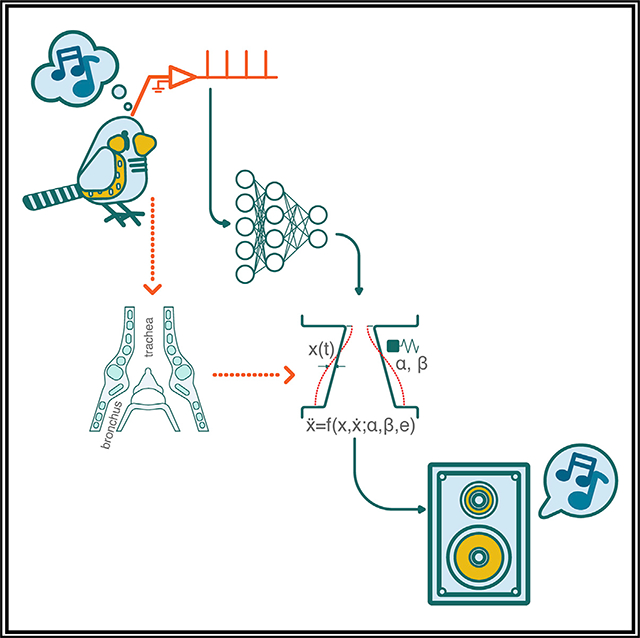
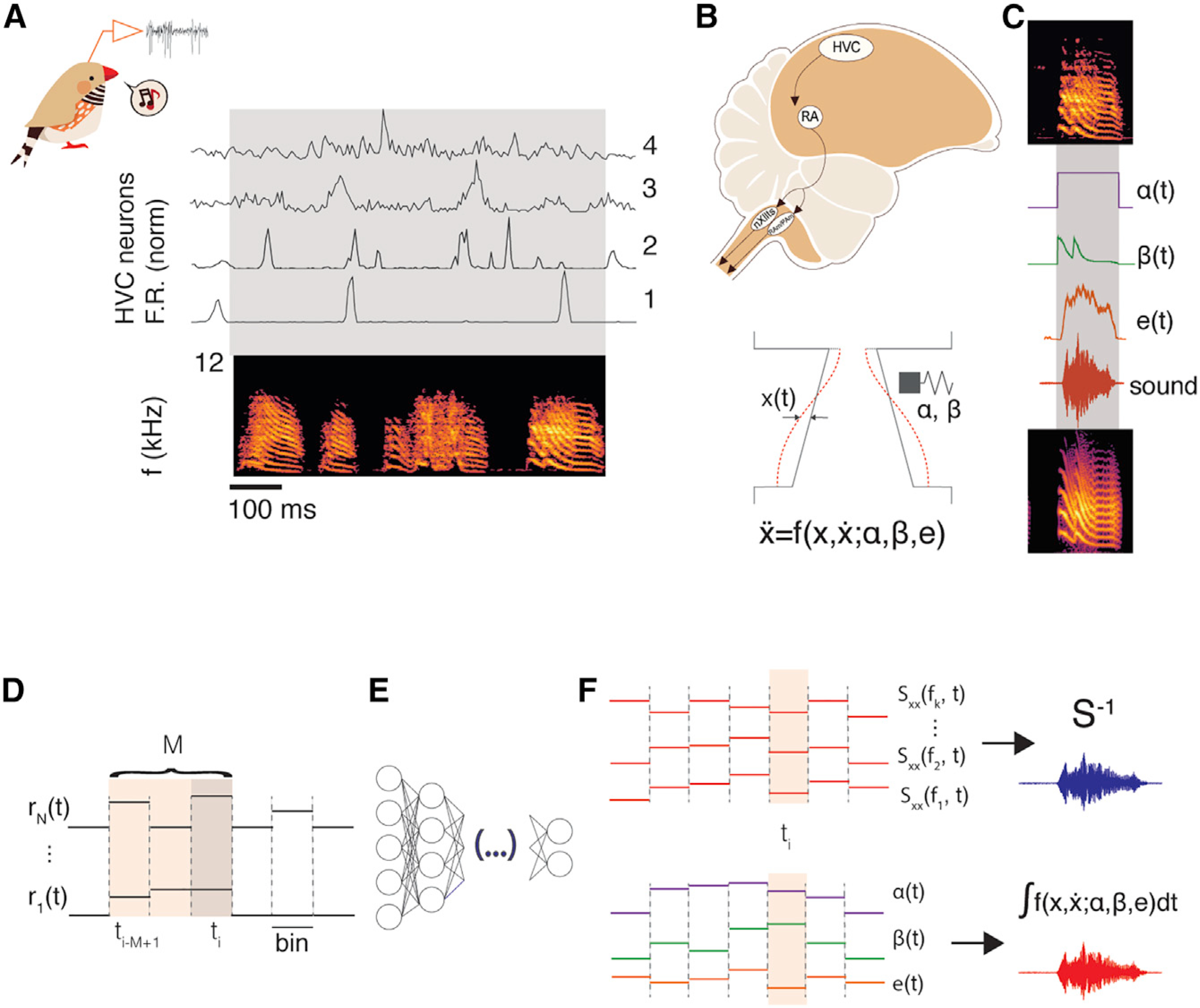
      • +
      • +75.Anderson SE, Dave AS, and Margoliash D (1996). Template-based automatic recognition of birdsong syllables from continuous recordings. J. Acoust. Soc. Am. 100, 1209–1219. [DOI] [PubMed] [Google Scholar]
      • +

      Associated Data

      +

      This section collects any data citations, data availability statements, or supplementary materials included in this article.

      +

      Supplementary Materials

      +
      mmc5
      +
      +Download audio file (677.2KB, mp3) +
      mmc4
      +
      +Download audio file (687.4KB, mp3) +
      mmc3
      +
      +Download audio file (678.5KB, mp3) +
      mmc2
      +
      +Download audio file (685KB, mp3) +
      mmc1
      +

      Data Availability Statement

      +

      Data generated in this study have been deposited to https://doi.org/10.6084/m9.figshare.14502198.

      +

      Code for data acquisition, processing pipeline and analysis developed for this work is available in the following github repositories: https://github.com/zekearneodo/swissknife; https://github.com/kaichensh/curr_bio_2021.

      + + + +
      +
      +
      +
      + + + + + + +
      +
      + + + +
      +

      RESOURCES

      + +
      +

      + +

      +
      + +
      +

      + +

      + + +

      + +

      + + + +
      + +
      + + + +
      +
      + + + + + + + + + +
      +
      +
      + + + + + + + + + + + + + + + + + + + + + + + + + + + + + + + + + + + + + + + + + + + + + + + + + + + + + + diff --git a/research/syrinx-modeling/sources/synthetic-birdsongs-replay.html b/research/syrinx-modeling/sources/synthetic-birdsongs-replay.html new file mode 100644 index 0000000..fede1c7 --- /dev/null +++ b/research/syrinx-modeling/sources/synthetic-birdsongs-replay.html @@ -0,0 +1,2729 @@ + + + + + + + + + + + + + + + + + + + + + + + + + + + + + + + + + + + + + + + + + + + + Synthetic Birdsongs as a Tool to Induce, and Iisten to, Replay Activity in Sleeping Birds - PMC + + + + + + + + + + + + + + + + + + + + + + + + + + + + + + + + + + + + + + + + + + + + + + + + + + + + + + + + + + + + + Skip to main content + + + + + + +
      +
      +
      +
      +
      + +
      + + + + + + + + + + + + + + + + + + + + + + + + + + + + +
      +
      + + +
      +
      + + + + + + + + +
      +
      + + + +
      +
      +
      + + NCBI home page + + + + + + + + + + + + + + + + + + + + + + + + + + + + + + + +
      + + + + + + + + + + + + + + + + + + + + + + + + + + + + + + + + + +
      + +
      +
      + + + + + + + +
      + + + + + +
      +
      +
      + + +
      + +
      +
      + + + + + + + + +
      + + + + + + + + +
      +
      +
      +
      +
      +
      + +
      +
      +
      + +
      + + +
      Frontiers in Neuroscience logoLink to Frontiers in Neuroscience
      +
      . 2021 Jul 5;15:647978. doi: 10.3389/fnins.2021.647978 +
      +
      +

      Synthetic Birdsongs as a Tool to Induce, and Iisten to, Replay Activity in Sleeping Birds

      +Ana Amador +1,2,*, Gabriel B Mindlin +1,2 +
      +
        +
      • +
      • +
      • +
      +
      + + + +
      +
      PMCID: PMC8287859  PMID: 34290576 +
      +

      Abstract

      +

      Birdsong is a complex vocal behavior, which emerges out of the interaction between a nervous system and a highly nonlinear vocal device, the syrinx. In this work we discuss how low dimensional dynamical systems, interpretable in terms of the biomechanics involved, are capable of synthesizing realistic songs. We review the experimental and conceptual steps that lead to the formulation of low dimensional dynamical systems for the song system and describe the tests that quantify their success. In particular, we show how to evaluate computational models by comparing the responses of highly selective neurons to the bird’s own song and to synthetic copies generated mathematically. Beyond testing the hypothesis behind the model’s construction, these low dimensional models allow designing precise stimuli in order to explore the sensorimotor integration of acoustic signals.

      +

      Keywords: birdsong, dynamical systems, nonlinear dynamics, replay, acoustics

      Introduction

      +

      Birdsong is a behavior that emerges as a set of brain generated physiological instructions are delivered to respiratory and vocal muscles. These gestures, delicately synchronized, set in motion a variety of biomechanical processes that end up in the production of spectrally and temporally complex sounds. The vocal muscles control the configuration of the syrinx, the vocal organ, determining the tension of some tissues, whose oscillations modulate the airflow generating sound (Suthers et al., 1999; Suthers, 2001; Suthers and Margoliash, 2002). The nonlinear nature of the labial oscillations translates into their spectral content, and therefore into the timbre of the resulting sounds (Mindlin, 2017). In this way, the interaction between the nervous system and the nonlinear nature of the vocal organ determines the acoustic features of the uttered sounds (Mindlin and Laje, 2005; Amador and Mindlin, 2014). In fact, this simple description is the result of a long and rich interplay between experiments, theoretical models, and mathematical advances in the field of nonlinear dynamics. We will discuss some important moments of this rich history.

      +

      With this perspective, we explore the physics involved in birdsong production. Physics aims to provide minimal descriptions, i.e., the simplest mechanisms compatible with a given dynamics. But in a biological problem, it is not obvious which could be a criterium for deciding that a model is acceptable. The simplest option in biology may not be the most successful in an evolutionary context. This essential difference between biology and physics makes development of biomechanical models a delicate issue.

      +

      Birdsong is also thoroughly studied in the field of neuroscience as an animal model for vocal learning (Bolhuis and Gahr, 2006; Zeigler and Marler, 2012; Nieder and Mooney, 2020). Approximately 40% of the known bird species require the exposure to a tutor in order to develop their songs. The learned physiological gestures required to generate those complex vocalizations is achieved through a complex neural architecture that involve several neural nuclei. A remarkable characteristic of birdsong is the degree to which cortical areas contribute to the generation of vocal patterns. In songbirds, the neural nucleus HVC (used as proper name, analogous to a premotor cortex in mammals), has proven to be essential to the generation of learned vocalizations (Nottebohm et al., 1976). Since this nucleus also receives inputs from the auditory pathway, it was natural to explore the nature of its auditory response to a variety of stimuli (Janata and Margoliash, 1999; Amador and Margoliash, 2011). As a result of those explorations, it was found that some HVC neurons that present song premotor activity, also respond to playback of the bird’s own song (BOS). This response was found to be highly selective to BOS, i.e., responding more to BOS than to other acoustic stimuli as white noise, tones, and even conspecific songs (CON) or the BOS played in reverse (REV) which preserves the spectral content but affects the temporal information of the stimulus (Margoliash, 1983; Margoliash and Konishi, 1985). In many cases, the evoked activity through auditory stimulation and the premotor activity were very similar (Prather et al., 2008). Moreover, in anesthetized and sleeping birds, auditory stimulation with the BOS can entrain motor like activity in the whole network composed by the neural nuclei involved in birdsong production (Doupe and Konishi, 1991; Dave and Margoliash, 2000; Cardin and Schmidt, 2003). Moreover, recently it was shown that sleeping songbirds exposed to the recordings of their own songs display motor like activity patterns in their syringeal muscles (Bush et al., 2018). Syringeal muscles are innervated by motor neurons contained in the tracheosyringeal part of the hypoglossal motor nucleus (nXIIts), which is part of the song system neural network. Therefore, measurements in the syringeal muscles constitute a direct readout of the song system.

      +

      The high selectivity displayed by some neurons to the BOS allows to have a well-defined challenge: a physical model of the avian vocal organ should include enough elements so that the sound it generates is able to elicit responses in neurons highly selective to the BOS. It also paves the way to explore other important issues: is there a hierarchy of importance within the parameters that are included in our minimal models? How does the response degrade as the parameters of the model are varied? Beyond validating a physical model, the strategy of stimulating with physically realistic models allows varying interpretable parameters and exploring the way in which responses degrade.

      +

      Beyond the possibility of validating biomechanical hypothesis, and its use as generators of auditory stimuli, biomechanical models of birdsong production can be used to explore brain activity during sleep. It has been recently shown that spontaneous replay activity generated in a sleeping bird can be registered in syringeal muscles (Young et al., 2017). A code for translating brain activity into song is not yet available, but there have been significant advances in the association between acoustic features and certain patterns of muscle activity. In this work we will describe dynamical models of birdsong production and discuss the physics behind them. We will discuss their potential as generators of acoustic stimuli, and the possibility of using them to translate a bird’s neural activity during sleep into actual sound.

      Towards a Low-Dimensional Biomechanical Model

      +

      Evolutionary distant species as humans and songbirds produce some of their communication sounds through similar mechanisms, engaging the motor systems in charge of controlling respiration, the vocal organ and the upper vocal tract (Wild, 2004; Riede and Goller, 2010; Elemans, 2014). In the case of birdsong production, respiratory gestures are used to generate airflow, which induces connective tissue masses (known as labia) to oscillate (Goller and Larsen, 1997; Suthers et al., 1999). These oscillations bare some similarity with those displayed by the human vocal folds when voiced sounds (like vowels) are produced (Titze, 1994; Mindlin and Laje, 2005).

      +

      This brief description does not honor the conceptual and experimental difficulties in reaching this picture. When a human wants to imitate a bird, the person whistles. It is therefore natural to conjecture that at least for some bird species, some form of whistle-like mechanism could be responsible for the generation of at least the tonal sounds. And in fact, in one of the earliest papers on the subject of birdsong production, the anatomist George Cuvier proposed in 1800 an analogy between a trombone and the song system (Cuvier, 1800). Although in bronze instruments the sound source is the oscillation of the lips, it is the strong feedback of the instrument what stabilizes the sounds source (Adachi and Sato, 1996). This is also the case in a whistle, where the sound source is the periodic vortex detachment from a jet. In both cases, the changes in the resonances of the device attached to the source would determine the fundamental frequencies of the sound (Olson, 1967). A conceptual breakthrough would be provided by Thorpe (Thorpe, 1959), who in 1959 suggested that a more appropriate analogy for the song system would be found in human phonation. The human model is a strong conceptual departure from the previous ones, since independently of the nature of the sound source dynamics (vortex departure or tissue modulations of an airflow), its frequency is unaffected by the properties of the attached cavity. In human phonation, tongue, lips and jaw determine the way in which the spectral richness of the signal generated by the sound source is filtered, but they do not condition the dynamics of the vocal folds (Titze, 1994). An additional conceptual challenge to the models that required a strong interaction between a tract and a sound source was provided by the observation of sounds built out of two non-harmonically related tones. It was Greenewalt (Greenewalt, 1968) who observed that two sound sources could not act independently of each other if their dynamics was conditioned by a unique tube. This delicate observation of the spectral content of some birds’ songs could be possible before the development of computational tools as the spectrograph. But beyond this smart observation, experimental evidence was necessary. A crucial experiment was carried out by Nowicki (Nowicki, 1987), who recorded the songs and calls of nine species of oscine birds in a Helium atmosphere. No change was found in the values of the fundamental frequencies, although the speed of sound in this altered atmosphere changes significantly. This built confidence in the theory that the sound source’s dynamics is basically independent of the resonances of the attached tract. Notice that when a human speaks after the inhalation of Helium, the perceived change in pitch if due to the alteration of the filter: the fundamental frequencies are basically unchanged (Nowicki and Marler, 1988).

      +

      At this point, the idea of sound sources capable of displaying dynamics largely independent of the tract was well established. But the general view was that the medial tympaniform membranes were the principal sound generators. Goller and Larsen performed a series of experiments surgically incapacitating the tympaniform membranes as vibratory sources in cardinals (Cardinalis cardinalis) and zebra finches (Taeniopygia guttata), which were yet capable of singing nearly normal songs (Goller and Larsen, 1997). Moreover, they studied the syrinx filming it endoscopically during spontaneous vocalizations and were capable of describing the reconfiguration that the syrinx undergoes in the process. They found that the vocalization starts with a rostral movement that stretches the syrinx and pushes the medial and lateral labia into the bronchial lumen. They also reported that during song, these tissues oscillate (although at the time, the resolution of the film did not allow them to directly compare the labial frequency with the song’s fundamental frequency). With this experimental evidence at hand, it was clear that there were many common elements between the mechanisms involved in birdsong production and the generation of some of the sounds that are used in human vocalizations. In particular with those called voiced sounds, that are generated when the airflow sets in motion the vocal folds (Titze, 1994).

      +

      In the case of the human voice, the search for a computational model implementing the acoustic principles of sound production was motivated by the need to obtain speech synthesis by machines. In Bell labs Flanagan and Ishizaka developed the first finite element computational implementation of a mathematical model of voiced sounds production (Ishizaka and Flanagan, 1972). They assumed that the vocal cords could be approximated by a self-oscillating sound source built out of two stiffness-coupled masses. The tract was modeled as a transmission line. A one-dimensional Bernoulli flow was used to model the dynamics of the air between the masses, and a plane wave was used to approximate the behavior of the fluid in the tract. These basic elements are present in many models of voice production until these days. This model allows a mathematical description of the problem in terms of a dynamical system, i.e., a finite set of ordinary differential equations ruling the dynamics of a finite set of variables. In particular, the positions of the masses will obey Newton’s laws. The forces acting on each mass include the Bernoulli force, which requires computing the pressure of the air at the lumen, the elastic forces that mimic the internal elastic properties of the vocal folds, and the highly nonlinear dissipation that accounts for the energy loses that occur when the folds bump into each other. With its complexity, this is a finite set of ordinary differential equations, which is much easier to study than a continuous model, expressed by a nonlinear partial differential equation. Still, this model can display a remarkable variety of qualitatively different solutions. The dynamical model studied by Herzel et al. (1995) allowed them to account for several irregularities found in the voices of patients with pathological conditions. This model, with its nonlinearities, and its dimensionality, is capable of displaying not only periodic solutions (what would be enough to reproduce a simple sound), but also quasiperiodic and chaotic solutions, whose spectra are extremely rich.

      +

      Yet, the simulations of these 2-mass models (the name is derived from the two masses used to represent each vocal fold) showed that for wide regions of the parameter space, the four masses representing the two vocal folds would oscillate periodically, with fixed phase differences between them. Interestingly enough, this collective dynamic can be displayed even for some degree of asymmetry between the opposing folds (Steinecke and Herzel, 1995). More importantly, it suggested the possibility of describing this behavior in terms of simpler spatial modes, and therefore, with a smaller number of equations. Titze carried out this additional simplification in the models for voice production (Titze, 1988). He observed that the phase difference between the upper and lower mass in representing each of the folds could be interpreted as a unique flapping surface wave. At this point bird’s labia and human vocal folds can be treated similarly. In the following section, we will discuss the implementation of this model in greater detail.

      +

      Once a sound is generated by self-sustained oscillations (of vocal folds in the human case, of syringeal labia in the case of birds), the sound is passively filtered. In the case of human communication, the delicate articulation of motor gestures controlling lips, tongue and jaw allows the generation of different vowels, and it is the case for many human languages that many of those sounds are generated with a modest variation of the fundamental frequency during normal speech (Titze, 1994). Turns out that humans are not the only vertebrates with tunable vocal tract filters. It was shown (Riede et al., 2006) that birdsong is accompanied by cyclical movements of the hyoid skeleton and changes at the cranial end of the esophagus that allow the tuning of the vocal filters to enhance the song’s fundamental frequency.

      A Mathematical Implementation of a Flapping Model of the Sound Source

      +

      As discussed in the previous section, an important reduction in the dimensionality of the problem is to consider the oscillating labia (in principle with many degrees of freedom) as an oscillating mass subject to the action of forces. To define a dynamical model for this mass, the Newton’s second law is used, which states that the sum of forces ∑iFi acting on a body is equal to the mass m of the body multiplied by the acceleration of its center of mass a : m⁢a=∑iFi. In this way, the equation of motion is defined by the following differential equations with variable x representing the medial position of a labium measured from its equilibrium position:

      + + + +
      d⁢xd⁢t=y(1)
      + + + +
      m⁢a=m⁢d⁢yd⁢t=-k⁢x-b⁢y+f0+Fd⁢(x,y)+G⁢(ps⁢u⁢b⁢x,y),(2)
      +

      with −kx the elastic force, −by the dissipative force, f0 a constant force generated by the syringeal muscles. The function Fd(x,y) = −cx2y represents a nonlinear dissipative force that depends on the labium position, and G(psubx,y) represents the force due to the airflow. For sufficiently high values of the pressure’s airflow the labia start to oscillate, with a wavelike upwards motion (Goller and Larsen, 1997; Elemans et al., 2015). This wave can be described in terms of two basic modes: a lateral displacement of the labia, and a flapping-like motion, leading to an out-of-phase oscillation of the top and bottom portion of the labia [for a detailed description see Titze (1988, 1994); Gardner et al. (2001); Mindlin and Laje (2005)]. In this way, a specific function for G(psubx,y)=psubalabf(x,y), is defined, being alab the lateral labial area and f(x,y) a function including geometrical aspects of the labia and its flapping motion. The dynamical model of the sound source is completed by assuming labial nonlinear restitution elastic properties and nonlinear dissipation, with k = k(x)=k1 + k2x2 and b = b(y)=b1 + b2y2:

      + + + +
      d⁢xd⁢t=y(3)
      + + + +
      m⁢d⁢yd⁢t=-k1⁢x-k2⁢x3-b⁢(y)⁢y+f0-c⁢x2⁢y+ps⁢u⁢b⁢al⁢a⁢b⁢f⁢(x,y)(4)
      +

      For a detailed deduction of these equations and further details see (Titze, 1988; Gardner et al., 2001; Mindlin and Laje, 2005; Amador and Mindlin, 2008; Mindlin, 2017). With the appropriate parameter values, an energy transfer from the airflow to the labia allows the emergence of auto-sustained oscillations during phonation. In this way, a low dimensional model can account for the labia oscillations during birdsong production. To complete the model of phonation, the vocal tract needs to be included. The sound source is the rate of mass injection for unit of volume s⁢(t)=∂⁡q∂⁡t, being q proportional to the air velocity (Howe, 2003). These density perturbations, plus the back propagating wave, build the pressure fluctuations at the input of the trachea pi(t) and the transmitted pressure wave excites the oro-esopharingeal cavity [OEC, see Fletcher et al. (2006); Perl et al. (2012)]. The OEC is modeled as a Helmholtz resonator (Perl et al., 2011). These steps are illustrated in Figure 1, that displays a schematic of the syrinx, the trachea and the OEC. The different time traces at the right of Figure 1 show the labial motion (bottom, red), the pressure at the input of the tract (middle, green) and the output pressure (top, blue).

      +

      FIGURE 1.

      +

      FIGURE 1

      + +

      Schematized view of the sound source and vocal tract of songbirds, and its filtering effects. The syringeal membrane modeled as a mass (m) with damping (b) and a restitution force (k), is able to display auto-sustained oscillations when nonlinear functions representing a flapping movement of the labia are introduced. These oscillations are the sound source [x(t), red line, representing the medial position of a labium] as pressure variations are generated at the input of the trachea [Pi(t), green line], and then filtered by the oro-esopharingeal cavity (OEC). The output of the dynamical model is the pressure [Pout(t), blue line] that will result in the synthetic sound (see text for further details). Adapted from Amador et al. (2013).

      It is pertinent to discuss how much of the synthesized acoustics will depend on the specific hypothesis used to build the model. For example, the specific nonlinearity used to represent the nonlinear dissipation. In this problem, we are particularly interested in the transition from stationary to oscillatory labia, as this is the transition from silence to sound. This qualitative change in the dynamics is known as a bifurcation (Strogatz, 1994). Physical models, for parameter values in the vicinity of a bifurcation can be taken to their “normal forms.” These are minimal dynamical systems capturing the basic bifurcations (Guckenheimer and Holmes, 1997). It is one of the most beautiful results in nonlinear dynamics that for a given dimensionality, the qualitatively different number of ways in which an oscillation can be born is small, and therefore many nonlinear dynamical systems which look very different (i.e., contain different nonlinear terms), can be taken to the same normal form by the appropriate change of variables.

      +

      It turns out that in many cases, identifying the underlying normal form of a model is enough to capture the timbre of the synthesized sounds. For example, oscillations born in Hopf bifurcations lead to tonal sounds, while those born in “Saddle Node in Limit Cycle” (SNILC) bifurcations are spectrally rich, giving rise to rougher sounds (Amador and Mindlin, 2008; Sitt et al., 2008). Both these bifurcations can be found for parameters close to those where a Hopf line is tangent to a saddle node curve (see bifurcation diagram of the model in Figure 2, left). This is known as a “Takens–Bogdanov” bifurcation, and scaling the time through a constant γ the normal form for this bifurcation can be written as:

      +

      FIGURE 2.

      +

      FIGURE 2

      + +

      Bifurcation diagrams of birdsong production models. For the physical model (upper left panel), the diagram is displayed in the (psub, k1) parameter space, representing the subglottal pressure and the labial tension, respectively. The bifurcation diagram of the normal form (upper right panel) is displayed in the (α,β) parameter space. Typical portraits of the (x,y) phase spaces for each region are shown in the corresponding numbered lower insets, showing the different dynamical regimes that occur in each region separated by bifurcation lines. In both upper panels, continuous red line represents a Hopf bifurcation, dashed blue line the homoclinic bifurcation, and green lines the saddle-node bifurcations. Paths H and S in the parameter space represent different ways to start oscillations of the labia, either by crossing the Hopf (H) or the saddle-node in limit cycle (S) bifurcation lines, thus generating either tonal or spectrally rich sounds. Adapted from Sitt et al. (2010).

      + + +
      d⁢xd⁢t=y(5)
      + + + +
      d⁢yd⁢t=-α⁢γ2-β⁢γ2⁢x-γ2⁢x3-γ⁢x2⁢y+γ2⁢x2-γ⁢x⁢y(6)
      +

      where α and β stand for the unfolding parameters [for a detailed description see, for example (Sitt et al., 2010; Perl et al., 2011; Mindlin, 2017)]. The bifurcation diagram of this dynamical system is shown in Figure 2, upper right panel. In other words, for parameter values close to those in which the physical model presents a Takens–Bogdanov bifurcation, a nonlinear change of variables will allow us to write it in this simpler way. The bifurcation diagrams of the complete model (Eqs. 3, 4) and its normal form (Eqs. 5, 6) shown in Figure 2 highlight the important normal form feature of preserving the dynamics of the complete model. Given this similarity, the parameter α is associated with the subglottal pressure (psub) and the parameter β with the labial tension (k1).

      +

      The generation of sound further requires the input of physiological instructions, or simple time dependent parameters (α(t), β(t)) that guarantee that the synthesized sounds present acoustic features similar to the bird’s song (Perl et al., 2011). The interesting aspect of this problem is that the nonlinear nature of the model, and more specifically, the bifurcations taking place, guarantee that given a fundamental frequency, the spectral content of the synthesized signal will be correct (Sitt et al., 2008). In other words, the spectral content is provided by the dynamics.

      +

      Normal form reduction is the ultimate physics exercise: not only considering the minimal number of effects when formulating a model, but further simplifying the system of equations by eliminating, through nonlinear changes of coordinates, nonlinear terms. In the example shown here, it also reduces substantially the number of physiological related parameters. Can such a reduced, simplified system constitute a reasonable model for a bird’s song?

      Inducing Physiological Responses With Low-Dimensional Models

      +

      In order to process and establish vocal communication, it is important to find a correspondence between the sensory and motor codes used to represent and generate a given signal. One plausible way to establish their correspondence is to count with neurons that are active both when the animal perceives the communicating signal, and when it produces it. Neurons in HVC highly selective to the BOS respond in this way (Prather et al., 2008). We will not discuss here the plausible role that these neurons might play in the process of learning. Instead, we will show how these neurons can be used as tools to explore the bird’s response to a variety of synthetic stimuli generated by computational models based on the physics of birdsong production.

      +

      The high selectivity of HVC neurons to the BOS is itself a sensible way to test whether a normal form, which is a simplified system of nonlinear equations derived from of an already idealized physical model, would be capable of generating meaningful auditory stimuli. This would pave the way to explore the degradation of the response as different parameters present in the model are varied.

      +

      An example of the selectivity property of HVC neurons is shown in Figure 3 (red boxes). Figure 3A shows the spectrograms of all the auditory stimuli presented to the bird. In Figure 3A the red box highlights the stimuli used to test the neural selectivity to bird’s own song (BOS). This is a well-established protocol including the auditory stimulus to be tested (BOS) and two control stimuli: the bird’s own song played in reversed (REV) and a conspecific song, i.e., song from a different bird of the same species (CON). Notice that REV has all the same sounds that BOS has but in a reversed order and CON contains similar sounds of the species but each individual has its own song due to the learning process to acquire it. Figures 3B,C show the neural responses to the presented stimulus: each dot in the raster plot indicates the time when a spike occurs. In the example shown here, 20 trials of each stimulus were presented (shown as black bars at the top of each panel) and each row in the figure shows the spike occurrence along each trial. To have a graphical quantification of the neural response, a histogram of the occurred spikes is shown in the upper panel. A robust response to BOS and no significant responses to REV and CON is a signature of the selective property of the recorded neuron (Figures 3B,C, red boxes). HVC selective neurons may exhibit phasic responses (Figure 3B) or tonic responses (Figure 3C) to the stimuli presented.

      +

      FIGURE 3.

      +

      FIGURE 3

      + +

      Testing a low-dimensional model of vocal production and the relative importance of physiological-related parameters of the model. (A) Spectrograms of the recorded songs and synthetic songs used as auditory stimuli presented to sleeping birds. The recorded songs (BOS, REV, and CON) were used to test the neurons selectivity to BOS. A series of synthetic variants were generated (SYN, typically 9–12) using parameters from a grid. The indexes (a, b) in the legend SYN (a; b) refer to the level of noise in β and dissipation of the OEC resonator, respectively. These synthetic songs variants are represented as blue dots in the grid of the right panel. (B) Example of a raster plot and histogram of a phasic neuron response to the presentation of the auditory stimuli shown in (A). The timing of the three repeated motifs that were presented is indicated by the bold horizontal lines. (C) Same as (B) but showing a recording of a tonic neuron. Adapted from Amador et al. (2013).

      This kind of neural responses suggested that in order to generate a significant neural response the auditory stimulus should be very similar to BOS. To generate the synthetic copy of the bird’s own song (SYN), the fundamental frequencies of the recorded bird’s own song were computed as a function of time. For each frequency in the time series, the parameter α was computed to generate a time trace with that fundamental frequency. The interesting contribution of the normal form is that the spectral content of the signal is determined by the distance of the parameter α to the bifurcation line where the oscillations are born. Therefore, the timbre of the sound is severely conditioned by its fundamental frequency.

      +

      A grid of stimuli can be generated by smoothly changing parameters in the model. In this way, it is possible to explore their relative contribution to the elicitation of selective responses. An example of such an exploration is shown in Figure 3 (blue boxes). The level of noise in the parameter β, as well as the dissipation of the resonator representing the OEC were varied. A high value for the dissipation corresponds to decreasing the OEC presence in the model, therefore decreasing the resonator effect, which is enhancing a specific frequency band of the sound signal. For each set of parameters, a synthetic song can be generated, using it to acoustically stimulate the bird, while recording the response of a selective HVC neuron. When the level of noise was set to zero and the dissipation was high no significant responses were found in HVC selective neurons. Notice that when the parameters are modified the synthetic copies can be very similar to BOS but the neural responses can change substantially [see spectrograms of SYN(0;0), SYN(5;0), SYN(10;0) in Figure 3A and its neural responses in Figures 3B,C]. The neural responses to a grid of SYN stimuli with identical timing [same functions for (α(t), β(t))] but different spectra from BOS identified optimal estimates for two remaining free static parameters. In this way, SYN(5;0) can be selected as the best fit according to the neural responses obtained. Notice that the timing and shape of the histograms are very similar between SYN(5;0) and BOS but the responses to SYN(5;0) show a reduced amplitude. A quantification of this can be achieved by normalizing the neural response to SYN with the neural response to BOS. The grouped data of this quantification is shown in Figure 4 (Amador et al., 2013). A maximum for the neural response is clearly noticeable, corresponding to an intermediate level of noise and full presence of OEC resonator (zero dissipation), i.e. SYN(5;0). Notice that the maximum level of response is 58%, showing that there are some acoustic features of BOS that the synthetic copies are not yet able to reproduce. It is also interesting to notice that the neural response decreases substantially for synthetic acoustic stimuli with no noise, but it is rather robust to high levels of noise (see inset of Figure 4).

      +

      FIGURE 4.

      +

      FIGURE 4

      + +

      Quantification of neural response to synthetic songs variants. Grouped data of 30 recorded neurons in HVC selective to the bird’s own song (BOS). The synthetic songs (SYN) variants changing the level of noise in β and dissipation of the resonator representing the OEC are organized as in the grid shown in Figure 3. The Z scores of SYN, were normalized to the BOS Z score, and averages across neurons were reported as means of normalized responses ± SEM. The inset (Dissipation = 0) shows the neural responses to high levels of noise with full presence of the OEC resonator. Adapted from Amador et al. (2013).

      Recently, it has been reported that spontaneous replay during sleep could be detected in syringeal muscles (Young et al., 2017). Also, muscle activity can be elicited when the sleeping bird was acoustically stimulated with presentation of BOS and synthetic copies of the song (SYN) (Bush et al., 2018). In fact, electromyograms (EMGs) of a syringeal muscle show playback-evoked patterns strikingly similar to those recorded during birdsong production. Interestingly enough, the activity of the muscle integrates instructions from many neurons, and therefore provides a reading of global nature of the selective activity in the bird’s brain. Therefore, it is possible to read a global signal with the potential to provide detailed aspects of the responses to the different stimuli. As we can see in Figures 5A,B, the response to the BOS is very similar to the response to the synthetic stimulus (SYN). The top panels of Figure 5 display the spectrograms of the presented auditory stimuli while the bottom ones display an overlay of the recorded responses in the syringealis ventralis (vS) muscle of zebra finches during sleep. There is a weaker response to the presentation of SYN but notice that the reduction is in the number of elicited responses for the synthetic stimuli, preserving the shape of the response. Figures 5C,D show the response to the temporal reversed bird’s own song (REV) and to a conspecific song (CON), respectively, highlighting the selectivity to BOS of these responses.

      +

      FIGURE 5.

      +

      FIGURE 5

      + +

      Syringeal muscle activity is selectively evoked by auditory playbacks. Playback responses in sleeping zebra finches to (A) the bird’s own song (BOS), (B) a synthetic copy of the bird’s own song (SYN), (C) the bird’s own song played in reverse (REV), and (D) a conspecific song (CON). In all cases, the top panel shows the spectrogram of the auditory stimulus presented, and the bottom panel shows an overlay of all recorded vS responses to those songs. Adapted from Bush et al., 2018.

      A similar exploration in the static parameters that was tested with neural responses (Figures 3, 4) can be performed with muscle responses. Figure 6 shows the results obtained when a sleeping bird was subjected to a variety of acoustic stimuli, while the activity of the syringealis ventralis muscle (vS) was monitored. The different synthetic stimuli were generated varying the level of noise added to the physiological parameters representing the labial tension. In the second-sixth panels of Figure 6A, we show the overlays of vS activity when the noise is increased, for a synthetic song whose spectrogram is displayed in the first panel. Figure 6B shows the response probability as a function of the noise. As the noise is increased, there is a region where the responses remain high and even increase, and at some point, when the noise is very high, the vS response gets smaller. When the response probability is reduced, there are some presentations of the synthetic stimulus that elicit muscle responses. Remarkably, in these cases, the elicited vS activity patterns match execution patterns in shape and timing, indicating an all-or-nothing activation of the vocal motor program [see (Bush et al., 2018) for further details]. This is interesting, since continuously degraded songs could drive a response in an all or none fashion, consistent with an attractor dynamics (Amit, 1992; Mooney, 2020). If the auditory stimulus was close enough to the BOS, as to fall into the attractor’s basin, the system would respond very similarly to the way it would to the BOS. Otherwise, the system would simply fail to fall to the attractor.

      +

      FIGURE 6.

      +

      FIGURE 6

      + +

      Degraded auditory stimuli evoke motor gestures with lower probability. (A) Overlays of vS activity traces elicited by motifs synthesized with the indicated amount of noise (σβ) added to the parameter representing the tension of the labia, β(t). (B) Response probability, calculated as the fraction of playbacks with normalized projection score (ρ) higher than the 90th percentile of REV and CON (ρ90R⁢E⁢V-C⁢O⁢N). Adapted from Bush et al. (2018).

      Notice that the results presented in Figures 5, 6 for syringeal muscle responses to acoustic stimuli are similar to the results presented in Figures 3, 4 for HVC neural responses.

      Questions Suggested by These Physiological Responses

      +

      Obtaining responses to synthetic stimuli from highly selective neurons is an interesting result in itself. A physical model, and specifically the one described in detail in this review, assumes a number of non-trivial assumptions: reduced number of active modes in the labial dynamics; synchronized movement of opposing labia; a nonlinear dissipation; a nonlinear restitution force; a simplified computation of the inter labial pressure, among others. Such a model needs to be capable of displaying a bifurcation from quiescent to oscillatory labia capable of providing a spectral richness which, when properly filtered by a resonator, is realistic enough to elicit the measured physiological responses. Previous work indicated that it is not only the spectral richness of some sounds, but the way the spectral content correlates with frequency what constitutes the fingerprint of the bifurcation (Sitt et al., 2008; Mindlin, 2017). From that perspective, the simplification of the physical model to the normal form should not be considered as an additional simplification, but as the reason itself the model was successful.

      +

      The responses obtained when the static parameters are varied, are very informative as well. A variation of the dissipation of the Helmholtz resonator used to model the OEC gave rise to a variation of the neural response. A study performed in Northern cardinals (C. cardinalis) showed that the OEC volume could be modified during song production so that the resonant frequency of the resonator matches the fundamental frequency of the sound (Riede et al., 2006). In other words, it was shown that the birds have direct control of the OEC to enhance the tonal sounds decreasing the energy in the higher harmonics (Fletcher et al., 2006). In zebra finches though, some vocalizations have fundamental frequencies that are an order of magnitude smaller than the typical resonant frequency of the OEC. In fact, the low frequency sounds used in zebra finch song are spectrally very rich, with the OEC enhancing reasonably high harmonics of those sounds. A similar phenomenon is found in a South American suboscine (Phytotoma rutila), where the combination of a spectrally rich sound source filtered by a cavity of a much higher resonant frequency allowed to predict the precise way in which body size is encoded in its vocalizations (Uribarri et al., 2020). For the sound production mechanism that consists of a pulsatile excitation of a static cavity, it can be expected a reliable signature of body size in the peak frequency. Although there is no direct evidence that conveying size information is a relevant feature in zebra finch vocal communication, the works discussed here show that 1. the vocal production mechanism allows the sound to carry size information of the individual generating the sound, and 2. that selective neurons in the song system are very sensitive to changes of the parameters characterizing OEC size used in the generation of synthetic stimuli. These results can be then translated to syringeal muscle activity.

      +

      Fitting the fundamental frequencies of the sounds and incorporating the proper filters was not enough to elicit strong responses by selective neurons [see responses to synthetic stimulus SYN(0;0) in Figures 4B,C]. To maximize the neural response, noise to the parameter representing the labial tension needed to be added. Figure 4 shows the simultaneous variation of the noise level in β(t) and a parameter characterizing the dissipation of the OEC. An optimal noise level can be deduced from the existence of a maximum in the neural response [for the synthetic stimulus SYN(5;0)]. The tension of the labia is the result of forces exerted by syringeal muscles. In fact, the force emerges as the sum of several twitches that are the result of neural impulses sent by the nervous system. It is likely that for small muscles, the average does not add up to a smooth, continuous gesture. Therefore, a realistic time dependent physiological instruction has to present some level of roughness if it is used to synthesize a stimulus capable of eliciting a neural response (Amador et al., 2013).

      From Syringeal Muscle Activity to Sound

      +

      An interesting aspect of the replay recorded in the syringeal muscles is that using those physiological recordings, a reasonably link between muscle activity and behavior can be achieved. This cannot be done with neural activity recorded from a unique area of the song system, as the code used to represent behavior is yet to be unveiled.

      +

      In a previous section we described the syringeal muscle activity that was induced when a sleeping bird was subjected to stimuli similar to the BOS. In recent years, it was also reported that patterns of syringeal activity could spontaneously emerge (Young et al., 2017), similarly to the spontaneous neural replays previously reported (Dave and Margoliash, 2000). The global nature of the syringeal readout may allow to quantify the nature of those spontaneous replays. In zebra finches, it was reported that less than ten percent of the spontaneous replays could be classified as the complete motif used by the bird for singing, while close to fifteen percent of the replays included vS patterns that cannot be recognized as part of the motor gestures used for singing (Young et al., 2017). It is a song-like activity, noticeably different from noise, but which does not correlate with actual motor gestures. This raises the question of whether models can be used as a tool to “listen” to synthetic sounds associated to them, i.e., use the periphery as a window to explore the brain.

      +

      Unfortunately, only modest approximations to the actual songs could be synthesized at this point. All the syringeal muscles are necessary to properly set the vocal organ into the configuration necessary to synthesize a given sound, and measuring them all simultaneously is difficult. Dorsal muscles are likely to participate in the gating of the airflow (Goller and Suthers, 1996b), just as the syringealis ventralis muscle (vS) has been shown to participate in the modulation of the frequencies (Goller and Suthers, 1996a). On the other hand, some important pieces of the puzzle are already in place. In fact, it has been shown that from EMGs measurements in the vS muscle, it is possible to estimate the frequency modulations of zebra finch song. This requires transducing EMGs into muscle force by means of a model for the muscle, and this force into labial tension (Doppler et al., 2018). In order to build this bridge between EMG and frequency modulation several quantitative tools had to be developed. One of them is a model capable of translating EMG activity recorded in a muscle into the force that this can exert. Then another model is needed to account for the increase of tension that a labium can experience as force is applied to it. Since the restitution properties of a labium depend on this tension, the models that we discussed in the previous section will allow us to translate the changes of labial tension into frequency modulations.

      +

      Actually, this is an example of a much wider problem. The neural system does not work in isolation: it interacts with the physical world. It receives sensory inputs and generates outputs via muscles. Therefore, the activity and coding of the neural circuits can only be fully understood by considering the biomechanics of muscles, the body they are embedded, and the conditions of the exterior world (Tytell et al., 2011). For that reason, there is a rich history of modeling efforts in order to build these bridges (Keener and Sneyd, 1998).

      +

      From a phenomenological perspective, the muscle can be modeled as a sliding slack in parallel with a dissipative component, with the slack’s length is controlled by the electrical activity in the muscle (Shapiro and Kenyon, 2000). The labium can be modeled through a stretching viscoelastic element subjected to the force exerted by the muscle. In this way, as the electrical activity shortens the slack, the difference between the muscles actual length and the slack is transduced into force (Shapiro and Kenyon, 2000) through a nonlinear (exponential) function. These models were developed and implemented in Doppler et al. (2018). Figure 7 shows the spectrogram of a song, and the temporal evolution of the estimated fundamental frequency after integrating the muscle model and the labial model with the syringeal EMG as input (shown in blue in Figure 7A). Notice that during the temporal periods in which there is phonation, the models provide a good estimation for the fundamental frequency. Therefore, it is possible to find the parameters of the model for birdsong production and synthesize a good proxy for the song (see Figure 7B). Unfortunately, the information from that muscle cannot be used to also estimate the onset and offset times of the sound. Listening to dreams will require at least to measure the simultaneous activity of ventral and dorsal muscles to properly select from the synthetic sounds, the segments that will approximate the actual syllables.

      +

      FIGURE 7.

      +

      FIGURE 7

      + +

      From syringeal muscle activity to acoustic features. (A) The spectrogram of a zebra finch song, and the simultaneous recording of the EMG at the syringealis ventralis muscle (blue traces). (B), the proxy of the fundamental frequency, as the models in Doppler et al. (2018) are integrated. The red segment was used to tune the parameters, and the black line shows the model’s prediction of the fundamental frequency for the complete song. Adapted from Doppler et al. (2018).

      Discussion

      +

      Behavior emerges from the interaction of nervous systems, physical effectors and the environment. In this review we discuss how some subtle acoustic properties of birdsong are conditioned by the dynamics of the periphery. We also show how a dynamical model for the sound source can condition the acoustic properties of the generated sounds, specifically showing how different bifurcations may lead to spectrally different sounds.

      +

      This is not unique to birdsong. A recent work showed that the qualitative changes that occur in the vocalizations of marmosets during development are rooted in the nonlinear interaction between the nervous system and the biomechanics involved in respiration (Zhang and Ghazanfar, 2018). Moreover, analyzing the qualitatively different dynamics of a computational model for the phonatory system, they were capable of identifying parameters that allowed to mimic growth reversal and recover lost vocalizations. This integrative view has a longer history in other biological systems like locomotion, in which neural circuits generate patterns that are coupled to the environment by the body–limb system, and the importance of the biomechanics involved is very clear (Tytell et al., 2011). But in other fields, this integrative approach is yet to be embraced. Across vertebrates, progressive changes in vocal behavior during postnatal development are mostly analyzed from the development of neural circuits. How the changing body influences vocal behavior is only recently being integrated into the analysis (Zhang et al., 2019).

      +

      In this work we have reviewed an interactive journey between modeling and experiments in the study of birdsong production. The response of highly selective neurons to a BOS was used to test the pertinence of low dimensional models. These models were not built just by simplifying the physical processes involved: they were designed to capture the basic dynamical mechanisms behind the functioning of the syrinx and vocal tract. Specifically, the bifurcations leading to the vocalizations. Synthetic songs (and the models used to generate them) were considered pertinent as long as they were capable of eliciting physiological responses similar to those obtained using the BOS.

      +

      Besides the success of a simplified model to elicit responses, it is interesting to explore which physiological related parameters are necessary to include in the model (and tune) to obtain a physiological response. In this work we have discussed experiments in which noise and filter properties were changed, but a systematic study of responses as a function of the model’s parameters is an interesting program which is yet to be carried out. The nature of the response itself, and the way in which this degrades as these parameters are moved away from the optimal values is informative.

      +

      Low dimensional models can be used as synthesizers of acoustic stimuli, as a tool that allows to read physiological instructions in a behavioral key. In the past, muted birds could drive an electronic synthesizer implementing these dynamical models and sing (Arneodo et al., 2012). Beyond these applications, the construction of simplified models capable of eliciting responses in highly selective neurons in the auditory pathway highlights the existence of mechanisms, parametrized by a reasonably small number of parameters, which might help us order our studies of the extremely complex and rich field of vocal communication. As we have discussed, these low dimensional models have not emerged out of a unique leap of intuition: they are the result of a long and fascinating discussion that included musical analogies, careful analysis of sound, experimentation and theoretical work.

      +

      Notably, the vocal organs of different species of oscine birds are very similar, and the models described in this work are designed to describe song production by these species. But there are approximately other 6,000 bird species displaying a remarkable morphological diversity. We expect fascinating physics and dynamics to be at play in non-oscines. Departing from the specific problem of birdsong, we expect this integrative view to allow us to deepen our understanding of many other neuroethological problems.

      Author Contributions

      +

      Both authors wrote this review.

      Conflict of Interest

      +

      The authors declare that the research was conducted in the absence of any commercial or financial relationships that could be construed as a potential conflict of interest.

      Acknowledgments

      +

      We thank Juan F. Döppler for useful discussions.

      Footnotes

      +

      Funding. This research has been partially funded by Consejo Nacional de Investigaciones Científicas y Técnicas (CONICET, Argentina), Agencia Nacional de Promoción Científica y Tecnológica (ANCyT, Argentina), and Universidad de Buenos Aires (UBA, Argentina).

      References

      +
        +
      1. +Adachi S., Sato M. A. (1996). Trumpet sound simulation using a two-dimensional lip vibration model. +J. Acoust. Soc. Am. +99 +1200–1209. 10.1121/1.414601 [DOI] [Google Scholar]
      2. +
      3. +Amador A., Margoliash D. (2011). “Auditory Memories and Feedback Processing for Vocal Learning,” in The Auditory Cortex, eds +Winer J. A., Schreiner C. E. (Springer; ), 561–575. 10.1007/978-1-4419-0074-6_26 [DOI] [Google Scholar]
      4. +
      5. +Amador A., Mindlin G. B. (2008). Beyond harmonic sounds in a simple model for birdsong production. +Chaos +18:043123. 10.1063/1.3041023 [DOI] [PubMed] [Google Scholar]
      6. +
      7. +Amador A., Mindlin G. B. (2014). Low dimensional dynamics in birdsong production. +Eur. Phys. J. B +87 +1–8. [Google Scholar]
      8. +
      9. +Amador A., Sanz Perl Y., Mindlin G. B., Margoliash D. (2013). Elemental gesture dynamics are encoded by song premotor cortical neurons. +Nature +495 +59–64. 10.1038/nature11967 + [DOI] [PMC free article] [PubMed] [Google Scholar]
      10. +
      11. +Amit D. J. (1992). Modeling brain function: The world of attractor neural networks. +Cambridge: Cambridge university press. [Google Scholar]
      12. +
      13. +Arneodo E. M., Perl Y. S., Goller F., Mindlin G. B. (2012). Prosthetic avian vocal organ controlled by a freely behaving bird based on a low dimensional model of the biomechanical periphery. +PLoS Comput. Biol. +8:e1002546. 10.1371/journal.pcbi.1002546 + [DOI] [PMC free article] [PubMed] [Google Scholar]
      14. +
      15. +Bolhuis J. J., Gahr M. (2006). Neural mechanisms of birdsong memory. +Nat. Rev. Neurosci. +7 +347–357. 10.1038/nrn.1904 [DOI] [PubMed] [Google Scholar]
      16. +
      17. +Bush A., Doppler J. F., Goller F., Mindlin G. B. (2018). Syringeal EMGs and synthetic stimuli reveal a switch-like activation of the songbird’s vocal motor program. +Proc. Natl. Acad. Sci. U S A. +115 +8436–8441. 10.1073/pnas.1801251115 + [DOI] [PMC free article] [PubMed] [Google Scholar]
      18. +
      19. +Cardin J. A., Schmidt M. F. (2003). Song system auditory responses are stable and highly tuned during sedation, rapidly modulated and unselective during wakefulness, and suppressed by arousal. +J. Neurophysiol. +90 +2884–2899. 10.1152/jn.00391.2003 + [DOI] [PubMed] [Google Scholar]
      20. +
      21. +Cuvier G. (1800). Sur les instruments de la voix des oiseaux. +J. Physique Chimie d’Histoire Nat. +50 +426–451. [Google Scholar]
      22. +
      23. +Dave A. S., Margoliash D. (2000). Song replay during sleep and computational rules for sensorimotor vocal learning. +Science +290 +812–816. 10.1126/science.290.5492.812 + [DOI] [PubMed] [Google Scholar]
      24. +
      25. +Doppler J. F., Bush A., Goller F., Mindlin G. B. (2018). From electromyographic activity to frequency modulation in zebra finch song. +J. Comp. Physiol. A Neuroethol. Sens. Neural. Behav. Physiol. +204 +209–217. 10.1007/s00359-017-1231-3 + [DOI] [PubMed] [Google Scholar]
      26. +
      27. +Doupe A. J., Konishi M. (1991). Song-selective auditory circuits in the vocal control system of the zebra finch. +Proc. Natl. Acad. Sci. U S A. +88 +11339–11343. 10.1073/pnas.88.24.11339 + [DOI] [PMC free article] [PubMed] [Google Scholar]
      28. +
      29. +Elemans C. P. (2014). The singer and the song: The neuromechanics of avian sound production. +Curr. Opin. Neurobiol. +28 +172–178. 10.1016/j.conb.2014.07.022 + [DOI] [PubMed] [Google Scholar]
      30. +
      31. +Elemans C. P., Rasmussen J. H., Herbst C. T., During D. N., Zollinger S. A., Brumm H., et al. (2015). Universal mechanisms of sound production and control in birds and mammals. +Nat. Commun. +6:8978. 10.1038/ncomms9978 + [DOI] [PMC free article] [PubMed] [Google Scholar]
      32. +
      33. +Fletcher N. H., Riede T., Suthers R. A. (2006). Model for vocalization by a bird with distensible vocal cavity and open beak. +J. Acoust. Soc. Am. +119 +1005–1011. 10.1121/1.2159434 [DOI] [PubMed] [Google Scholar]
      34. +
      35. +Gardner T., Cecchi G., Magnasco M., Laje R., Mindlin G. B. (2001). Simple motor gestures for birdsongs. +Phys. Rev. Lett. +8720:208101. 10.1103/Physrevlett.87.208101 + [DOI] [PubMed] [Google Scholar]
      36. +
      37. +Goller F., Larsen O. N. (1997). A new mechanism of sound generation in songbirds. +Proc. Natl. Acad. Sci. U S A. +94 +14787–14791. 10.1073/pnas.94.26.14787 + [DOI] [PMC free article] [PubMed] [Google Scholar]
      38. +
      39. +Goller F., Suthers R. A. (1996a). Role of syringeal muscles in controlling the phonology of bird song. +J. Neurophysiol. +76 +287–300. 10.1152/jn.1996.76.1.287 + [DOI] [PubMed] [Google Scholar]
      40. +
      41. +Goller F., Suthers R. A. (1996b). Role of syringeal muscles in gating airflow and sound production in singing brown thrashers. +J. Neurophysiol. +75 +867–876. 10.1152/jn.1996.75.2.867 + [DOI] [PubMed] [Google Scholar]
      42. +
      43. +Greenewalt C. H. (1968). Bird song: Acoustics and physiology. +Washington: Smithsonian Institution Press. [Google Scholar]
      44. +
      45. +Guckenheimer J., Holmes P. (1997). Nonlinear oscillations, dynamical systems, and bifurcations of vector fields. +Berlin: Springer. [Google Scholar]
      46. +
      47. +Herzel H., Berry D., Titze I., Steinecke I. (1995). Nonlinear dynamics of the voice: signal analysis and biomechanical modeling. +Chaos Interdiscipl. J. Nonline. Sci. +5 +30–34. 10.1063/1.166078 [DOI] [PubMed] [Google Scholar]
      48. +
      49. +Howe M. S. (2003). Theory of vortex sound. +Cambridge: Cambridge university press. [Google Scholar]
      50. +
      51. +Ishizaka K., Flanagan J. L. (1972). Synthesis of voiced sounds from a two-mass model of the vocal cords. +Bell Syst. Technic. J. +51 +1233–1268. 10.1002/j.1538-7305.1972.tb02651.x [DOI] [Google Scholar]
      52. +
      53. +Janata P., Margoliash D. (1999). Gradual emergence of song selectivity in sensorimotor structures of the male zebra finch song system. +J. Neurosci. +19 +5108–5118. 10.1523/jneurosci.19-12-05108.1999 + [DOI] [PMC free article] [PubMed] [Google Scholar]
      54. +
      55. +Keener J. P., Sneyd J. (1998). Mathematical physiology, Vol. 1. New York NY: Springer. [Google Scholar]
      56. +
      57. +Margoliash D. (1983). Acoustic parameters underlying the responses of song-specific neurons in the white-crowned sparrow. +J. Neurosci. +3 +1039–1057. 10.1523/jneurosci.03-05-01039.1983 + [DOI] [PMC free article] [PubMed] [Google Scholar]
      58. +
      59. +Margoliash D., Konishi M. (1985). Auditory representation of autogenous song in the song system of white-crowned sparrows. +Proc. Natl. Acad. Sci. U S A. +82 +5997–6000. 10.1073/pnas.82.17.5997 + [DOI] [PMC free article] [PubMed] [Google Scholar]
      60. +
      61. +Mindlin G. B. (2017). Nonlinear dynamics in the study of birdsong. +Chaos +27:092101. 10.1063/1.4986932 [DOI] [PMC free article] [PubMed] [Google Scholar]
      62. +
      63. +Mindlin G. B., Laje R. (2005). The physics of birdsong. +Berlin: Springer Verlag. [Google Scholar]
      64. +
      65. +Mooney R. (2020). The neurobiology of innate and learned vocalizations in rodents and songbirds. +Curr. Opin. Neurobiol. +64 +24–31. 10.1016/j.conb.2020.01.004 + [DOI] [PMC free article] [PubMed] [Google Scholar]
      66. +
      67. +Nieder A., Mooney R. (2020). The neurobiology of innate, volitional and learned vocalizations in mammals and birds. +Philos. Trans. R Soc. Lond. B Biol. Sci. +375:20190054. 10.1098/rstb.2019.0054 + [DOI] [PMC free article] [PubMed] [Google Scholar]
      68. +
      69. +Nottebohm F., Stokes T. M., Leonard C. M. (1976). Central control of song in the canary, Serinus canarius. +J. Comparat. Neurol. +165 +457–486. 10.1002/cne.901650405 + [DOI] [PubMed] [Google Scholar]
      70. +
      71. +Nowicki S. (1987). Vocal tract resonances in oscine bird sound production: evidence from bird- songs in a helium atmosphere. +Nature +325 +53–55. 10.1038/325053a0 + [DOI] [PubMed] [Google Scholar]
      72. +
      73. +Nowicki S., Marler P. (1988). How do birds sing? +Music Percept. +5 +391–426. [Google Scholar]
      74. +
      75. +Olson H. F. (1967). Music, physics and engineering. +New York, NY: Dover Publications, Inc. [Google Scholar]
      76. +
      77. +Perl Y. S., Arneodo E. M., Amador A., Goller F., Mindlin G. B. (2011). Reconstruction of physiological instructions from Zebra finch song. +Physic. Rev. E +84:051909. 10.1103/Physreve.84.051909 [DOI] [PMC free article] [PubMed] [Google Scholar]
      78. +
      79. +Perl Y. S., Arneodo E. M., Amador A., Mindlin G. B. (2012). Nonlinear dynamics and the synthesis of Zebra finch song. +Int. J. Bifurcation Chaos +22:1250235. 10.1142/s0218127412502355 [DOI] [Google Scholar]
      80. +
      81. +Prather J. F., Peters S., Nowicki S., Mooney R. (2008). Precise auditory-vocal mirroring in neurons for learned vocal communication. +Nature +451 +305–U302. 10.1038/nature06492 + [DOI] [PubMed] [Google Scholar]
      82. +
      83. +Riede T., Goller F. (2010). Peripheral mechanisms for vocal production in birds - differences and similarities to human speech and singing. +Brain Lang. +115 +69–80. 10.1016/j.bandl.2009.11.003 + [DOI] [PMC free article] [PubMed] [Google Scholar]
      84. +
      85. +Riede T., Suthers R. A., Fletcher N. H., Blevins W. E. (2006). Songbirds tune their vocal tract to the fundamental frequency of their song. +Proc. Natl. Acad. Sci. U S A. +103 +5543–5548. 10.1073/Pnas.0601262103 + [DOI] [PMC free article] [PubMed] [Google Scholar]
      86. +
      87. +Shapiro M. B., Kenyon R. V. (2000). Control variables in mechanical muscle models: A mini-review and a new model. +Motor Control +4 +329–349. 10.1123/mcj.4.3.329 + [DOI] [PubMed] [Google Scholar]
      88. +
      89. +Sitt J. D., Amador A., Goller F., Mindlin G. B. (2008). Dynamical origin of spectrally rich vocalizations in birdsong. +Physic. Rev. E +78:011905. 10.1103/PhysRevE.78.011905 + [DOI] [PubMed] [Google Scholar]
      90. +
      91. +Sitt J. D., Arneodo E. M., Goller F., Mindlin G. B. (2010). Physiologically driven avian vocal synthesizer. +Phys. Rev. E +81:31927. [DOI] [PubMed] [Google Scholar]
      92. +
      93. +Steinecke I., Herzel H. (1995). Bifurcations in an asymmetric vocal-fold model. +J. Acoust. Soc. Am. +97 +1874–1884. 10.1121/1.412061 [DOI] [PubMed] [Google Scholar]
      94. +
      95. +Strogatz S. H. (1994). Nonlinear dynamics and chaos: with applications to physics, biology, chemistry and engineering. +Massachusetts: Perseus Books. [Google Scholar]
      96. +
      97. +Suthers R. A. (2001). Peripheral vocal mechanisms in birds: are songbirds special? +Netherl. J. Zool. +51 +217–242. 10.1163/156854201750385163 [DOI] [Google Scholar]
      98. +
      99. +Suthers R. A., Goller F., Pytte C. (1999). The neuromuscular control of birdsong. +Philosop. Transact. R. Soc. Lond. Ser. B Biol. Sci. +354 +927–939. [DOI] [PMC free article] [PubMed] [Google Scholar]
      100. +
      101. +Suthers R. A., Margoliash D. (2002). Motor control of birdsong. +Curr. Opin. Neurobiol. +12 +684–690. 10.1016/s0959-4388(02)00389-0 [DOI] [PubMed] [Google Scholar]
      102. +
      103. +Thorpe W. H. (1959). Talking birds and the mode of action of the vocal apparatus of birds. +Proc. Zool. Soc. +1 +441–455. 10.1111/j.1469-7998.1959.tb05530.x [DOI] [Google Scholar]
      104. +
      105. +Titze I. R. (1988). The physics of small-amplitude oscillation of the vocal folds. +J. Acoust. Soc. Am. +83 +1536–1552. 10.1121/1.395910 [DOI] [PubMed] [Google Scholar]
      106. +
      107. +Titze I. R. (1994). Principles of voice production. +Englewood Cliffs, NJ: Prentice Hall. [Google Scholar]
      108. +
      109. +Tytell E. D., Holmes P., Cohen A. H. (2011). Spikes alone do not behavior make: why neuroscience needs biomechanics. +Curr. Opin. Neurobiol. +21 +816–822. 10.1016/j.conb.2011.05.017 + [DOI] [PMC free article] [PubMed] [Google Scholar]
      110. +
      111. +Uribarri G., Rodriguez-Cajarville M. J., Tubaro P. L., Goller F., Mindlin G. B. (2020). Unusual Avian Vocal Mechanism Facilitates Encoding of Body Size. +Phys. Rev. Lett. +124:098101. 10.1103/PhysRevLett.124.098101 + [DOI] [PubMed] [Google Scholar]
      112. +
      113. +Wild J. M. (2004). Functional neuroanatomy of the sensorimotor control of singing. +Behav. Neurobiol. Birdsong +1016 +438–462. 10.1196/Annals.1298.016 + [DOI] [PubMed] [Google Scholar]
      114. +
      115. +Young B. K., Mindlin G. B., Arneodo E., Goller F. (2017). Adult zebra finches rehearse highly variable song patterns during sleep. +PeerJ +5:e4052. 10.7717/peerj.4052 + [DOI] [PMC free article] [PubMed] [Google Scholar]
      116. +
      117. +Zeigler H. P., Marler P. (2012). Neuroscience of Birdsong. +Cambridge: Cambridge University Press. [Google Scholar]
      118. +
      119. +Zhang Y. S., Ghazanfar A. A. (2018). Vocal development through morphological computation. +PLoS Biol. +16:e2003933. 10.1371/journal.pbio.2003933 + [DOI] [PMC free article] [PubMed] [Google Scholar]
      120. +
      121. +Zhang Y. S., Takahashi D. Y., Liao D. A., Ghazanfar A. A., Elemans C. P. (2019). Vocal state change through laryngeal development. +Nat. Communicat. +10 +1–12. [DOI] [PMC free article] [PubMed] [Google Scholar]
      122. +

      +

      Articles from Frontiers in Neuroscience are provided here courtesy of Frontiers Media SA

      + + + +
      +
      +
      +
      + + + + + + +
      +
      + + + +
      +

      RESOURCES

      + +
      +

      + +

      +
      + +
      +

      + +

      + + +

      + +

      + + + +
      + +
      + + + +
      +
      + + + + + + + + + +
      +
      +
      + + + + + + + + + + + + + + + + + + + + + + + + + + + + + + + + + + + + + + + + + + + + + + + + + + + + + + diff --git a/state/evidence.jsonl b/state/evidence.jsonl index 593091f..7a95fb1 100644 --- a/state/evidence.jsonl +++ b/state/evidence.jsonl @@ -205,3 +205,4 @@ {"evidence":"Added `AcousticSourcePort.Impedance`, parser aliases `impedance`/`load`/`source_impedance`, load-aware graph source lowering using node incident pressure, graph contact terminals with named closure/reservoir/release locals, generated tract contact terminals, a syrinx structural test, TractGraphRenderer `mode=syrinx`, and `patches/advanced/bird-syrinx.aqua`. Rendered `artifacts/audition/syrinx-graph-20260528b.wav` and `artifacts/audition/tract-contact-graph-20260528b.wav`; focused graph/PT parity smokes passed.","claim":"Source-tract coupling and closure storage are now graph-owned reusable semantics, not Pink Trombone-shaped gain hacks. A syrinx is expressible as paired loaded labial source ports feeding one acoustic graph through a merge junction and beak radiation, giving Mimir a differentiable bird-voice target surface.","timestamp":"2026-05-28T14:20:00+01:00","topic":"graph-source-load-contact-syrinx"} {"evidence":"Added `tools/BirdSyrinxGolf`, a CC birdcall sidequest tool that downloads Commons/xeno-canto mirrored bird recordings, extracts loudest 1.2 second clips, renders graph-native paired-labium syrinx candidates through Faust, and writes reference/candidate WAVs plus reports under `artifacts/bird-syrinx-golf/`. First run `20260528T141443104` produced candidate WAVs for Common Iora, Bohemian Waxwing, California Quail, and American Crow with log-mel cosine similarities from 0.2356 to 0.3654.","claim":"The syrinx graph now has a real bird-audio fitting surface, but static coarse candidates are not enough for species-like calls. Next improvement should add time-varying pressure, labial tension, left/right gating, beak opening, and morphology curves over the same graph rather than a larger static brute-force grid.","timestamp":"2026-05-28T15:20:00+01:00","topic":"bird-syrinx-golf"} {"evidence":"Replaced noisy Bohemian Waxwing, California Quail, and American Crow bird-golf references with cleaner Commons files: Common Blackbird (CC BY 4.0), Red-footed Falcon (CC BY 3.0), Warbling White-eye (KOGL Type 1), and Eurasian Wren (KOGL Type 1), keeping Common Iora. Run `artifacts/bird-syrinx-golf/20260528T143401133` produced reference/candidate WAVs for all five clean sources with log-mel cosine similarities from 0.2081 to 0.3692.","claim":"Bird reference quality now better isolates syrinx model failures from background-noise contamination. The tool should describe the corpus as open-licensed, not CC-only, because the Korean clean clips are KOGL Type 1.","timestamp":"2026-05-28T15:41:00+01:00","topic":"bird-syrinx-clean-reference-set"} +{"evidence":"Created `research/syrinx-modeling` with downloaded PDFs/HTML snapshots and a provenance ledger for public syrinx modeling work: Fee nonlinear dynamics, Laje/Gardner/Mindlin pressure-tension oscillator models, source-source/source-tract coupling papers, Elemans mechanical validation, prosthetic/neurally driven synthesis, and recent nonlinear review material. The distilled summary maps the literature to Aqua ownership: a generalized tissue-valve/labial oscillator source coupled to the acoustic graph, with pitch derived from pressure/tension/aperture/load dynamics instead of owned by `freq=`.","claim":"The next coherent syrinx build is not bigger static golf. It is a reusable graph-coupled nonlinear labial/tissue-valve oscillator with time-varying pressure, tension, opening, bilateral gating, and radiation controls, scored by pitch/envelope/onset/subharmonic structure plus log-mel.","timestamp":"2026-05-28T15:59:00+01:00","topic":"syrinx-modeling-research"} diff --git a/state/map.yaml b/state/map.yaml index 50b48fa..9cbb1dd 100644 --- a/state/map.yaml +++ b/state/map.yaml @@ -21,6 +21,7 @@ surfaces: pink_trombone_parity: docs/pink-trombone-parity.md pink_trombone_dsl_parity_plan: docs/pink-trombone-dsl-parity-plan.md bird_syrinx_golf_research: research/bird-syrinx-golf/README.md + syrinx_modeling_research: research/syrinx-modeling/README.md wet_voice_witness_fixture: tests/AquaSynth.Dsl.Tests/Fixtures/Speech/WetVoice01 faust_toolchain_boundary: docs/faust-toolchain-boundary.md dx7_public_domain_fixtures: tests/AquaSynth.Dsl.Tests/Fixtures/Dx7/PublicDomain